The Decade Design Forgot
We tend to remember Italian design in neat chapters: the postwar exuberance of the 1950s, the industrial confidence of the 1960s, the postmodern theatrics of the 1980s. The decade in between often slips through the cracks, dismissed as a transitional moment or lumped in with the broader "radical design" movement. Yet a significant number of furniture and lighting pieces from the 1970s have returned to production this year, suggesting the era deserves closer examination.
What makes this decade distinct is not just its formal language but the mindset behind it. Italian designers in the 1970s were operating under conditions that mirror our own: political instability, economic uncertainty, and a growing skepticism about consumption itself. The objects they created reflected that tension, balancing functionality with a self-awareness about design's role in daily life.
A Culture of Questioning
The reference point for understanding this period remains the 1972 exhibition at MoMA titled "Italy: The New Domestic Landscape." The show arrived at a moment when Italian design had reached a level of international recognition that prompted introspection. Rather than celebrating achievement, the exhibition asked whether design was solving the right problems.
Paola Antonelli, Senior Curator of Architecture and Design at MoMA, has noted the parallels between that era and the present. Designers in the 1970s were grappling with a future that felt uncertain, and their work carried what she describes as an "undertone of anxiety" beneath the surface polish. The pieces included in the exhibition, such as Joe Colombo's Total Furnishing Unit, pushed beyond conventional furniture typologies to propose entire systems for living.
This shift in thinking moved Italian design away from isolated objects and toward integrated environments. The question was no longer "what does a chair look like?" but "how should we organize space, movement, and daily rituals?" It was a moment when designers were as much philosophers as they were makers.
Reissues That Reveal the Decade's Range
The recent wave of reissues offers a cross-section of the decade's diverse approaches. Some pieces lean toward minimalism and industrial clarity, while others embrace playfulness and craft.
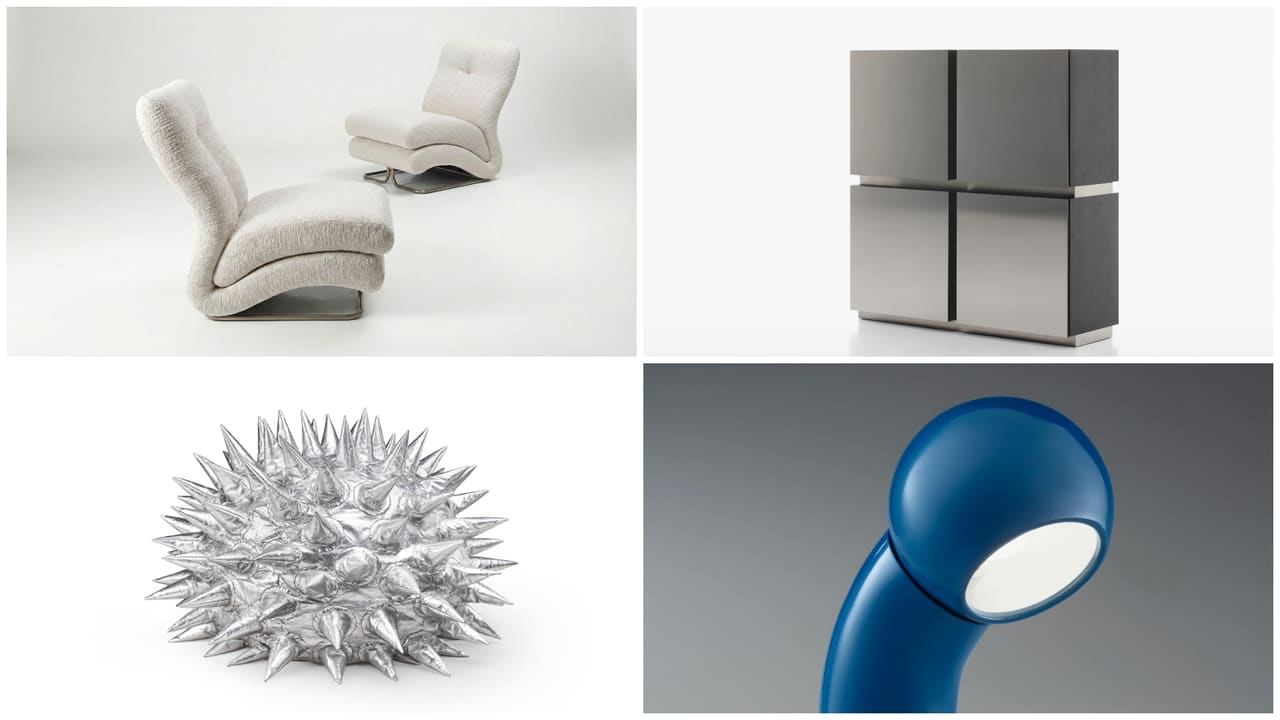
Vittorio Varo's Cigno chair, originally conceived in the early 1970s for IPE (the parent company of Visionnaire), exemplifies the sculptural ambitions of the period. The design was recently showcased in a Milan listening room that paired 1970s furniture with the decade's music, underscoring how objects and culture were intertwined.
Lodovico Acerbis's Parioli Cabinet, designed in 1971, brings architectural thinking to storage. The piece uses a wooden frame in ash or walnut, concealed by satin stainless steel doors whose geometry creates a sense of movement. It is modular without being sterile, rigorous without being cold.
In lighting, Ernesto Gismondi's Sintesi lamp for Artemide strips away decoration to reveal function. As the first lamp Gismondi designed for the company he founded, Sintesi uses two intersecting profiles to create both a floor and wall version. The design embodies the decade's fascination with systems and essential components.
Gae Aulenti's Alcinoo lamp, also for Artemide and dating to 1975, takes a different approach. A mouth-blown glass sphere sits within a metal cylinder, merging artisanal craft with industrial language. Gismondi recalled the lamp's development as a challenge, noting that Aulenti's strong vision paid off when the light activated the space with subtle, scattered illumination.
Glass, Modularity, and Material Innovation
The 1970s marked a technical turning point for several Italian manufacturers. Gallotti e Radice, celebrating its 70th anniversary this year, developed a method in 1975 for joining glass panes with simple stainless steel joints. This breakthrough enabled more complex structures, including Pierangelo Gallotti's T35 Trio, a three-part coffee table set now reissued in bronze-tinted tempered glass and brushed silver travertine.
The innovation reflects a broader trend in the decade: material experimentation driven by both aesthetic curiosity and structural necessity. Designers were testing how far they could push glass, metal, and plastic while maintaining the sense of warmth and livability that defined Italian interiors.
Playfulness Within Rigor
Not every piece from the decade was austere. Cini Boeri's Papero lamp, conceived in 1971, takes the shape of a duck (its namesake). Two pieces of opal polystyrene connect via a chrome-plated steel plate with a black PVC profile. The lamp is both whimsical and precise, embodying the decade's ability to balance humor with technical sophistication.
Marzio Cecchi's Fachiro for Gufram, designed in 1975, pushes this playfulness further. The chair looks uncomfortable, its surface covered in what appears to be sharp points, but the soft leather construction makes it entirely pleasant to sit on. Cecchi drew inspiration from his mother's work as a couturier and his observations of natural forms, resulting in a piece that provokes before it comforts.
Elio Martinelli's Pallino lamp, also from the 1970s, carries a similar curiosity. The design suggests a character peeking around a corner, inquisitive and lighthearted. Emiliana Martinelli, President of Martinelli Luce, describes the lamp as embodying the "formal lightness and chromatic boldness" that characterized Italian design during the decade.
Colombo's Vision of Equipment, Not Furniture
Joe Colombo's work during this period represents the most radical rethinking of domesticity. His Total Furnishing Unit, presented at the 1972 MoMA exhibition, proposed that homes should not contain furniture but rather "equipment" integrated into the space itself. Every element, from seating to storage to plumbing, was part of a unified system.
Colombo's tap design for Mamoli, now reissued with minor updates for contemporary use, exemplifies this philosophy. The tap is not an accessory but an integral component of the domestic experience. It reflects a belief that every object in a home should be considered in relation to the activities it supports and the spatial logic it inhabits.
This approach anticipated many of the concerns driving design today: efficiency, adaptability, and the relationship between objects and behaviors. Colombo's work was not about creating isolated products but about rethinking how we live.
Why These Pieces Matter Now
The resurgence of 1970s Italian design is not simply nostalgia. These pieces are being reissued because they address questions that remain unresolved. How do we design for uncertainty? How do we balance material innovation with environmental responsibility? How do we create objects that are both functional and meaningful?
The designers of the 1970s were working through similar tensions, and their solutions remain instructive. They did not retreat into decoration or escapism. Instead, they engaged directly with the challenges of their time, producing work that was both critical and optimistic.
At World Archi Design, we have been tracking this renewed interest in the decade, and what stands out is the sophistication of the thinking behind the objects. These are not just beautiful forms but propositions about how to live. They carry the weight of their historical moment while remaining open to reinterpretation.
The 1970s in Italy were not a golden age in the conventional sense. They were a period of doubt, experimentation, and questioning. That is precisely what makes the decade's design so relevant today. The anxiety Antonelli describes was not a weakness but a catalyst, pushing designers to look beyond surface solutions and engage with the deeper structures of everyday life.
As these reissues enter contemporary interiors, they bring with them a reminder that design is never just about objects. It is about the values, concerns, and aspirations embedded within them. The 1970s gave us a body of work that remains unresolved, still asking questions, still proposing possibilities. That restlessness is its greatest strength.
Save this story. A free account keeps your reading list and the 07:00 email in one place.
CREATE FREE ACCOUNT →SIGN IN