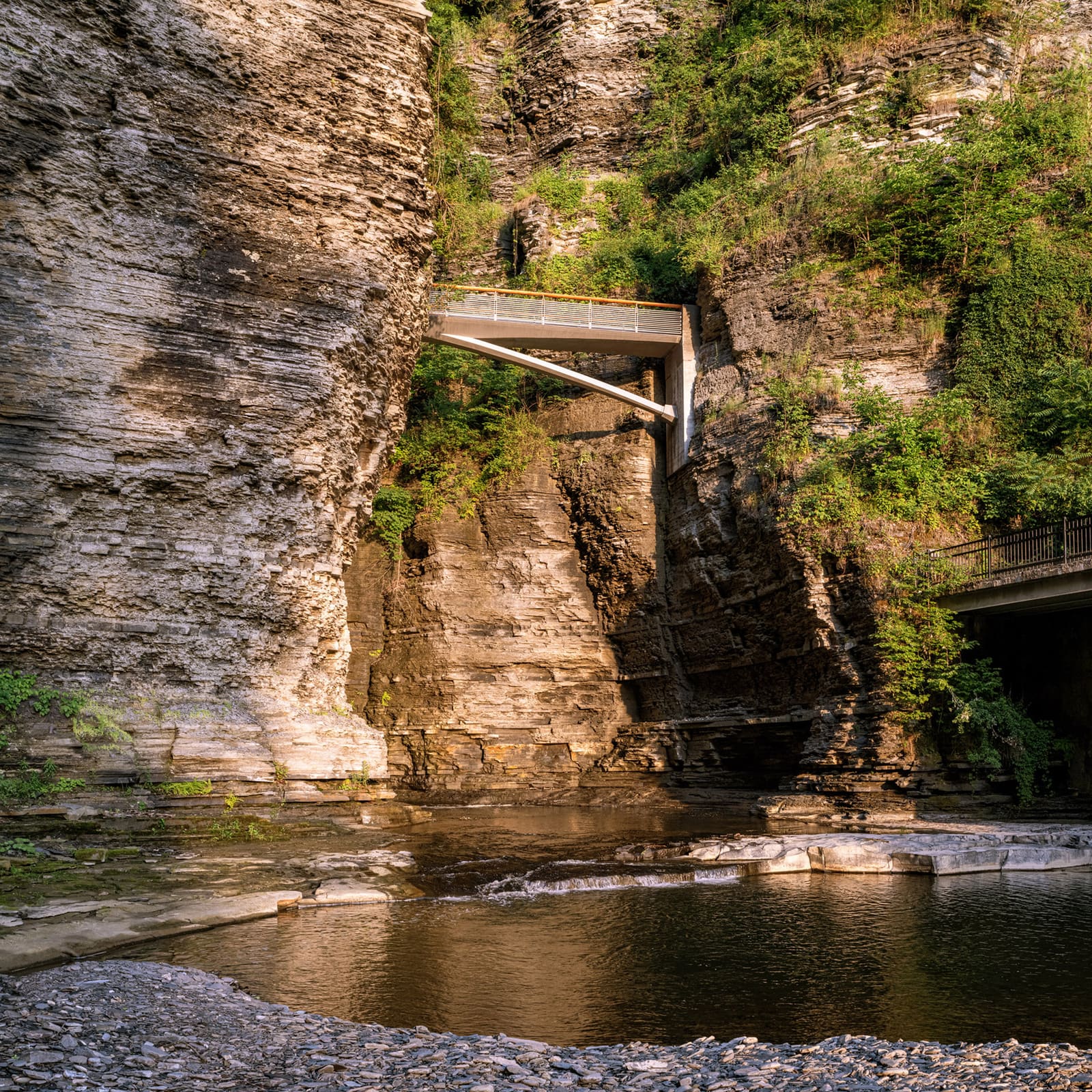
The Problem of Replacing What Cannot Be Removed
At World Archi Design, we've been tracking a growing subspecialty within infrastructure design: the art of building where heavy machinery cannot go. The Sentry Bridge, recently completed in Watkins Glen State Park, belongs squarely to this tradition. Wedged between two cavernous rock faces in the Finger Lakes region of Upstate New York, the crossing replaces a decaying structure of the same name without disturbing the fragile cliff ecosystems or the riverbed below.
The site is unforgiving. The gorge twists through mossy trails, its walls streaked with mineral deposits and seepage. A waterfall tumbles into the narrow channel. Bedrock stability varies dramatically from one side to the other. Any intervention had to be fabricated elsewhere, lifted in, and assembled with surgical precision.
Schlaich Bergermann Partner, the New York-based structural consultancy, collaborated with Snøhetta to design a half-arch cantilever that solves the problem by leaning into asymmetry. The bridge anchors entirely to the north wall, where the bedrock is stronger, and extends 46 feet to the opposite side without intermediate support. The result is a structure that reads as both tethered and airborne, a steel ribbon hovering above the creek.
Structural Logic and Material Honesty
The primary structure is stainless steel, chosen for its corrosion resistance in the perpetually damp microclimate of the gorge. Unlike a conventional arch that distributes load symmetrically, this half-arch transfers all force back to a single rock face, requiring deep anchorage into the north wall. The engineering strategy recalls the cantilevered platforms of Peter Zumthor's Allmannajuvet Zinc Mine Museum in Norway, where heavy steel members are pinned into unstable terrain, but here the span is longer and the visual mass more delicate.
Prefabrication was essential. The main structural assembly was built offsite and craned into position, minimizing construction time and impact. Once in place, the team added black locust wood railings, a species native to the eastern United States and prized for its natural rot resistance. The landing is paved with bluestone, a sedimentary stone quarried regionally, and the formwork for the concrete abutments was cast using rough-sawn hemlock, leaving a textured imprint that echoes the bark and lichen of the surrounding forest.
The material palette is deliberately restrained. Stainless steel, black locust, bluestone, and hemlock-formed concrete: each element is either structurally necessary or rooted in the vernacular building traditions of the Finger Lakes. There is no decorative cladding, no applied ornament. The bridge's presence derives entirely from its tectonic clarity.
Embedding Narrative in the Infrastructure
Beyond the span itself, the design team embedded a series of bronze castings into the site, small sculptural markers that invite visitors to pause. These castings depict local flora and fauna, including an endangered dragonfly species, a rare plant found only in the gorge's microhabitat, and a miniature model of the historic Sentry Bridge that preceded this one.
This gesture is unusual in infrastructure projects, where interpretive elements are typically relegated to signage. Here, the bronze pieces function as tactile artifacts, distributed along the approach and departure paths. They are not didactic; they do not explain. Instead, they operate as mnemonic devices, linking the experience of crossing the gorge to the ecological and historical layers beneath it.
The strategy recalls the work of artist Andy Goldsworthy, who has long embedded ephemeral and permanent interventions into landscapes to heighten awareness of natural processes. But where Goldsworthy's work is often poetic and abstract, these castings are indexical, grounded in the specific biology and history of Watkins Glen.
Framing the Gorge
The bridge marks the beginning of the gorge path, a sequence of stone steps and wooden walkways that ascend through the narrow canyon. Its position is threshold-like, both physically and experientially. According to Snøhetta project director Matt McMahon, the design aims to "honour the histories and craft traditions of the gorge, protect unique cliff and creek ecosystems, and heighten the experience of stone and water."
That last phrase is key. The bridge does not simply provide access; it curates views. The cantilevered form opens sightlines to the waterfall upstream and the riverbed below, while the narrow profile minimizes visual obstruction. Visitors are made aware of the mist rising from the falls, the shifting light on wet rock, the sound of water amplified by the gorge walls.
This is architecture as perceptual apparatus. The bridge does not compete with the landscape; it sharpens the visitor's encounter with it. The precedent here is less the grand viaduct and more the observation platform: think Miralles and Pinós's Igualada Cemetery pathways, where concrete and steel elements are threaded through topography to intensify spatial and temporal awareness.
Prefabrication and Site Sensitivity
Managing director Michael Stein of Schlaich Bergermann Partner emphasized the role of prefabrication in reducing site disturbance. "By developing a lightweight, cantilevered structure that could be prefabricated and installed with minimal impact on the gorge," he noted, "we were able to create a resilient crossing that responds to the site's environmental sensitivities."
This is not rhetoric. The gorge's cliff ecosystems are home to species that depend on stable moisture levels, minimal soil disruption, and undisturbed rock faces. Traditional construction methods, involving excavation, formwork, and extended scaffolding, would have been ecologically catastrophic. The prefabrication strategy compressed the construction timeline and reduced the footprint of heavy equipment.
The approach aligns with a broader shift in landscape infrastructure toward low-impact installation techniques. We've seen similar strategies in the recent footbridge over the River Tarn in France, which was assembled offsite and lifted into place over a 19th-century viaduct, and in a low-lying pedestrian bridge in Belgium that was floated into position to avoid riverbank excavation.
Durability and Maintenance in a Harsh Microclimate
The gorge is not a benign environment. Water flows year-round, freezing in winter and thawing in spring. Moss and algae colonize every surface. The mist from the waterfall deposits minerals on steel and wood. Over time, untreated materials corrode, rot, or crack.
The Sentry Bridge addresses these challenges through careful material selection. Stainless steel resists oxidation. Black locust contains natural compounds that inhibit decay. Bluestone is dense and non-porous. Hemlock formwork, while temporary, left a texture on the concrete that encourages water runoff rather than pooling.
Maintenance access is another consideration. The bridge is remote, reachable only on foot. Replacement components must be carried in by hand or lifted by helicopter. The design team anticipated this constraint by specifying modular railings and replaceable wear surfaces, ensuring that future repairs can be executed without disassembling the primary structure.
Precedent and Context
The Finger Lakes region has a long history of infrastructure embedded in dramatic topography. The gorges, carved by glacial meltwater, have been traversed by stone bridges, wooden trestles, and steel spans for over a century. Many of these structures are now deteriorating, and the question of how to replace them without compromising the landscape has become urgent.
The Sentry Bridge offers one model. Rather than replicating the historic arch in contemporary materials, the design team developed a new structural typology suited to modern fabrication techniques and environmental standards. The half-arch cantilever is not a nostalgic gesture; it is a response to the specific conditions of this site, this bedrock, this gorge.
Other recent pedestrian bridges have taken different approaches. The Tarn footbridge in France preserves the 19th-century viaduct by adding a lightweight steel deck above it, celebrating the layering of infrastructure over time. The Belgian river crossing sits low to the water, minimizing visual impact in a flat, open landscape. Each project negotiates its own balance between visibility and discretion, between homage and innovation.
The Sentry Bridge leans toward innovation. It does not mimic the historic structure; it acknowledges it through the bronze casting and moves on. The cantilevered form is unapologetically contemporary, a steel gesture that could only be realized with 21st-century engineering software and fabrication tools.
A Threshold, Not a Destination
What distinguishes the Sentry Bridge from conventional infrastructure is its refusal to be neutral. It does not pretend to disappear. Instead, it frames the act of crossing as a deliberate, heightened experience. The visitor steps onto bluestone, grips black locust, walks above rushing water, and arrives on the other side having been made acutely aware of the gorge's depth, its moisture, its sound.
This is architecture operating at the scale of the body and the landscape simultaneously. The structure is legible from a distance, a dark line against pale rock. Up close, it reveals texture, grain, and the marks of fabrication. It is both object and instrument, both crossing and lens.
We've argued before that the best infrastructure is invisible, that it should serve without announcing itself. The Sentry Bridge complicates that position. Here, visibility is part of the project's value. The bridge declares its presence not to dominate the gorge but to clarify the threshold it marks: the beginning of a journey into stone, water, and mist.
In this sense, the project succeeds not despite its conspicuousness but because of it. The cantilevered steel span is a statement about how we build in fragile landscapes, how we balance access with preservation, and how we design crossings that are both functional and, yes, graceful.
Save this story. A free account keeps your reading list and the 07:00 email in one place.
CREATE FREE ACCOUNT →SIGN IN