
Project Info
Project Name: Cape Flats Aquifer Recharge Plant
Architect: SALT Architects
Client: City of Cape Town
Location: False Bay Nature Reserve, Cape Town, South Africa
In the face of escalating droughts and water scarcity, architecture is rising to meet necessity with elegance and rigor. The Cape Flats Aquifer Recharge Plant, designed by SALT Architects for the City of Cape Town, is one such example: infrastructure as civic design, form crafted by function, and utility shaped with dignity.

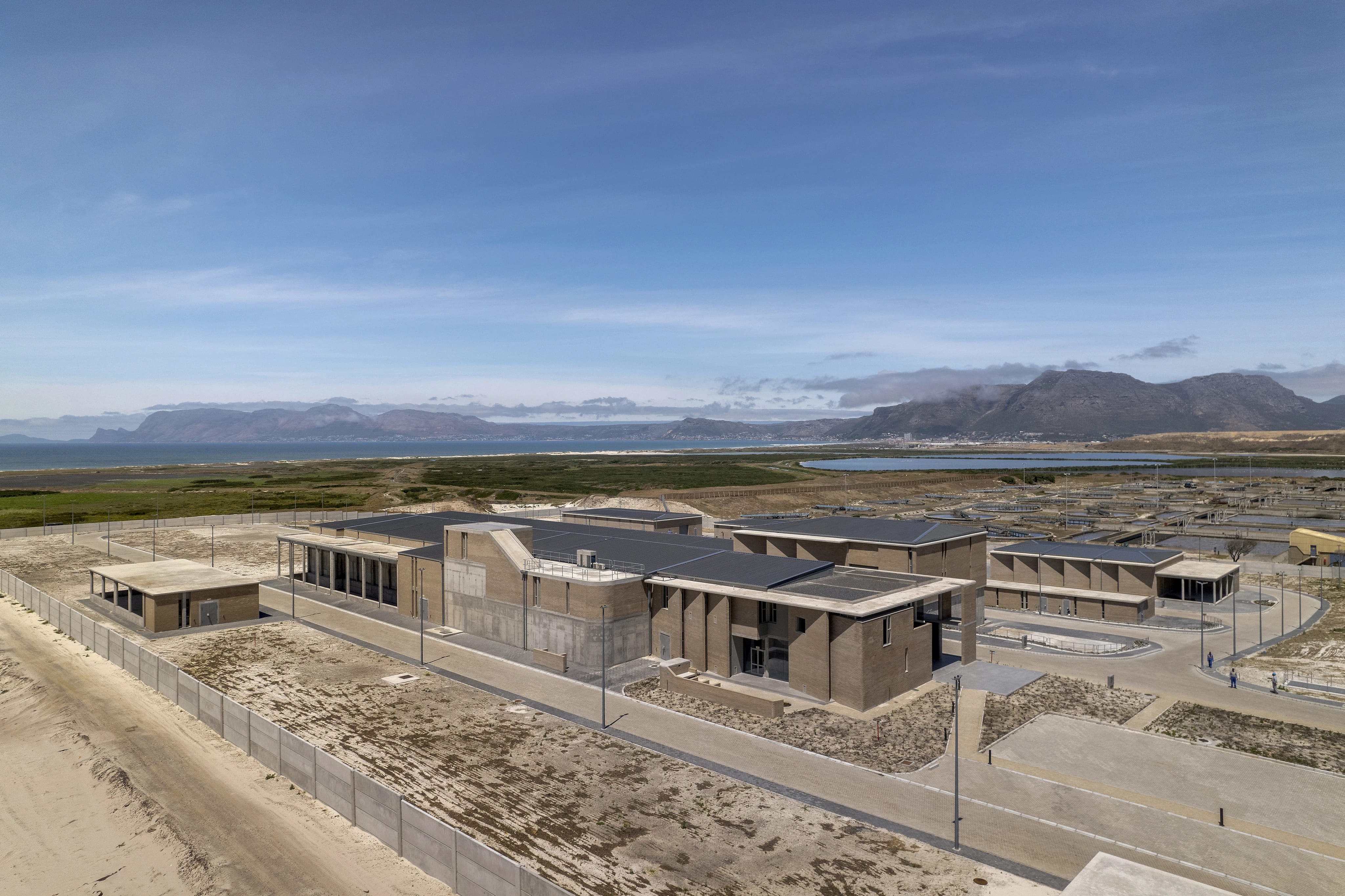
The overall geometry reflects gravity's role in the water filtration process, creating an ordered, rhythmic procession of utility
Turning Crisis into Opportunity
Cape Town’s water crisis pressed the city to look beyond temporary fixes. The aquifer recharge plant responds to long-term need: to safeguard drinking water, stabilize supply, and manage nature’s cycles more predictably. Located in the Pelican Park section of the False Bay Nature Reserve—some 23 kilometres from the city centre—this is more than a treatment facility. It is a design intervention in a sensitive ecological landscape, an act of stewardship.

Angled brick fins on the façade modulate harsh sunlight and are chosen for their durability in coastal conditions
Linear Filtration & Terraced Geometry
At the core of the project are four linear filtration buildings, arranged in strict alignment with an artificial slope. Gravity becomes a silent collaborator: as water moves downhill, it passes through successive stages of filtration. This downhill geometry is not only efficient but gives the architecture a rhythm—an ordered procession of utility, quietly beautiful in its geometry.
The slope is more than mechanical; it’s expressive. It gives scale to the landscape, echoes geological strata, and references the natural incline of the land towards the bay. Form and function merge: the slope organizes water, but also frames sightlines, frames the experience of passing through or around the buildings.

The administrative building's robust brickwork and thoughtful openings maintain human dignity within technical infrastructure
Balancing Light, Protection & Materiality
One of the striking design features is the play of enclosure and exposure—and how SALT manipulates light and view without compromising function or environmental performance.
+ The facades are articulated with angled brick fins that modulate sunlight, particularly harsh light, preventing overheating and also discouraging unwanted algal growth in filtration channels.
+ Glazing is carefully constrained: narrow south-facing openings allow daylight without direct solar gain, preserving interior conditions and protecting sensitive interior processes.
+ The materials—brick, glass, masonry—are chosen for durability, low maintenance, and ecological compatibility. The brickwork offers thermal mass; the masonry and concrete are robust in coastal conditions; glazing is placed not for spectacle but for service and human comfort.

The glazed atrium of the administrative building is set back, communicating order and transparency to staff and visitors
The Human Element in Infrastructure
Though fundamentally industrial in purpose, SALT Architects do not omit the human dimension. The administrative building—positioned at the highest point of the site—serves as a point of identity and gathering rather than merely a utility room. Its double-volume glazed atrium, set back behind the brick fins, is more than an access point. It is an entry that communicates calm, order, and transparency.
Within, ground-floor spaces serve plant operations; upper floors house offices, meeting rooms, and the plant’s control centre. The architecture respects the needs of staff and visitors: daylight, spatial clarity, views, and the dignity of place even in technical infrastructure.
Landscape, Sustainability, and Resilience
Set within False Bay Nature Reserve, the project demands ecological sensitivity. SALT Architects negotiate this with both humility and intelligence:
+ Terrain and topography are respected: minimal disruption in siting, using gravity rather than pumps where possible.
+ Light management isn’t aesthetic alone—it is essential for preventing biological issues (like algae), for mitigating heat, and for creating enduring structures that fare well over time.
+ Materials and orientation are selected with low maintenance and environmental durability in mind. Coastal exposure demands weather resistance; careful detailing ensures performance.

Linear filtration buildings feature brick walls and calculated shadows, ensuring low maintenance and environmental compatibility
Form as Poise, Design as Promise
What elevates the Cape Flats Aquifer Recharge Plant beyond mere utility is how its architecture makes a promise: that essential infrastructure can be beautiful, considered, and aligned with landscape, environment, and community. The plant doesn’t shout its presence; it whispers its function through form, material, shading, and order.
In design, SALT offers not only a solution to water shortage—but a model: that architecture can respond to crisis with elegance; that infrastructure can be civic poetry; that form need not be sacrificed for function, but rather born from it.
Save this story. A free account keeps your reading list and the 07:00 email in one place.
CREATE FREE ACCOUNT →SIGN IN