The Infrastructure Problem
Most American cities treat highway overpasses as a kind of spatial exhaust: necessary, ugly, and best ignored. Louisville is attempting something different. The Belvedere, a waterfront site that has hosted concerts and gatherings since the 1970s, sits astride the I-64 highway, a concrete deck suspended between downtown and the Ohio River. For decades, it has been both stage and barrier, a space that draws people for events yet repels everyday use. The question Heatherwick Studio now confronts is whether design can reconcile those contradictions without resorting to sculptural distraction.
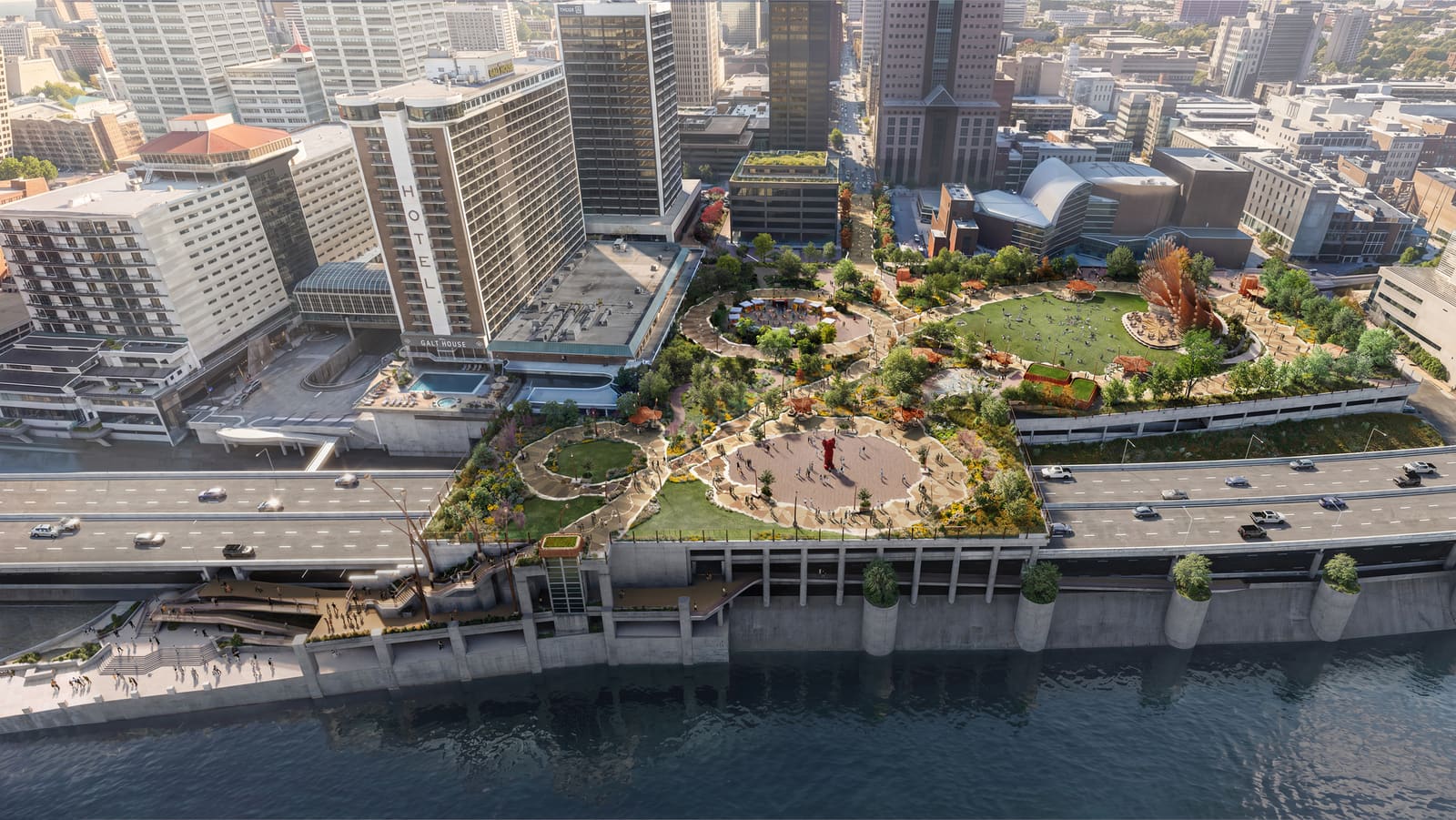
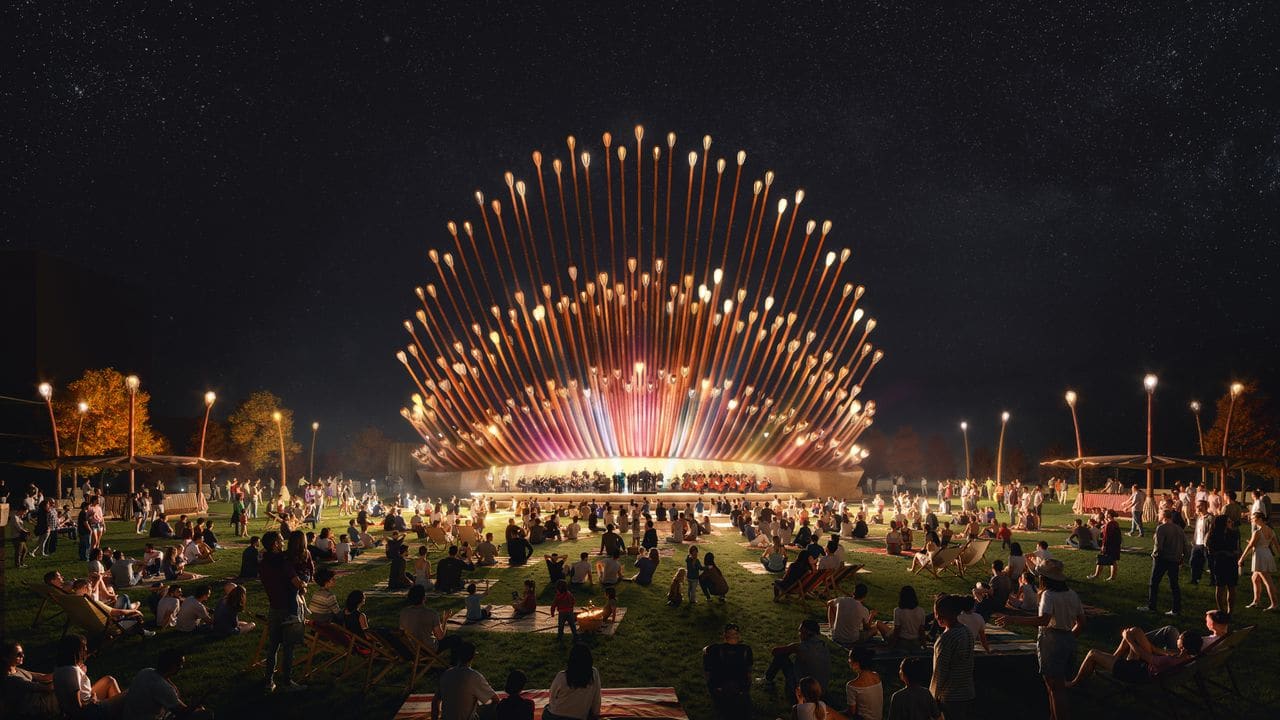
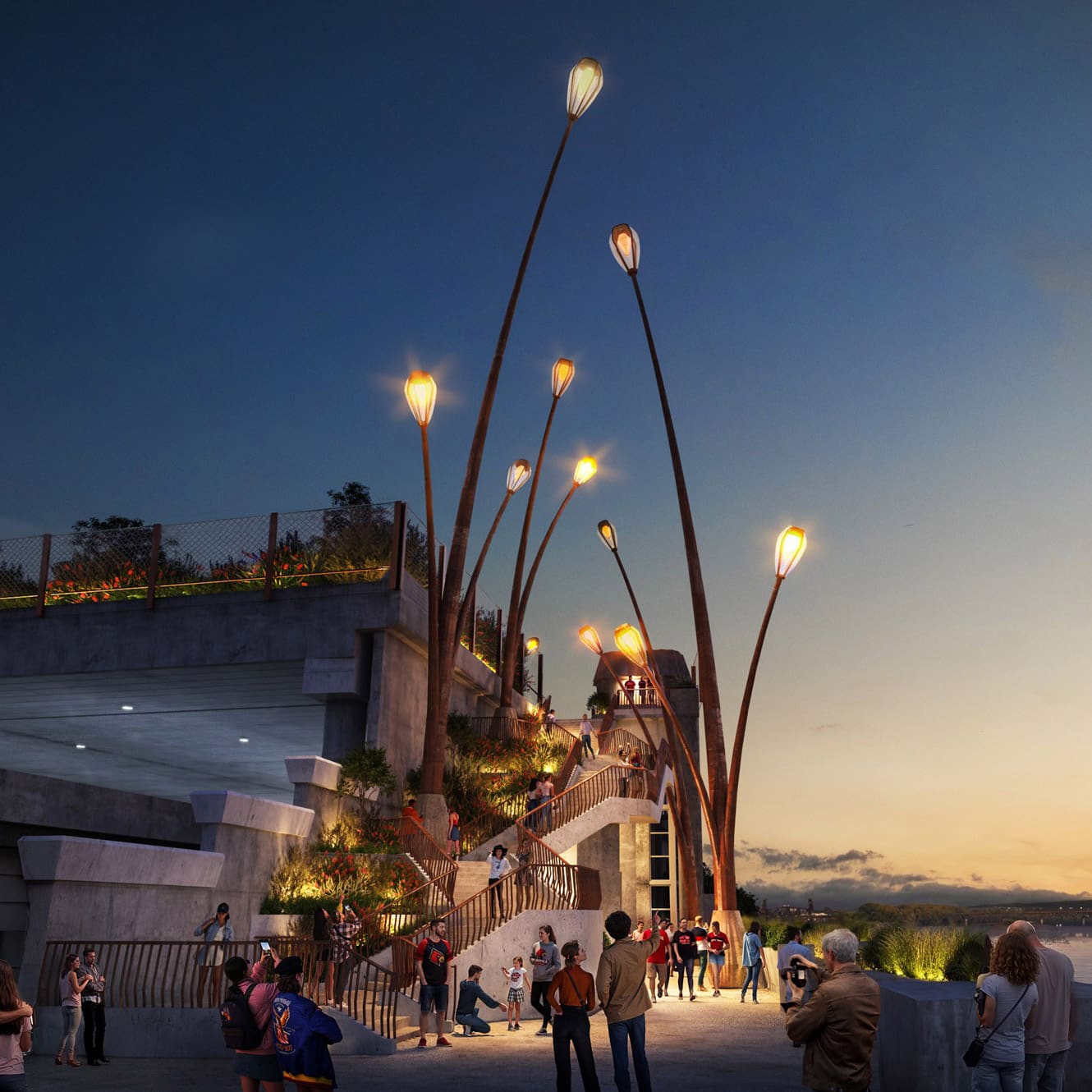
The revised scheme, which replaces an earlier, more exuberant proposal, centers on a looping pathway approximately 400 yards in length and a semi-circular performance pavilion assembled from clustered lampposts. The pathway threads through open lawns, smaller stone pavilions, and down a staircase to the Louisville Riverwalk below. Foliage, fountains, and sculptural elements punctuate the route, while the overpass itself becomes a planted deck rather than a buried liability. The parti is straightforward: knit the elevated platform back into the city's pedestrian fabric, then program it densely enough to sustain activity beyond scheduled events.
Retreat from the Spectacular
Last year, Heatherwick Studio presented a design dominated by a large, undulating landform covered in grass, a signature move for a practice known for gestural massing. That proposal has been set aside. According to local sources, cost and safety concerns drove the revision, alongside feedback gathered through community meetings and an online survey late last year. The new design is quieter, more modular, and arguably more tactical.
The pavilion, for instance, is no longer a singular sculptural object but a congregation of elements already present in the site language. Dozens of curved lampposts, repeated throughout the park, gather to form a half-shell canopy over the performance area. It is a tectonic move rather than a sculptural one, an assembly logic that reads as both pragmatic and legible. The pathway, meanwhile, loops without grandstanding, a continuous ribbon that organizes circulation and frames views without demanding attention for its own sake.
We have tracked a broader shift in Heatherwick Studio's recent work, particularly in public realm projects where early maximalism has given way to a more calibrated urbanism. The Vessel at Hudson Yards in New York remains the studio's most polarizing built work, a stair-object that prioritized experience over program. Louisville suggests a different calculus: infrastructure first, spectacle second.
Precedents in Elevated Urbanism
The Belvedere sits within a lineage of projects that attempt to reclaim highway infrastructure as civic space. The High Line in New York, designed by Diller Scofidio + Renfro and James Corner Field Operations, demonstrated that obsolete rail viaducts could become high-value public amenities. The Bentway in Toronto, by Public Work, carved winter skating trails and performance zones beneath the Gardiner Expressway. Both projects share a strategy: accept the infrastructure, then program the void.
Louisville's challenge is different. The Belvedere is not a ruin to be adaptively reused but an active platform that must remain accessible, serviceable, and safe while hosting large crowds. The highway below is not a relic but a live artery. The design must therefore operate simultaneously as park, stage, and structural lid, a triple mandate that constrains formal freedom.
Heatherwick Studio's response leans on landscape as mediator. Trees, grassy berms, and planted edges soften the concrete deck while providing flexible zones for informal gathering. The looping path becomes a promenade, a device borrowed from 19th-century park design but deployed here to mask the site's infrastructural origins. The lampposts, repeated obsessively, establish rhythm and coherence across a fragmented program. It is a compositional strategy that privileges continuity over incident, a marked departure from the studio's earlier, more episodic work.
The Performance Apparatus
At the heart of the scheme is the pavilion, a structure that must serve both as event infrastructure and everyday amenity. The half-shell form, constructed from clustered lampposts, provides acoustic reflection and weather protection while remaining visually porous. The design recalls Cedric Price's Fun Palace in its open-endedness, a framework that accommodates rather than dictates use.
The pavilion's materiality is less clear. Renderings suggest a metallic or composite finish, though the structural logic of bundled posts implies either steel or composite tubing. The form itself is biomorphic, a canopy that reads as organic growth rather than engineered assembly. This ambiguity between natural and artificial is a recurring theme in Heatherwick's work, seen in projects like the UK Pavilion at Expo 2010 and the Learning Hub at Nanyang Technological University in Singapore. In Louisville, the effect is more restrained, the pavilion a backdrop rather than protagonist.
The surrounding program is deliberately loose. Open lawns allow for picnicking, play, and informal gathering. Stone pavilions, smaller in scale, provide shade and seating without enclosing space. The fountain and sculptural elements, still undefined in available renderings, will likely function as focal points and gathering nodes. The design avoids over-programming, a choice that reflects both budgetary pragmatism and a recognition that the site's value lies in flexibility.
Civic Repair or Civic Theater?
Thomas Heatherwick has framed the project as an effort to "restore the buzz" of the Belvedere's early years, a nostalgia for a moment when the site functioned as a genuine civic commons. But that framing raises questions about what kind of public life the design actually supports. Is the Belvedere a stage for programmed events that draw crowds but require tickets, security, and infrastructure? Or is it a park in the traditional sense, a space for unscripted encounter and everyday use?
The design hedges. The pavilion and open lawns suggest the latter, while the scale and prominence of the performance infrastructure imply the former. This tension is not unique to Louisville. Many contemporary public spaces struggle to balance spectacle and habit, the need to attract attention and the need to sustain routine. The High Line, for instance, has become a tourist destination as much as a neighborhood park, its success measured in visitor numbers rather than local use.
Louisville's context is different. The Belvedere is not embedded in a dense residential neighborhood but situated between downtown and the riverfront, a threshold zone that serves both residents and visitors. Its success will depend on whether it can function as both gateway and destination, a space that facilitates movement while rewarding pause.
Timeline and Constraints
Construction is expected to begin this autumn, with completion targeted for 2030. That four-year timeline reflects the complexity of building atop active highway infrastructure, a process that requires coordination with transportation authorities, structural engineers, and multiple municipal agencies. The overpass itself will need reinforcement to support the added weight of soil, trees, and pavilion structure, a technical challenge that will likely constrain material choices and planting depth.
The budget, though not publicly disclosed, has clearly shaped the design. The retreat from the earlier grassy landform suggests that cost was a determining factor, as was the decision to modularize elements like the lampposts. This pragmatism is not necessarily a compromise. Some of the most successful public spaces, from Paley Park in New York to Superkilen in Copenhagen, have emerged from constrained budgets that forced clarity of intent.
A Test Case for Adaptive Infrastructure
Louisville's Belvedere is part of a broader conversation about how American cities can reclaim infrastructure as public amenity. As highway removal gains traction in cities like Rochester, Syracuse, and San Francisco, projects like the Belvedere offer an alternative: not demolition but transformation, a strategy that acknowledges infrastructure's permanence while insisting on its civic potential.
Whether Heatherwick Studio's design succeeds will depend on details still unresolved: the quality of materials, the maintenance regime, the programming strategy, and the degree to which the space genuinely serves local residents rather than functioning as a stage set for occasional events. The revised scheme is more restrained than its predecessor, a shift that reflects both pragmatic constraints and, perhaps, a maturing understanding of what public space requires. In a practice often criticized for prioritizing spectacle over use, Louisville may represent a quieter, more grounded ambition.
Save this story. A free account keeps your reading list and the 07:00 email in one place.
CREATE FREE ACCOUNT →SIGN IN