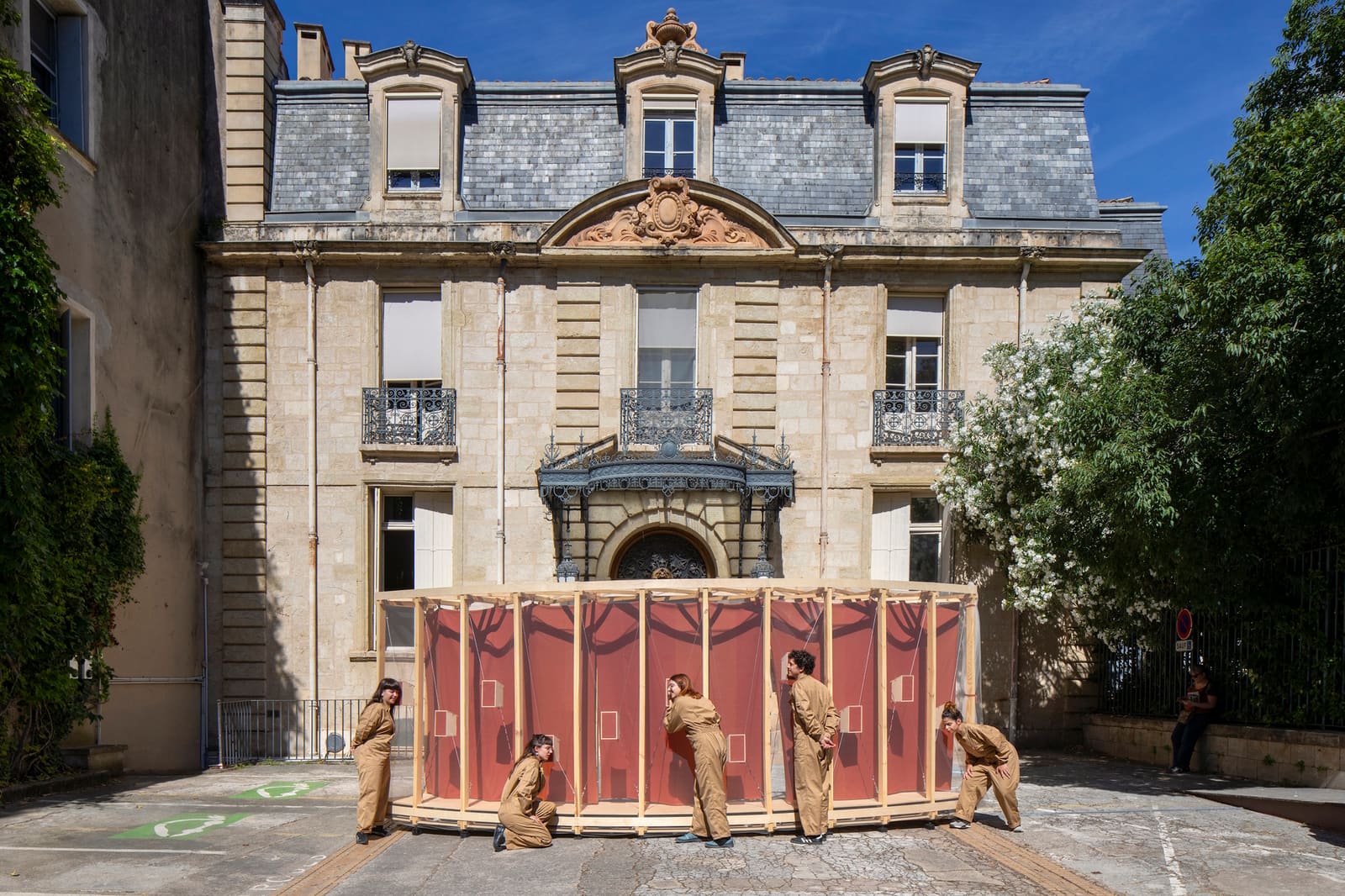
The Acoustic Architecture of Intimacy
What happens when private confessions become public material? Coletivo 624's latest intervention explores this tension through sound rather than form. Installed in Montpellier, the 10-square-meter piece invites passersby to record anonymous secrets, which are then woven into a continuously shifting audio environment. The installation operates as both confessional booth and listening chamber, collapsing the boundary between speaker and audience.
We've been tracking how temporary installations increasingly prioritize immaterial experience over built form. Where earlier interventions often relied on visual spectacle or structural novelty, this project foregrounds the ephemeral: voice, anonymity, and the act of listening itself. The physical structure serves primarily as housing for the sonic program.
Material and Spatial Containment
The installation uses Burel Factory textiles alongside technical components from Frontal 360 and JJTeixeira. Burel, a traditional Portuguese wool felt, provides acoustic absorption while signaling a material lineage tied to the collective's origins. The choice is functional but also quietly indexical, grounding the project in a specific craft tradition without announcing it.
The compact footprint requires careful calibration. At 10 square meters, the installation must accommodate both recording and playback zones while maintaining a degree of acoustic separation. The spatial challenge is less about monumentality than about intimacy at urban scale, a problem that recalls Junya Ishigami's small pavilions or the early telephone booth typology, where enclosure is psychological as much as physical.
Participation as Compositional Method
Visitor contributions form the raw material of the soundscape. Each recorded confession enters a looping system that layers voices, creating a polyphonic texture that evolves with each new submission. The installation's "composition" is thus never fixed; it accumulates and shifts according to public input.
This approach aligns with participatory practices in contemporary art, but it also raises questions about authorship and curation. Who determines which confessions are included? How long does each voice remain in the mix? The project's technical team, led by Vicente Spínola, must have developed protocols for managing duration, overlap, and potentially sensitive content, though those protocols are not visible to the listener.
Anonymity and the Public Sphere
The promise of anonymity is central to the work's premise. Without it, the installation risks becoming a novelty rather than a genuine space for disclosure. Yet anonymity in public space is increasingly difficult to guarantee. The project assumes a social contract: that participants will speak freely because their identity is obscured, and that listeners will respect the vulnerability embedded in each voice.
This dynamic echoes confessional traditions in religious architecture, where the screen or lattice mediates between confessor and priest. Here, the mediating technology is digital rather than material, but the spatial logic is similar. The installation creates a threshold condition, a liminal zone where private utterance becomes semi-public without full exposure.
Precedents and Divergences
The project shares lineage with Rafael Lozano-Hemmer's relational architecture, particularly works like "Pulse Room" or "Voice Array," which also use participant input to generate immersive environments. But where Lozano-Hemmer often scales up to building facades or large installations, Coletivo 624 works within a more constrained footprint, emphasizing proximity over spectacle.
There's also a connection to Janet Cardiff and George Bures Miller's sound walks, which similarly privilege auditory experience and narrative layering. The difference lies in fixity: Cardiff's works are mobile, guiding listeners through space, while "Raconte-moi un secret" roots listeners in place, asking them to remain still and listen as the soundscape shifts around them.
Temporary Urbanism and Duration
Commissioned by Start - Teatro and realized in 2026, the installation occupies Montpellier's public realm as a temporary intervention. Its impermanence is part of its identity. Unlike permanent public art, which must negotiate long-term maintenance and shifting political contexts, temporary works can afford to be more experimental, more provisional.
Yet ephemerality also raises questions about documentation and legacy. Once dismantled, what remains? Photographs by Paul Kozlowski and the collective offer visual evidence, but the installation's core experience, its acoustic dimension, resists capture. This is a recurring problem for sound-based work: the gap between lived encounter and mediated record.
The Collective Model
Coletivo 624's team structure, comprising Beatriz Rosendo, Maria Eduarda Filipe, Miguel Van-Zeller, Patrícia Varão Moreira, Raquel Stattmiller, and Ruben Vasques, reflects a collaborative model increasingly common in architecture and spatial practice. The collective operates without a single named author, distributing agency across multiple practitioners.
This model has implications for how we understand authorship in architecture. Where the modernist tradition often celebrated the singular vision of the architect-auteur, collectives foreground process, negotiation, and shared responsibility. The trade-off is legibility: it becomes harder to identify a consistent formal signature, but the work may gain in adaptability and responsiveness.
Listening as Spatial Practice
Ultimately, the installation proposes listening as a form of spatial engagement. Visitors are not asked to navigate a path or decode a visual composition, but to pause and attend to layered voices. The act of listening, sustained over time, becomes the primary mode of inhabiting the work.
This reframes what we consider architectural experience. If architecture is traditionally understood through movement, materiality, and visual apprehension, sound-based installations like this one expand the field to include temporal layering, acoustic texture, and the social dynamics of shared listening. The space is not defined by walls or ceiling, but by the reach of sound and the duration of attention.
The project's title, "Raconte-moi un secret," translates to "Tell me a secret," a phrase that is both invitation and command. It positions the installation as interlocutor, a non-human listener that absorbs and redistributes what it hears. In doing so, it offers a model for public space that is less about visibility and more about audibility, less about what can be seen and more about what can be heard, anonymously, collectively, and continuously.
Save this story. A free account keeps your reading list and the 07:00 email in one place.
CREATE FREE ACCOUNT →SIGN IN