The Site as Co-Author
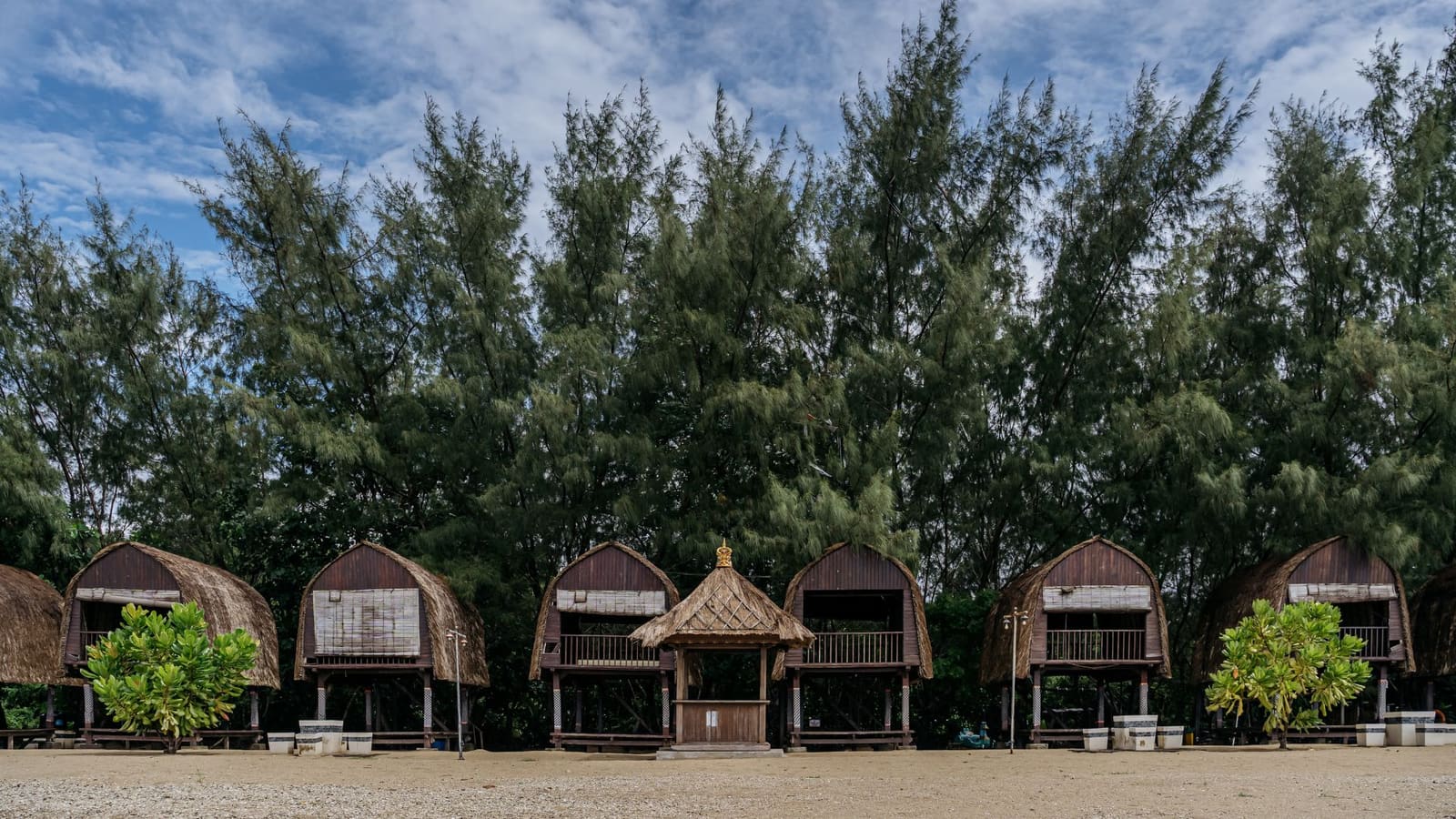
Most festivals treat their venue as a container. Jia CURATED 2026 treats it as a collaborator. When the organizing team scouted Pengembak Beach on Bali's eastern shore, co-founder Budiman Ong describes the encounter not as finding real estate but as meeting a participant. The 15,000-square-meter stretch of sand, stone, and coastal vegetation imposed immediate constraints: no hard paving, no structures that ignore tidal patterns, no pavilions that block sightlines to the water. Those constraints became the brief.
The beach's topography is unusual. It faces both sunrise and sunset, a geographic rarity that creates shifting light conditions throughout the day. Pine trees and mangroves frame the northern edge. The ground shifts between compacted sand and loose aggregate. At World Archi Design, we've seen plenty of festivals that talk about context; fewer that let context overrule curatorial ambition. Jia CURATED's fifth edition, running August 13-17, 2026, does exactly that.
Over 250 brands, studios, and independent makers from Indonesia and beyond will occupy the site, but none are permitted to treat it as a blank slate. The event's spatial logic flows from the beach itself: where structures can stand, how materials weather salt air, which zones accommodate foot traffic without eroding dunes. This is not scenography. It is tectonic negotiation.
Biophilia as Framework, Not Aesthetic
The organizing theme, Nature Weave, avoids the trap of treating biophilia as a style guide. There are no moss walls or fern installations here. Instead, the concept operates as a structural principle. Ong argues that we habitually position nature as external, something to be visited or admired, when in fact human systems are embedded within ecological ones. The theme asks exhibitors to design not for nature but with it, recognizing material flows, seasonal rhythms, and interdependence as active design parameters.
Argentinian artist Sares contributed a visual essay that illustrates the concept: overlapping webs of human activity, biological processes, and material cycles. The image does not romanticize wilderness. It diagrams entanglement. That distinction matters. Nature Weave is less about aestheticizing greenery and more about acknowledging that every design decision touches a larger system, whether you account for it or not.
This approach draws on Gotong Royong, the Indonesian principle of collective responsibility that has anchored Jia CURATED since its first edition. The festival operates on the premise that creative work is relational, not individual. Designers, artisans, manufacturers, and visitors form an interlocking network. What succeeds is not a single object but the exchange that produced it. In 2026, that network explicitly includes the beach, the mangroves, and the tidal cycle.
Scale Models as Spatial Arguments
Architecture in Scale returns for its second year, curated by Charmaine Chan. The exhibition gathers 25 architectural maquettes of completed projects from Indonesia and across Asia. Practices include Kengo Kuma & Associates, andramatin, Bensley Design Studio Bali, Alexis Dornier, IBUKU Studio, SHAU, Cave Urban, CHANG Architects, and DDAP Architect. The models are not presentation tools. They are analytical instruments.
Chan structured the show around biophilia as a design method, not a marketing term. How does a building negotiate wind, shade, or stormwater? Where does it create permeability between interior and exterior? Which details acknowledge local climate, and which impose universal solutions? The maquettes make those decisions legible at a scale that photographs cannot. You can see how a roof overhang responds to sun angle, how a courtyard channels airflow, how a facade's fenestration pattern shifts across elevations.
The exhibition loosely references Tri Hita Karana, a Balinese concept that describes balance among spiritual, communal, and environmental systems. Chan does not treat this as a prescriptive formula but as a lens for reading how architecture mediates those relationships. The models are arranged to encourage comparison: projects from different climates, different material palettes, different scales, all wrestling with similar questions about how a building sits in its surroundings.
Chan also emphasizes the value of physical models in an era saturated by renderings. A maquette has weight, shadow, and tactile presence. It occupies the same spatial dimension as the viewer. That shared physicality creates a different kind of understanding than a screen can offer.
Philippine Design Networks
Each year, Jia CURATED spotlights a regional design ecosystem. In 2026, that focus turns to the Philippines through an exhibition titled Tomorrow, curated by Gabriel Lichauco of NEWFOLK. The project pairs nine designers with ten Filipino craft workshops, generating new work that synthesizes indigenous techniques and contemporary practice.
The pairings are deliberate. Lichauco selected workshops that hold specialized knowledge in weaving, metalwork, ceramics, and natural-fiber construction, then matched them with designers whose methods align with those material traditions. The collaborations are framed around sustainability and cultural heritage, but not as nostalgic preservation. The goal is to activate traditional knowledge as a live resource for current production.
This approach mirrors the broader festival ethos: design as conversation, not monologue. The Philippine exhibition does not present finished objects as static artifacts. It documents active partnerships, showing how technique and concept inform each other across studio and workshop contexts. The work on display is recent, developed specifically for this edition, and grounded in questions about how craft scales, adapts, and evolves.
Material Reuse as Spatial Infrastructure
Waste to Wonder 2.0 expands the festival's circular design initiative, transforming last year's exhibition materials into functional infrastructure for 2026. Tyvek roofing becomes patio umbrellas and cushion fill. Cardboard tubes and salvaged timber are reconfigured as structural elements for new pavilions. Shipping crates from partner Lamitak are cut down and reassembled as seating distributed across the grounds.
This is not a side project or a token gesture. The reused materials form a significant portion of the festival's built environment. The initiative demonstrates that circularity can operate at event scale, not just in studio prototypes. It also makes visible the material afterlife of temporary installations, a topic most design festivals avoid.
The reuse program is pragmatic, not ideological. The organizers needed seating, shade structures, and pavilion frameworks. They had a stockpile of components from the previous year. Waste to Wonder 2.0 is the logistical and financial outcome of treating those components as inventory rather than waste. The environmental benefit is real, but it stems from operational logic, not virtue signaling.
Project Benih and Long-Duration Collaboration
New this year is Project Benih, a matchmaking initiative that pairs artisans and manufacturers from Indonesia with designers from Japan and Taiwan. Benih means seed in Indonesian, a deliberate metaphor for work that develops over time rather than resolving in five days. Nine designers will present previous projects that articulate their design philosophy. Thirteen Indonesian makers will demonstrate materials and techniques. During the festival, participants choose their own partners based on shared values or complementary skills.
The real work begins after the festival ends. Selected pairs will develop a joint project over the following year, supported by the curatorial team. Those collaborations will be exhibited in 2027. The model inverts the typical festival dynamic, where everything is produced in advance and presented as finished. Project Benih treats the event as a starting point, not a conclusion.
This structure acknowledges that meaningful collaboration requires more than a five-day sprint. It takes time to understand another maker's process, to negotiate differences in material culture, to build trust across language and geography. By extending the timeline, Project Benih creates space for that negotiation to happen without the pressure of an immediate deliverable.
Dialogues on Material and Place
The 360° Design Dialogues talk series, curated by Design Anthology, brings together practitioners whose work sits at the intersection of design, material, and site. Keynote speakers include Bethan Laura Wood, Peter Stutchbury, and Fiona Lynch. Panel discussions feature Kwangho Lee, Cheng Tsung Feng, and Gabriel Tan. The lineup prioritizes voices from Southeast Asia, East Asia, and Oceania, regions that often occupy the periphery of global design discourse.
The program is structured around questions rather than presentations. How do local material traditions inform contemporary practice? What does it mean to design in a climate that is hot, humid, and subject to monsoons? How do you scale craft production without erasing the knowledge embedded in handwork? These are not abstract theoretical questions. They are operational challenges that the speakers navigate daily.
The talk series complements the exhibition program by making explicit the thinking behind the work on display. It also creates a forum for practitioners to speak directly to each other, not just to an audience. That peer-to-peer exchange is where the festival's collaborative ethos becomes most tangible.
A Festival That Resists Closure
Jia CURATED continues to distinguish itself by resisting the transactional model that dominates most design fairs. There is no VIP preview focused on acquisition. There is no hierarchy that privileges collectors over students. The event is structured around encounter, not purchase. That does not mean commerce is absent; many exhibitors are there to sell. But the spatial and programmatic framework emphasizes process, relationship, and knowledge exchange over market velocity.
This year's edition, shaped by the constraints and possibilities of Pengembak Beach, pushes that ethos further. The site itself becomes a participant, imposing limits and suggesting possibilities. The theme of Nature Weave is not a decorative overlay but a structural logic that runs through every program, from the architecture maquettes to the material reuse initiative to the year-long collaborations of Project Benih.
At World Archi Design, we've tracked Jia CURATED since its early editions, and we've watched it evolve from a regional gathering into a model that challenges the assumptions of the global design calendar. The 2026 iteration does not abandon that trajectory. It deepens it, asking what a festival can be when the ground beneath it is treated not as a stage but as a voice in the conversation.
Save this story. A free account keeps your reading list and the 07:00 email in one place.
CREATE FREE ACCOUNT →SIGN IN