A Character, Not a Store
Most optometry clinics fall into one of two categories: poorly lit spaces with tired carpet or antiseptic white boxes that feel more like laboratories than places to choose how you'll present your face to the world. Wink, a practice in Elwood, Melbourne, rejects both templates. Mitchell Zurek and Andy Kelly of Brud Studia approached the project not as retail design but as world-building, constructing an interior around a fictional persona rather than commercial imperatives.
The design team imagined a character part Iris Apfel, part impossibly chic grandmother who collects objects through circumstance rather than curation. She lives inside her glasses case, which itself sits inside a Simone Rocha egg clutch. Every surface holds a story; every drawer conceals a treasure. Nothing matches, yet everything belongs. This narrative framework shaped every material choice, every piece of joinery, every reflective surface in the space.
The result is an optometrist that feels like stepping into someone's apartment for half an hour, a place where the act of shopping recedes and the experience of inhabiting another sensibility takes over.
Kitchen Islands Instead of Retail Counters
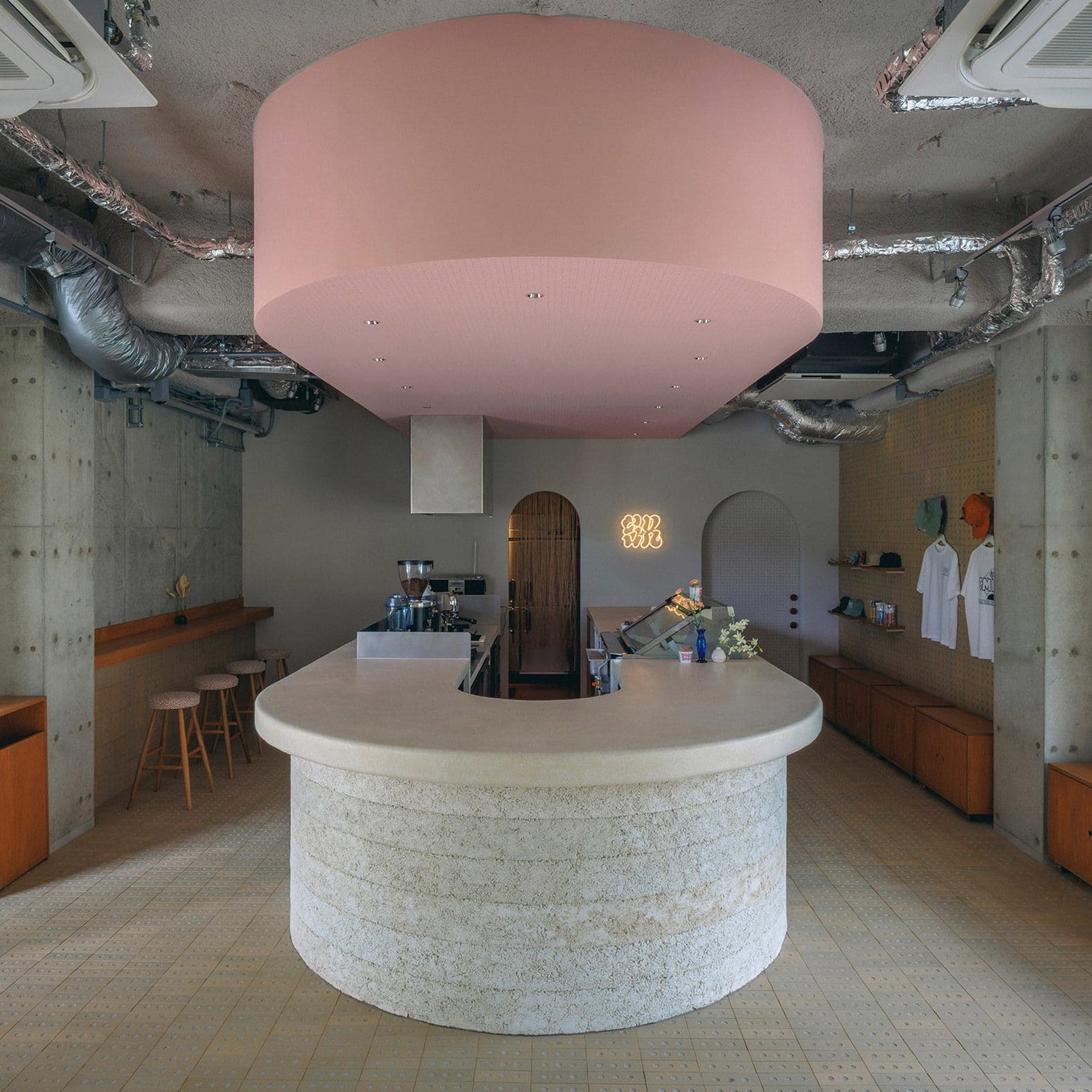
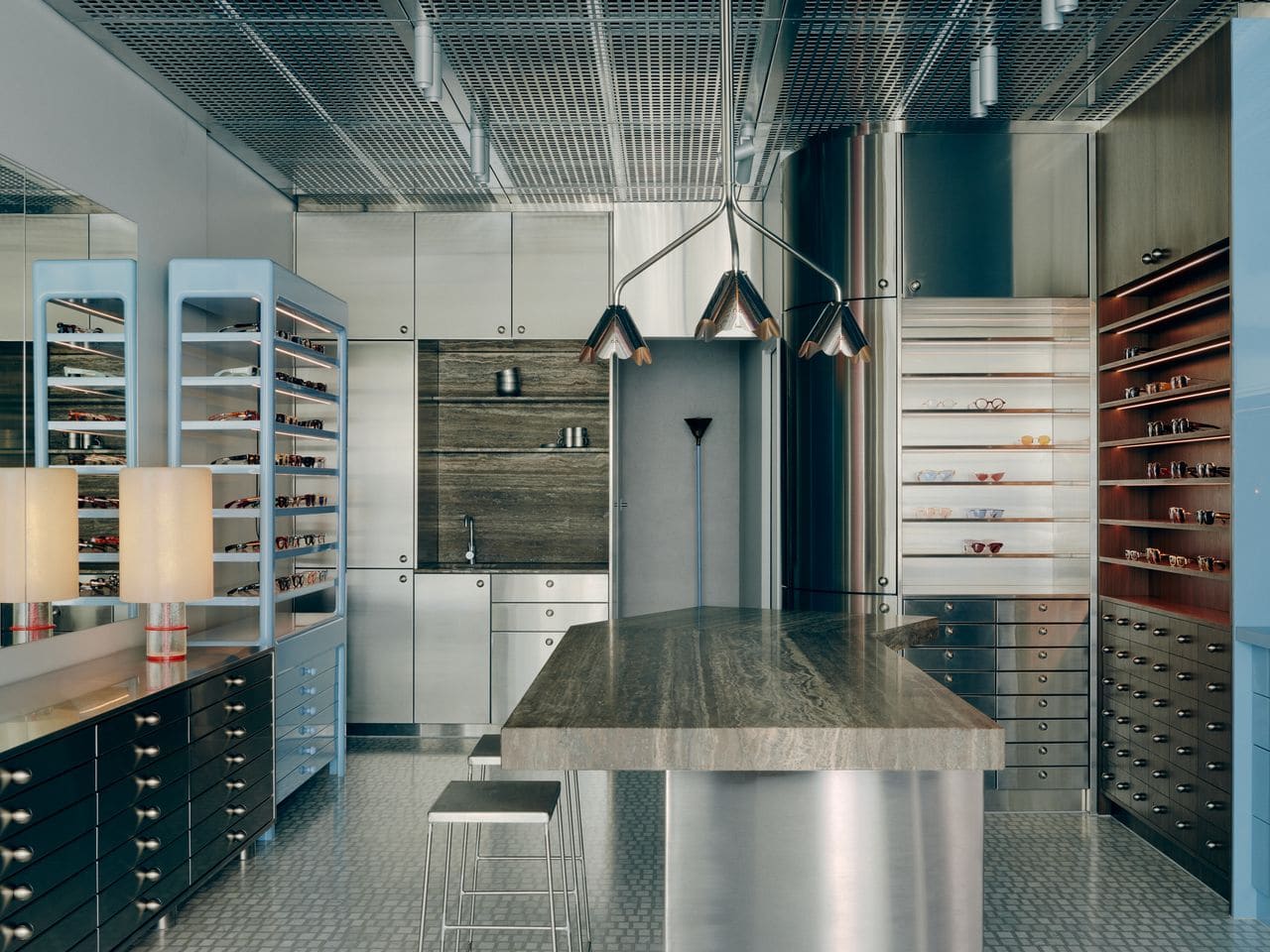
Brud Studia replaced the traditional retail counter with a central kitchen island. The shift is subtle but consequential. Counters create separation, establishing a transactional boundary between staff and client. Kitchen islands invite gathering, changing the spatial rhythm from confrontation to collaboration. Clients move around the island rather than standing opposite it, a choreography that softens the inherently vulnerable act of choosing frames in front of strangers.
The kitchen metaphor extends throughout. Stainless steel surfaces, block-color cabinetry, and timber joinery evoke domestic rather than commercial space. Lacquered red cabinets anchor one wall, bold but scaled to residential proportions. Tiny mosaic tiles underfoot, carefully considered handles, and mirrors that catch unexpected angles all operate at an intimate scale, rewarding close attention rather than demanding instant legibility.
This is retail in witness protection, as the designers describe it. The space refuses to announce itself immediately, unfolding gradually for those willing to linger, open a drawer, or sit with a coffee.
References That Wander
The interiors draw from Milan apartments, 1970s New York, and the particular strain of Australian suburbia shaped by European émigrés. The Old Woman Who Lived in a Shoe served as an oblique reference point, a nursery rhyme about making a home in unlikely circumstances. Here, that home exists inside an eyewear practice, layered with textures and tones that shouldn't cohere but do.
Collectible design objects punctuate the space without fighting for attention. The palette mixes stainless steel, warm timber, and saturated color. An industrial mesh ceiling reflects light and movement, doubling the space in fragments. Lighting punctuates rather than dominates, creating pockets of focus without clinical brightness.
The design avoids the trap many retail interiors fall into: the impulse to create one arresting gesture for social media. Instead, Brud Studia built a space that resists instant photography, privileging cumulative experience over singular moments. The boldest elements exist within a domestic scale, integrated rather than isolated.
Mirrors, Disguises, and Self-Perception
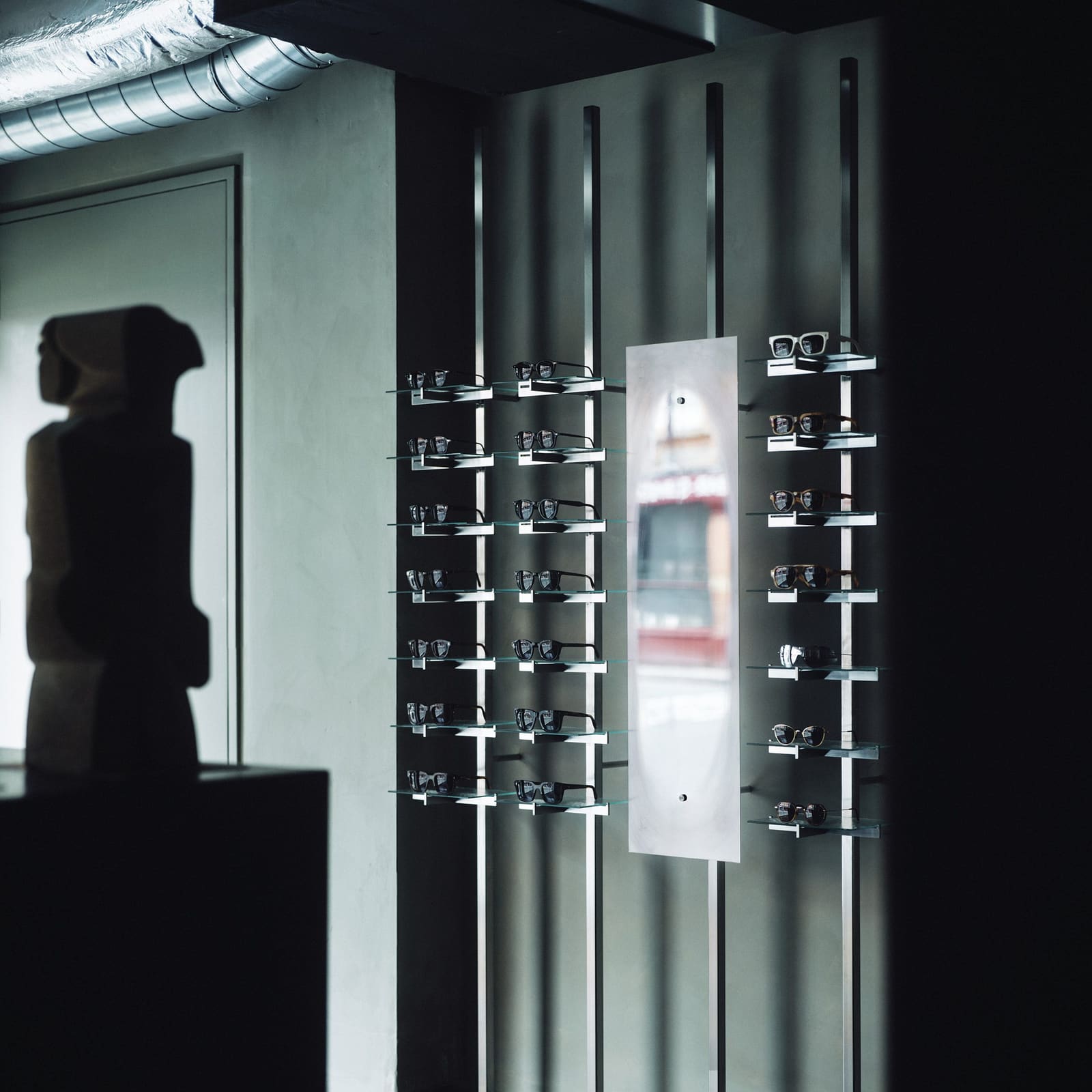
Eyewear occupies strange territory. Glasses are practical devices for correcting vision, but they're also one of the most visible ways we signal identity. A new pair permits reinvention, a shift in how you present your face and, by extension, yourself. Brud Studia leaned into this duality, filling Wink with reflective materials: mirrors, polished steel, the industrial mesh ceiling that catches and refracts.
In an optometrist, you're constantly confronted with your own image, trying on frames and evaluating versions of yourself. Rather than minimizing that self-scrutiny, the designers amplified it. Every reflective surface offers another vantage, another version of the space and of yourself within it. The strategy introduces a productive tension, making the act of looking at yourself feel less clinical and more exploratory.
The layered reflections also mean the space never looks the same twice. Depending on where you stand, which drawer you open, which mirror you glance into, the interior reveals different facets. It's a fitting approach for a place dedicated to vision and perception.
Domestic Scale, Retail Function
Brud Studia's first retail project under their studio name, Wink marks a deliberate departure from conventional commercial interiors. The design prioritizes atmosphere over efficiency, narrative over branding. There's no logo emblazoned on walls, no singular material or color that dominates. Instead, the space accumulates meaning through small gestures: a drawer pull, a tile pattern, the way light falls on a steel surface.
This approach aligns with a broader shift in retail design, particularly among independent practices and boutique brands that compete not on price or inventory but on experience. When the product is something as personal as eyewear, the environment in which you choose it matters. Wink offers a model for how retail space can function more like hospitality, creating a context where the transaction becomes secondary to the time spent.
The kitchen island, the domestic scale, the narrative framework, all work to make clients forget they're shopping. You're simply visiting someone's home, borrowing their taste, stepping into their world for half an hour. It's a seductive proposition, and one that suggests a different future for how we design spaces where commerce and intimacy overlap.
What It Means for Retail Interiors
At World Archi Design, we've been tracking the erosion of conventional retail typologies for years. The rise of e-commerce forced physical stores to justify their existence, leading to experiments in experiential design, pop-up formats, and hybrid spaces that blend retail with hospitality, culture, or community functions. Wink extends this trajectory but inverts the logic. Rather than adding experiences to retail, Brud Studia subtracted the retail signifiers entirely, leaving only the domestic gestures.
This strategy works particularly well for optometry, a field where the product is inseparable from personal identity and where trust matters more than transaction speed. But the principles translate beyond eyewear. Any retail category that depends on consultation, customization, or extended dwell time could benefit from spaces that prioritize comfort and curiosity over commercial clarity.
The challenge, of course, is scalability. Wink succeeds because it's singular, a one-off interior built around a specific character and context. Replicating this approach across multiple locations or franchises would require either flexibility in the design system or a rethinking of what consistency means for a brand. Not every optometrist needs to feel like stepping into Iris Apfel's apartment, but every optometrist could stand to feel less like a waiting room.
As retail continues to fragment into niches and independents, spaces like Wink offer a template: start with character, build the world around it, and let the commerce follow. It's a riskier path than templated fit-outs and brand guidelines, but it's also the one that creates spaces people remember, spaces they want to return to, spaces that feel less like shopping and more like visiting an old friend.
Save this story. A free account keeps your reading list and the 07:00 email in one place.
CREATE FREE ACCOUNT →SIGN IN