The Art of Incremental Intervention
Not every great piece of architecture announces itself from the street. Some of the most thoughtful work happens in the interstices: courtyards, rear lots, and terraces tucked behind heritage facades where architects must negotiate between preservation and possibility. At World Archi Design, we have long argued that adaptive reuse need not mean wholesale transformation. Sometimes the most eloquent gesture is a modest one, calibrated to the grain of what already exists.
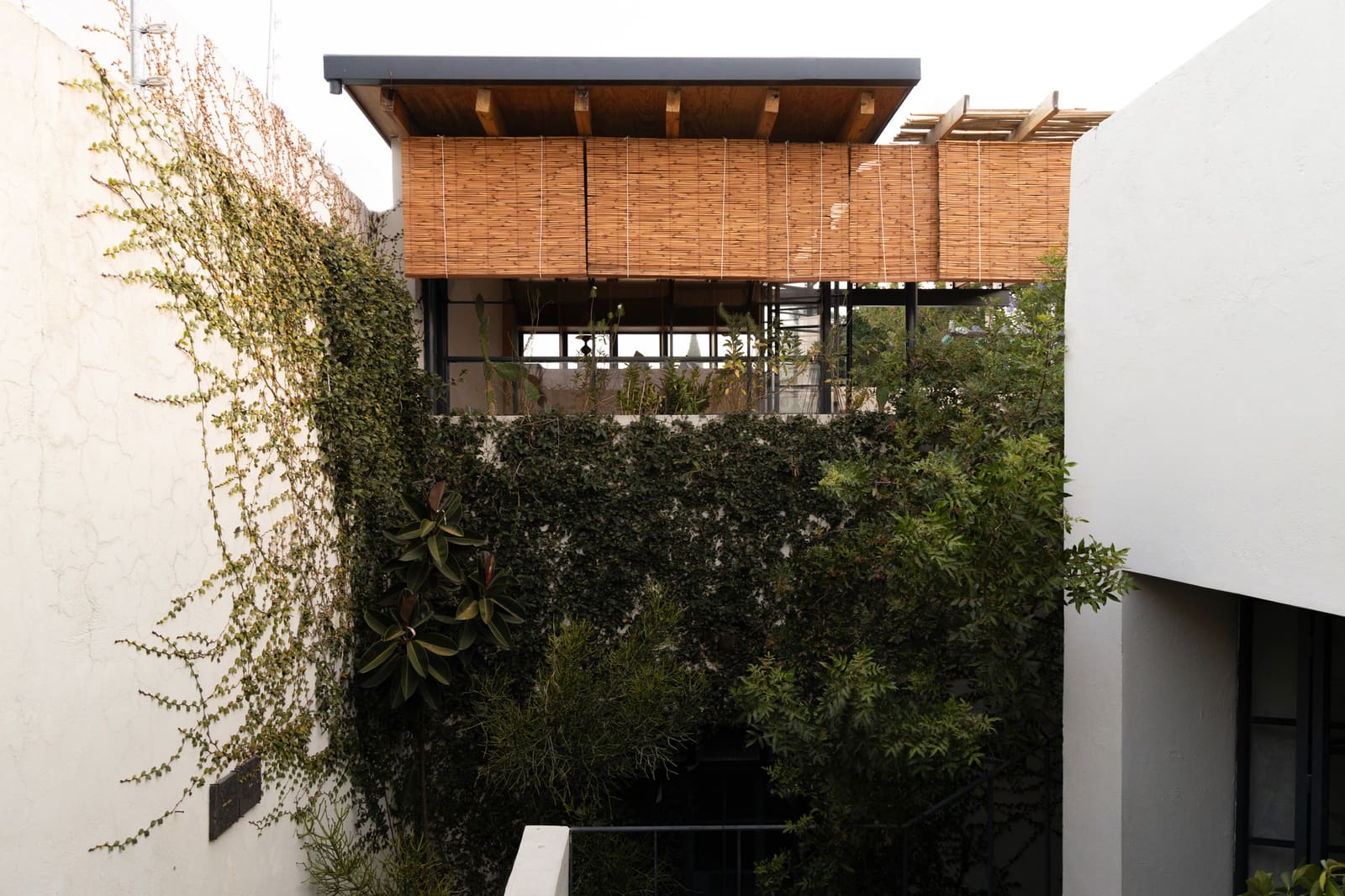
Eduardo Garretti studio's recent terrace project in Guadalajara's Colonia Americana neighborhood exemplifies this principle. Completed in 2025, the 25-square-meter intervention sits within a house built in the early twentieth century, a period when the district was consolidating its identity as one of the city's most culturally layered residential quarters. Rather than impose a new formal vocabulary, the design team chose to work within the existing spatial logic, extending the home's original character into an outdoor room that feels both inherited and invented.
The architects responsible for the broader property renovation, Aureliano Alejos and Leonora Castorena, had already established a framework that respected the home's preexistence while improving its habitability. Garretti studio's terrace builds on that foundation, creating a transition zone that mediates between interior volumes and the open air. In doing so, it performs a quiet but essential task: it makes legible the relationship between past construction methods and contemporary living patterns.
Reading the Site
Colonia Americana is dense with architectural palimpsests. Early-twentieth-century homes sit alongside mid-century insertions and more recent infill, creating a streetscape that rewards close observation. For designers working in this context, the challenge is not simply to add square meters but to maintain the neighborhood's textured continuity.
The terrace occupies a zone that might easily have been neglected or treated as leftover space. Instead, the design treats it as a destination, a place where thresholds become deliberate and materials acquire specificity. The project does not seek to mimic historical detailing; it acknowledges the age of the house through proportion, scale, and a careful selection of finishes that echo the tactile qualities of older construction without resorting to pastiche.
This approach aligns with a broader trend we have been tracking across Latin American cities, where architects are increasingly interrogating the boundary between restoration and reinvention. Projects such as this one suggest that adaptive reuse can be as much about spatial choreography as it is about surface treatment. The terrace functions as a hinge, allowing the house to breathe outward while preserving the intimacy that defines domestic space in neighborhoods like Colonia Americana.
Material Continuity and Contemporary Comfort
One of the most effective strategies employed here is the use of materials that establish visual and haptic continuity with the existing structure. Rather than introducing finishes that read as overtly modern, the design team selected elements that could have plausibly been part of the original construction, then deployed them in ways that reveal contemporary sensibilities.
This is not an exercise in nostalgia. The terrace does not attempt to freeze the house in its original state. Instead, it creates a layered reading, where older and newer components coexist without hierarchy. The result is a space that feels comfortably ambiguous in time, neither entirely historical nor aggressively contemporary.
The compact footprint demands discipline. At 25 square meters, there is little room for excess. Every element must justify its presence, and the spatial sequence must be compressed without feeling cramped. The design achieves this through careful calibration of thresholds, sightlines, and material transitions. The terrace becomes a study in how small interventions can recalibrate the experience of an entire property.
Precedents in Compact Adaptive Reuse
This project invites comparison with other modest-scale interventions that have successfully negotiated the tension between preservation and transformation. We think of Anna Heringer's work in Bangladesh, where new construction is woven into existing village fabric with a lightness of touch that respects social and material contexts. Closer to home, Mexican practices such as Taller Mauricio Rocha have demonstrated how incremental additions can honor the tectonic logic of older buildings while serving contemporary needs.
What distinguishes Garretti studio's terrace is its refusal to over-declare its presence. In an era when adaptive reuse projects often announce themselves through dramatic material contrasts or bold formal gestures, this terrace opts for subtlety. It does not seek to be photographed from every angle or to circulate as a standalone object. It exists primarily for the people who live in the house, which is perhaps the most radical position a designer can take in a media-saturated profession.
The project also speaks to a larger question about urbanism in historic districts. As cities like Guadalajara grapple with densification pressures and shifting housing demands, the temptation to replace older stock with higher-yield construction grows. Projects like this one offer a counter-narrative, demonstrating that existing buildings can be adapted, extended, and made more livable without erasing the character that makes neighborhoods legible and memorable.
Lessons in Restraint
The terrace's success lies in what it does not do. It does not attempt to compete with the main house for visual dominance. It does not introduce materials or forms that would read as alien to the site. It does not prioritize novelty over coherence. These omissions are, in fact, deliberate design decisions, and they require as much skill as any overt formal move.
Restraint in architecture is often misunderstood as a lack of ambition. In reality, it demands a deep understanding of context, an ability to read the existing conditions with precision, and the confidence to let those conditions guide the design process. Garretti studio's work here exemplifies this discipline. The terrace is not a neutral backdrop; it is a carefully composed space that enhances the life of the house without overwhelming it.
For emerging practices working in heritage-rich urban contexts, this project offers a valuable model. It shows that adaptive reuse need not be monumental to be meaningful. It demonstrates that small-scale interventions can carry significant architectural ideas. And it reminds us that the most enduring projects are often those that understand their place not as blank canvases but as active participants in ongoing urban narratives.
The Terrace as Urban Gesture
In Colonia Americana, outdoor space is a luxury. As the neighborhood continues to densify, the terrace becomes not just a domestic amenity but a small act of urban generosity. It does not contribute to the public realm in a literal sense, but it models a way of building that respects the district's scale and rhythm. In doing so, it participates in a collective project of maintaining the neighborhood's identity even as it evolves.
The terrace also raises questions about how we measure architectural success. If the goal is to create spaces that enhance daily life, support well-being, and contribute to the continuity of place, then this project succeeds on all counts. It may not generate headlines or win international awards, but it performs the essential work of making a house more habitable and a neighborhood more coherent.
As we continue to document projects that navigate the complex terrain of adaptive reuse, interventions like this one remind us why the work matters. They show that architecture can be both humble and ambitious, that it can honor history without becoming nostalgic, and that the smallest gestures can carry the weight of larger ideas. In a profession often seduced by scale and spectacle, the Rayón 376 terrace offers a quieter, more patient vision of what it means to build well.
Save this story. A free account keeps your reading list and the 07:00 email in one place.
CREATE FREE ACCOUNT →SIGN IN