The Problem with Celebrity Collections
Most celebrity furniture lines follow a predictable trajectory: a famous name, a selection of pre-existing designs from a manufacturer's catalogue, and a press release declaring creative partnership. France was acutely aware of this pattern when Castlery approached him. Rather than lending his name to an already-complete inventory, he insisted on designing from scratch, drawing from the aesthetic vernacular of two cultures that shaped his formative years.
The result is an eighteen-piece collection that includes seating, lighting, and accessories, each bearing the subtle imprint of scalloped detailing, a motif that appears in both South Asian decorative traditions and Georgian-era British architecture. This shared formal language became the throughline for the entire range, a visual syntax that speaks to hybridity without announcing it.
Designing Between Cultures
France grew up navigating the space between South Asian heritage and British surroundings, a duality that later expanded when he relocated to Salt Lake City. That experience of living across cultural contexts informed not just the aesthetic choices in this collection, but the underlying philosophy: that home is less a fixed place than a constructed environment, one that can hold multiple identities simultaneously.
The scalloped edge, present in everything from the Anika table lamp to the mirror frames, functions as a quiet reference point. It is not decorative flourish for its own sake, but a deliberate invocation of architectural memory. In South Asia, the scallop appears in Mughal archways and latticework; in Britain, it adorns Georgian doorways and neoclassical moldings. By foregrounding this shared element, France sidesteps the trap of exoticizing one tradition or defaulting to the other.
Materiality and Everyday Comfort
The collection's centerpiece is a sofa that integrates wooden detailing into its frame, an approach that adds tectonic clarity to what is typically an upholstered mass. France describes it as designed around everyday comfort rather than formal occasions, a subtle rejection of the ornamental sofa-as-sculpture that dominates high-end furniture marketing.
The blown glass table lamp, available in three colorways, balances material weight with visual lightness. Glass, particularly when hand-blown, carries an inherent variability that resists the uniformity of mass production. Here, it serves both functional and symbolic purposes: it diffuses light softly, and it signals craft without requiring overt handmade gestures.
Side tables and mirrors round out the collection, each piece maintaining the scalloped motif without becoming repetitive. The consistency is intentional. France wanted the collection to feel singular, as though it could only have emerged from his specific cultural vantage point. This is not eclecticism, where disparate references are assembled into a mood board. It is synthesis, where two traditions merge into a coherent formal language.
The Attic Bedroom as Origin Point
France traces his interest in interior design to a teenage attic bedroom, the first space he was permitted to decorate independently. With money saved from a weekend job, he assembled a room that prioritized both function and visual cohesion, a concept that felt foreign within his family's household at the time. That early exercise in spatial authorship, modest as it was, established a template: environments can be intentionally composed, not merely inhabited.
When he later designed his home in Utah, he returned to that principle, blending British and South Asian elements to construct a space that felt familiar across both lineages. The Castlery collection extends that logic into a product line, making the hybrid domestic aesthetic available beyond his own walls.
Who This Collection Is For
France emphasizes that while the collection draws from South Asian and British traditions, it is not exclusively for those who share that background. The design details are gentle enough to integrate into varied interiors, offering a point of difference without demanding a complete stylistic overhaul. This is furniture for people who want specificity without rigidity, objects that carry cultural memory but do not insist on it.
At World Archi Design, we have long observed that the most compelling furniture collections emerge when designers treat cultural heritage as material to be worked with rather than preserved in amber. France's approach is instructive: he does not treat his dual background as a constraint or a marketing angle, but as a legitimate design methodology, one that acknowledges that identity is constructed, layered, and always in motion.
Implementation in Domestic Space
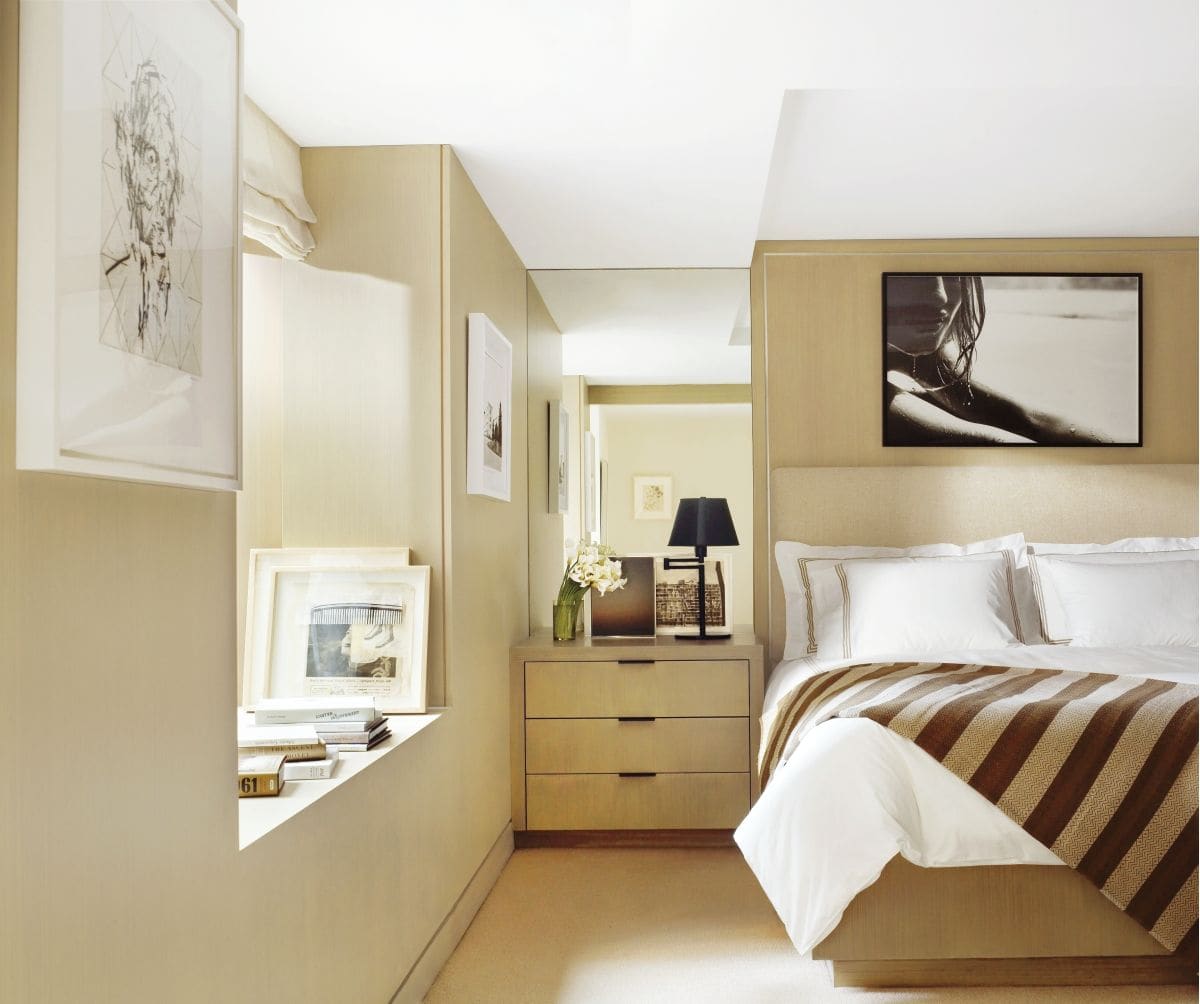
France has already installed several pieces in his own home. The large scalloped mirror now occupies his guest house, adding architectural detail to a space that previously felt underarticulated. The table lamps are distributed across the living room, kitchen, and bedroom, a decision that speaks to their versatility. Side tables flank the guest bedroom bed, providing symmetry without formality.
This kind of dispersed placement, rather than clustering the collection in a single room, suggests confidence in the pieces' ability to hold their own within varied contexts. It also reflects a pragmatic approach to design: these are not showpieces meant to anchor a room, but elements that contribute to a larger domestic composition.
The Scallop as Shared Grammar
The scallop motif, repeated across the collection, functions as both unifying gesture and historical reference. In Islamic architecture, the scalloped arch, or cusped arch, appears in structures from the Alhambra to the Taj Mahal, a formal device that softens the severity of straight lines while maintaining structural clarity. In British architecture, particularly during the Georgian and Regency periods, the scallop shell became a decorative element in doorways, niches, and furniture, a nod to classical antiquity.
By selecting this motif, France anchors the collection in two distinct but overlapping design traditions. The scallop is not a compromise between cultures, but a point of convergence, a form that both traditions arrived at through different routes. This kind of formal resonance is rare in contemporary furniture design, which tends to favor either minimalist neutrality or overt cultural signaling.
What Comes Next
France describes the collection as items that feel familiar but with a unique touch, a phrase that captures the tension at the heart of successful domestic design. Too much familiarity, and furniture becomes invisible. Too much uniqueness, and it overwhelms the space it occupies. The challenge is to find the register where an object feels both recognizable and specific.
Whether this collection succeeds in that balance will depend less on critical reception than on how it performs in actual homes, over time, in varied contexts. Furniture is not architecture. It does not command space through scale or permanence. It earns its place through repeated use, through the way it accommodates daily life without announcing itself.
France has designed pieces that carry cultural memory without requiring their owners to share that memory. That is a more difficult task than it sounds. It requires restraint, clarity, and a willingness to let form speak without over-explaining. If the collection works, it will be because the design does not insist on being understood in a particular way. It simply exists, hybrid and whole.
Save this story. A free account keeps your reading list and the 07:00 email in one place.
CREATE FREE ACCOUNT →SIGN IN