The Posture Question
A reading chair occupies a curious position in residential design: it must balance ergonomic rigor with the aesthetic weight of a standalone piece, all while inviting hours of uninterrupted use. Unlike dining chairs, which enforce upright postures for defined durations, or lounge seating, which encourages full recline, the reading chair exists in a liminal zone. It must accommodate shifting positions without demanding constant adjustment, support the spine without rigidity, and frame the body in a way that feels deliberate rather than accidental.
At World Archi Design, we've observed a consistent thread across successful examples: the seat depth hovers between 22 and 26 inches, just generous enough to permit cross-legged postures or drawn-up knees without swallowing smaller frames. The back angle, meanwhile, tends toward 100 to 110 degrees, a range that supports the lumbar curve while preventing the head-forward slouch that plagues deeper recliners. Armrests, when present, sit low enough to allow elbows to rest naturally but high enough to cradle a book or tablet without shoulder strain.
Consider the Miramar Chair from Serena & Lily, upholstered in solution-dyed acrylic basketweave. Its firm construction and generous proportions invite what one tester described as "crisscross applesauce" sitting, a posture that would collapse lesser frames. The piece employs a spring-and-foam core that resists compression over time, a detail that separates furniture designed for daily ritual from occasional accent pieces. Performance fabrics like Perennials' offerings bring a technical dimension to upholstery: resistance to UV degradation, mold, and liquid penetration without sacrificing hand feel. In one durability test, a full mug of coffee beaded on the surface and rolled away with minimal intervention, a small miracle in natural-fiber-dominated interiors.
Scale and Spatial Presence
The reading chair's footprint carries consequences. Oversized silhouettes, such as Sabai's Eclipse Chair, measure wide enough to accommodate two bodies or a single reader with sprawling limbs. This model folds out into a twin-size sleeper, blurring the boundary between furniture typologies. Its modular construction aligns with circular design principles: damaged components can be replaced individually rather than condemning the entire piece to landfill. Padded arms extend the usable surface area, transforming the chair into a multi-zone landscape where books, devices, and beverages coexist.
But scale demands spatial awareness. A chair like the Willo Perron Bun Chair, with its dumpling-like profile and curved sides, commands more visual real estate than its functional footprint suggests. During extended office testing, the piece proved perpetually occupied, its cocoon geometry drawing occupants into a centered posture that one editor likened to "a puffy donut cradle." The floating-cloud aesthetic, achieved through turned legs that recede visually, prevents the mass from reading as heavy despite its girth. For tight reading nooks or compact apartments, however, such pieces risk overwhelming the room.
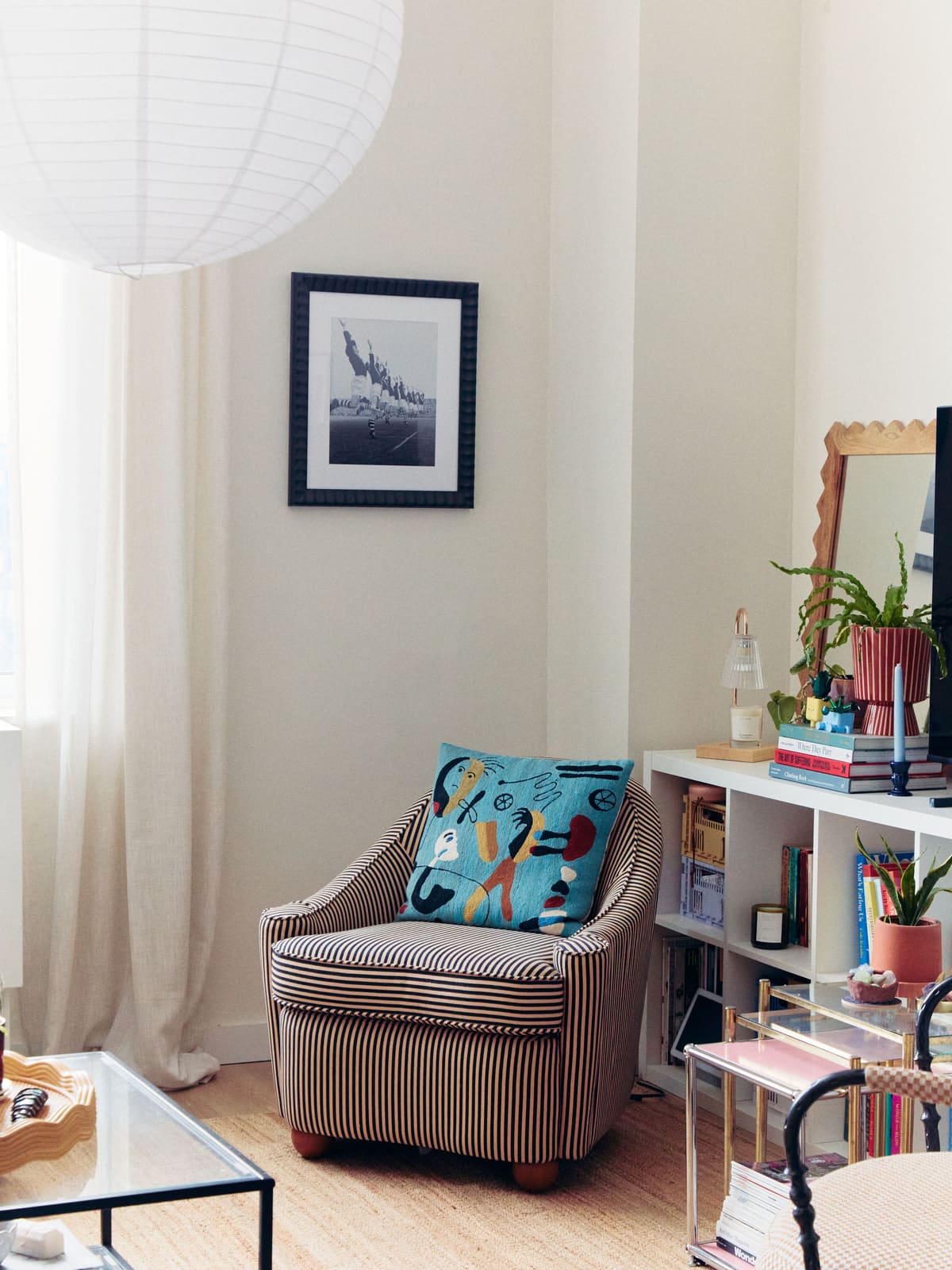
Contrast this with the Pierce & Ward Curved Slipper Chair, a low-slung profile that tucks into corners without demanding attention. Its upright stance discourages the sink-down effect common to overstuffed seating, a quality that extends conversational utility beyond solo reading sessions. The cotton pinstripe upholstery lacks performance coatings but offers tactile warmth and durability through tight weave density. Armrests sit low, ideal for elbow support during fine motor tasks like knitting but insufficient for leaning during extended lounging.
Material Intelligence
Upholstery choice transcends aesthetics. Solution-dyed acrylics, as deployed in the Miramar, embed pigment at the molecular level, rendering the fabric impervious to fading and simplifying maintenance in high-use contexts. Velvet, a perennial favorite for its light-refractive properties and soft hand, appears in pieces like Article's Sadie Lounge Chair, where a high back and subtle wingback silhouette nod to traditional club chair typology. The 23-inch seat depth strikes a middle ground: deep enough for comfort, shallow enough to permit easy egress without the struggle that plagues ultra-plush cushions.
Leather introduces another dimension. Arhaus's Callaway Chair employs full-grain hides that develop patina over time, a living material that records use through subtle texture shifts and color deepening. The generous curve supports lumbar regions without requiring supplemental pillows, a testament to thoughtful contouring in the frame itself. For those wary of visual heft, slim metal frames, as seen in Lulu and Georgia's Leni Outdoor Accent Chair, provide structural support while receding perceptually, a trick borrowed from mid-century design's obsession with apparent weightlessness.
Precedents and Lineage
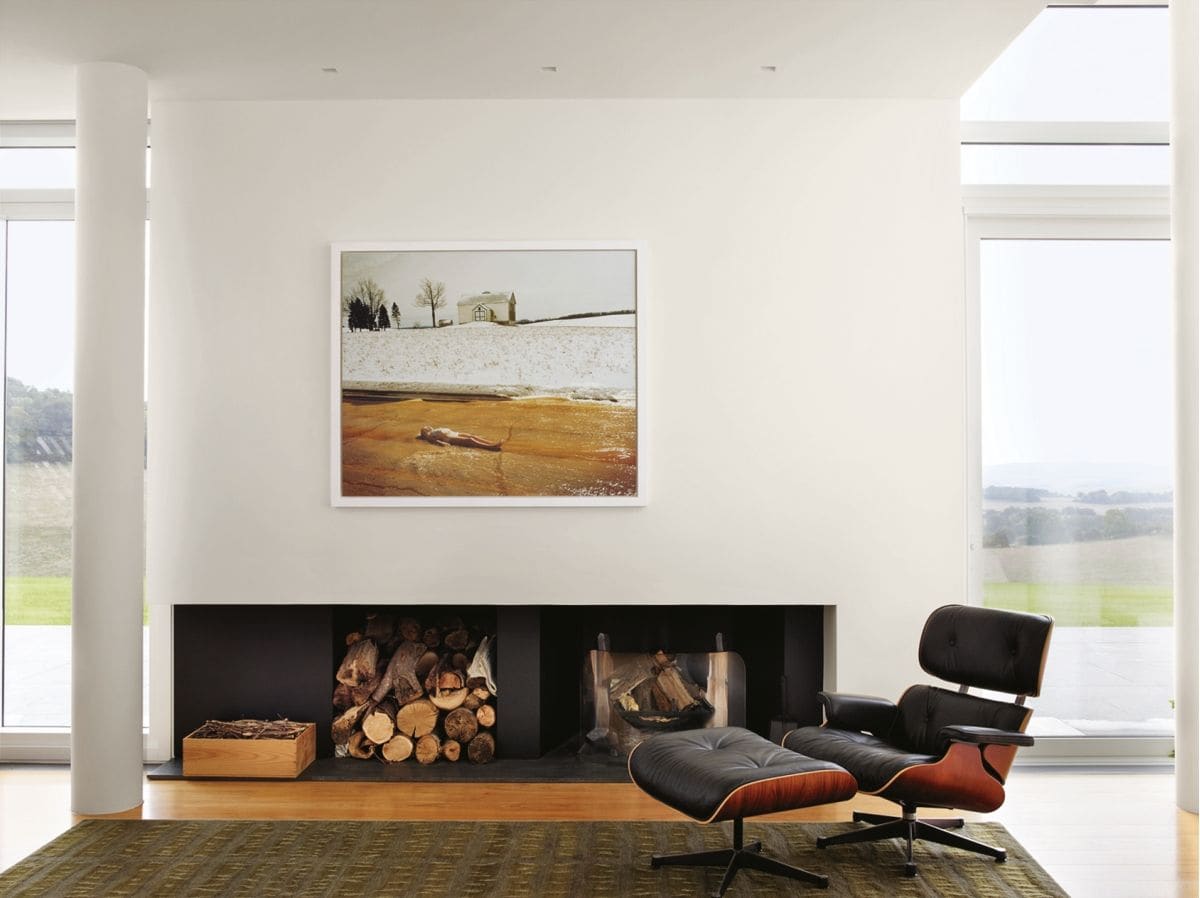
Few reading chairs carry the historical weight of Eero Saarinen's Womb Chair, introduced by Knoll in 1948. Saarinen conceived the piece as a response to his belief that seating should flex to accommodate any posture, a radical departure from the era's rigid upholstery norms. The fiberglass shell, upholstered and paired with a loose seat cushion, creates what one tester described as "the adult version of a baby bassinet." Indented armrests offer unexpected utility: enough surface area to rest a book or, more daringly, a cocktail glass. The slightly angled back and enveloping sides distribute weight across a broad surface, reducing pressure points during extended sessions.
Pierre Paulin's F300 Lounge Chair, designed in 1965 for Gubi, pushes even further into sculptural territory. Its Space Age silhouette, famously featured in Star Trek during the 1980s, prioritizes form as an equal partner to function. The piece invites unconventional postures, a design philosophy that trusts users to discover their own optimal positions within the chair's organic contours. Such pieces occupy a different register than task-oriented seating: they assert design as a primary value, comfort as a byproduct of thoughtful geometry rather than padding alone.
The Overlooked Elements
Lumbar support, often an afterthought, determines whether a chair sustains multi-hour sessions. Castlery's Mori Armchair includes a dedicated lumbar pillow, acknowledging that even deep seats require lower-back reinforcement. The accompanying ottoman extends the effective seating length, permitting full-body recline without the commitment of a chaise. Japandi-inspired platform bases elevate the piece visually, preventing the heaviness that can plague ultra-deep seating.
Chaise lounges, like West Elm's Riggins model, offer positional flexibility: sit upright against overstuffed cushions, sprawl lengthwise, or adopt a hybrid posture that shifts throughout the reading session. This adaptability addresses a truth often ignored in chair design: few readers maintain static positions for long. The body adjusts, fidgets, repositions, and a successful reading chair accommodates this restlessness without requiring conscious effort.
Where Design Meets Ritual
The reading chair functions as more than furniture. It anchors a ritual, a designated zone where the mind disengages from ambient demands and enters narrative space. This demands a level of comfort that transcends momentary pleasure, sustaining the body through chapter transitions and plot revelations without intrusion. But it also requires aesthetic conviction: the piece must justify its spatial claim even when unoccupied, contributing to the room's visual logic rather than apologizing for its presence.
We've seen this balance achieved through varied strategies. Some designers pursue maximal plushness, layering foam densities and feather fills to create yielding surfaces that adapt to body contours. Others favor firmer constructions that resist deformation, maintaining consistent support across years of use. Neither approach claims universal superiority; the choice hinges on individual physiology, reading habits, and tolerance for maintenance.
What unites the strongest examples is intentionality. Each design decision, from arm height to seat angle to fabric hand, serves the larger goal of sustained, comfortable occupation. The reading chair stands as a case study in how furniture can elevate daily practice, transforming the simple act of sitting with a book into an experience worth designing around.
Photo: Kate McGregor
Save this story. A free account keeps your reading list and the 07:00 email in one place.
CREATE FREE ACCOUNT →SIGN IN