The Intersection of Two Crafts
There is something instructive about examining the domestic environments of artists who worked across multiple disciplines. The late Tony Bennett, who would have turned 100 this August, maintained a parallel career as a painter under his birth name, Tony Benedetto. His homes over seven decades demonstrate how spatial choices can serve both public and private creative practice.
Bennett's residential trajectory moved from outer-borough rentals to suburban ownership and, eventually, to Manhattan penthouses positioned for views of Centralery Park. What remained constant was the presence of materials: records, art supplies, canvases in progress. His interiors functioned less as retreats from professional life than as extensions of it.
Early Foundations in the Bronx and Beyond
By 1955, Bennett and his first wife Patricia Ann Beech had settled in Briar Oaks, a luxury building in Riverdale. The apartment accommodated their growing family while maintaining proximity to Manhattan's performance venues. Two years later, they purchased a house on Lydecker Street in Englewood, New Jersey, a decision driven by the practical needs of raising two sons.
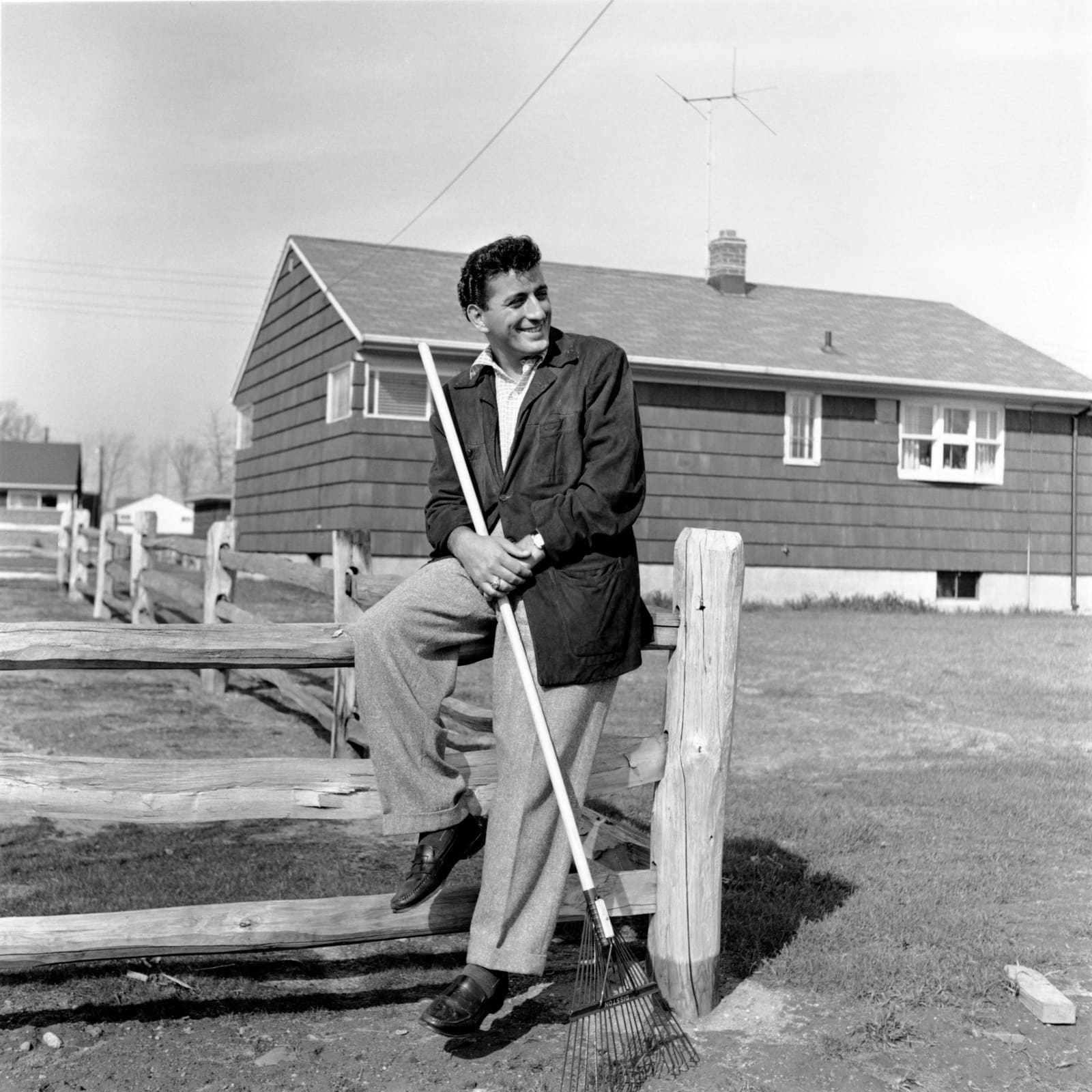
The Englewood residence appears in archival photographs as a modest suburban structure. In one 1957 image, Bennett is shown recording at home, microphone and equipment set up in a domestic room. Another photograph from 1960 captures him holding a rake in the garden. While Bennett was not known for horticultural pursuits, the outdoor space provided subject matter for his painting practice, which he conducted almost exclusively en plein air.
His approach to painting prioritized direct observation. Working under his legal surname, he focused on landscapes, still lifes, and cityscapes, often completing pieces outdoors. The garden in Englewood offered immediate access to natural forms and changing light conditions.
A Return to Tradition Through Material Culture
Bennett attended New York's School of Industrial Art before leaving at 16 to support his widowed mother. After military service in World War II, including participation in the Battle of the Bulge and the liberation of a concentration camp, he studied singing at the American Theatre Wing on the GI Bill. His early success allowed him to purchase a home for his mother near his own in New Jersey.
The proximity enabled a blending of domestic and professional spheres. Bennett's mother hosted gatherings that included figures from the music world; Duke Ellington and his entire band once came to her house for an Italian meal. These occasions reinforced the role of the home as a site for artistic exchange, not merely private life.
Inside the Englewood house, the living room doubled as a listening space. A 1963 photograph shows the family with their cats, surrounded by records. The image presents an idealized domesticity, though the period was marked by the strain of Bennett's touring schedule. He and Patricia separated in 1965 and divorced in 1971.
West Coast Interlude and Creative Struggle
Bennett's second marriage, to actor Sandra Grant, coincided with a move to Los Angeles in 1971. The Hollywood years proved challenging. His independent record label failed, and he faced significant tax liabilities. Substance abuse issues culminated in a near-fatal overdose, from which his wife revived him.
A 1977 photograph shows the couple at home with their two daughters, Joanna and Antonia. The Los Angeles residence, like earlier homes, contained the tools of both professions: records, instruments, art materials. Yet the period represented a low point in Bennett's career and personal stability.
He later reflected on the incident as a violation of his own talent. The realization prompted a decisive shift. Bennett ended the marriage in 1979 and returned to New York, where he would spend the remainder of his life.
Painting as Daily Practice
By 1983, Bennett had reestablished himself in Manhattan. A photograph from that year shows him working on a still life at home, palette and brushes in hand. The return to New York reconnected him with two essential resources: Central Park and the Metropolitan Museum of Art.
He became a regular visitor to the Met, studying the work of John Singer Sargent, whose technique he admired. The museum provided a counterpoint to his outdoor painting sessions in Central Park. The dual practice of studying historical work and executing contemporary landscapes informed his development as a painter.
Bennett estimated he completed over 800 paintings of Central Park during his lifetime. The repetition allowed for sustained investigation of a single subject under varying conditions: seasonal shifts, weather changes, different times of day. This approach mirrors the discipline of a musician revisiting standard repertoire, finding new interpretations through accumulated experience.
The Role of the View
From the early 1980s until his death in 2023, Bennett chose apartments based on their sightlines to Central Park. The decision was not sentimental but functional. The park provided an inexhaustible subject, visible from his windows and accessible for painting sessions.
A 2002 photograph shows Bennett with his Maltese, Boo, in his Manhattan apartment. The space appears uncluttered, with art on the walls and a sense of light. The simplicity suggests a prioritization of the view itself as the primary design element.
Bennett's son Danny, who became his business manager after the return to New York, helped revitalize his father's career by securing appearances on late-night television and MTV. The strategy introduced Bennett to younger audiences and led to collaborations with artists including Amy Winehouse and Lady Gaga. These professional developments occurred alongside his continued painting practice, which remained central to his daily routine.
Precedent and Influence
Bennett's dual practice invites comparison with other artist-musicians who maintained serious commitments to visual art. Joni Mitchell's painting and drawing have been exhibited alongside her musical work. Bob Dylan has shown paintings and sculptures in galleries internationally. Paul McCartney has pursued painting since the 1980s.
What distinguishes Bennett's approach is the sustained, decades-long engagement with a single geographic subject. While his musical career took him globally, his painting practice remained anchored to New York and, specifically, to Central Park. The constancy provided a counterbalance to the itinerant demands of performance.
Domestic Space as Studio
The architectural configuration of Bennett's later apartments supported both creative practices. High ceilings and generous natural light accommodated painting. Acoustic considerations allowed for vocal practice and recording. The spaces functioned as studios that happened to include living quarters, rather than homes with designated work areas.
This arrangement reflects a broader principle in residential design for artists: the importance of integrating production space into the primary dwelling. Separation of work and life may suit some professions, but for practitioners whose creative output depends on sustained, daily engagement, the home studio model offers practical advantages.
Bennett's third wife, Susan Crow Benedetto, whom he married in 2007 after a 20-year relationship, supported both his artistic pursuits and, later, served as his primary caregiver after his Alzheimer's diagnosis in 2016. The continuity of place during this period likely provided orientation and comfort as cognitive decline progressed.
Material Legacy
The archival photographs of Bennett's homes reveal consistent elements: instruments, recording equipment, art supplies, finished and unfinished canvases. These objects constitute the material evidence of a life organized around making. The homes themselves served as infrastructure for that making, chosen and configured to support it.
Bennett's work as a painter never achieved the commercial success or cultural reach of his music, but the practice shaped his daily existence and informed his observational capacity. The discipline of looking closely at landscape, of translating three-dimensional form onto a two-dimensional surface, cultivates a type of attention that extends beyond the easel.
His residences, from the Bronx to New Jersey to Manhattan, adapted to changing family structures and professional circumstances. Yet the core function remained stable: these were places for work, for looking, for the patient accumulation of skill across two demanding art forms. The view from the final apartment, overlooking Central Park, represented not luxury but necessity. It was the subject he returned to daily, the landscape that anchored a long life of observation and craft.
Save this story. A free account keeps your reading list and the 07:00 email in one place.
CREATE FREE ACCOUNT →SIGN IN