The Demographic Wager
Across the projects we've covered this year, a recurring theme has emerged: the instrumentalization of architecture as economic policy. In China's tier-three cities and county towns, the pattern is familiar. Young people leave for opportunities in Shanghai, Hangzhou, or Shenzhen. Industrial bases erode. Local governments commission cultural infrastructure, hoping that novelty and aesthetic capital might reverse the flow. Longyou County in Quzhou, Zhejiang, has joined this experiment with unusual candor. In 2022, officials declared their ambition to become a "youth development-oriented county," a frank acknowledgment that the demographic trajectory was untenable.
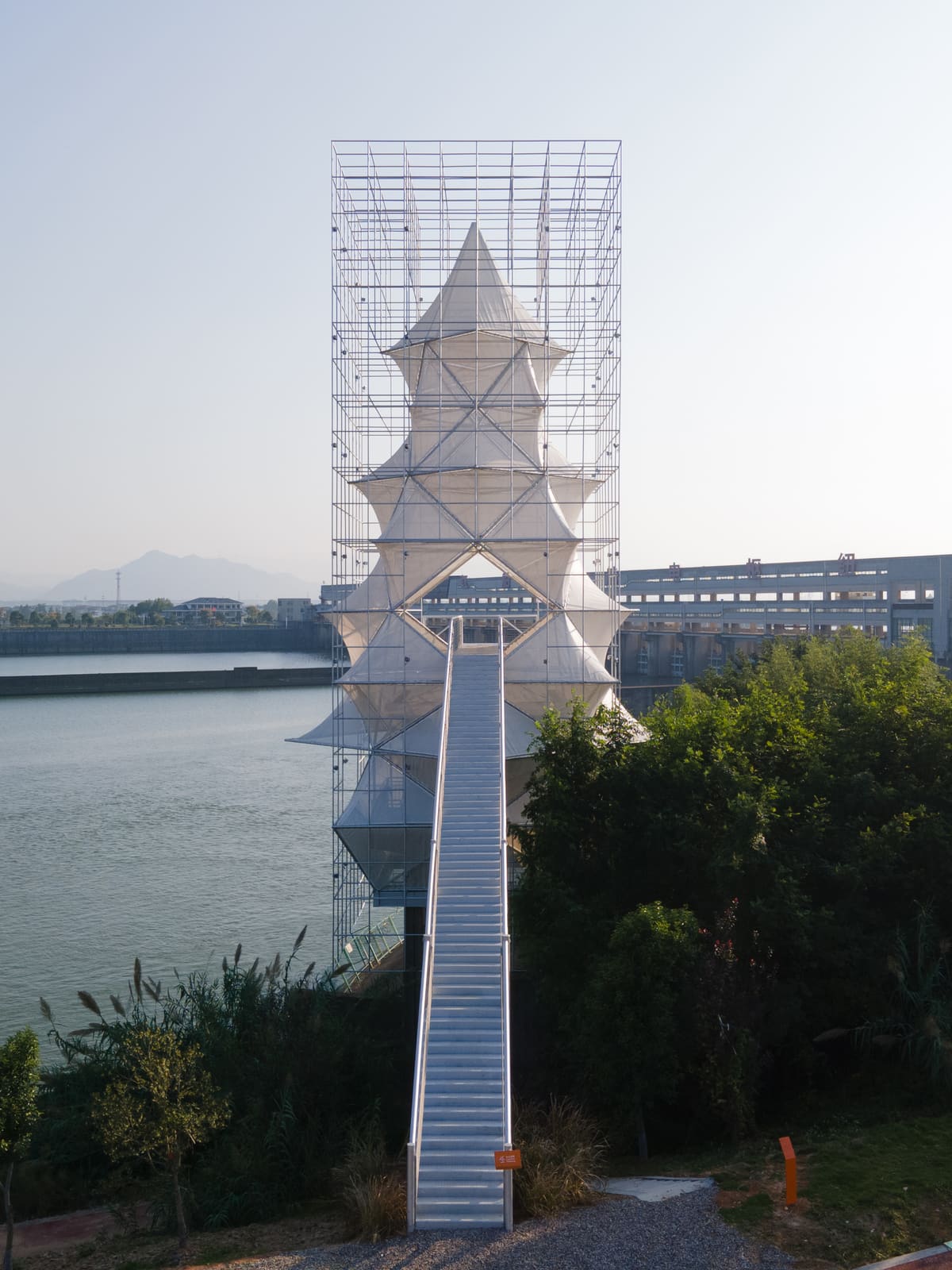
The response was not a single monument but a distributed strategy. The China Academy of Urban Planning and Design, working with cultural consultancy Fengyuzhu and digital platform Bilibili, initiated the HU SHI GUANG ART ECO SITE, a corridor punctuated by installations from twenty-seven design teams, later expanded to forty. All participants were born in the 1980s and 1990s, a deliberate curatorial choice intended to align the visual language with the target audience. Among these commissions, YXDesigners delivered a 155-square-meter observation tower and an expanded sluice management house, completed in 2023. The brief was explicit: create a visually dominant landmark at the corridor's entrance, a gateway structure legible enough to anchor the entire initiative.
Massing and Material Logic
The tower itself is a study in vertical compression. At just over 150 square meters, it cannot rely on horizontal sprawl or programmatic complexity. Instead, the design team, led by Jiahong Lu, Linghuizi Mo, Yiwen Xue, and Tan Peng, worked within the constraints of a slender footprint to articulate height and silhouette. The tectonic strategy is straightforward: a steel frame clad in perforated metal panels, allowing the structure to read as permeable rather than monolithic. This fenestration approach serves dual purposes. By day, the perforations modulate light and shadow across interior surfaces. By night, with lighting design by ADA consultants Sean Hung and Howard Tzeng, the tower becomes a lantern, visible from the riverbank and the arterial road beyond.
The sluice house renovation, by contrast, operates in the register of adaptive reuse. The original structure was utilitarian, a concrete box housing hydraulic controls. YXDesigners retained the base geometry but introduced a cantilevered canopy and reconfigured the facade with the same perforated metal system used on the tower. The result is a formal dialogue between the two structures, a shared material vocabulary that unifies the entrance precinct without flattening difference. The canopy extends the usable footprint, creating a sheltered threshold that can accommodate informal gatherings or small events, a gesture toward the programmatic flexibility that cultural corridors demand.
Context and Precedent
Longyou's strategy is not without precedent. We've seen similar efforts in Japan's Art Setouchi festival, where islands in the Inland Sea were repopulated, temporarily at least, through triennial art commissions. Closer to home, the Wuzhen Theatre Festival in northern Zhejiang has leveraged cultural programming to extend tourist seasons and generate local employment. But Longyou's model is distinct in its explicit focus on permanent infrastructure rather than temporary installations. The HU SHI GUANG corridor is not a biennial; it is a built environment intended to persist, to become part of the urban fabric.
This permanence raises questions. The tower and sluice house are legible as landmarks, but landmarks alone do not generate the social or economic ecosystems that retain young people. The design teams involved were not asked to solve housing affordability, employment diversity, or transit connectivity. They were asked to deliver visual anchors. In that sense, the project operates within a familiar limitation: architecture as branding, rather than architecture as infrastructure. The perforated metal panels and articulated massing may attract a visitor's gaze, but they do not address the structural forces driving migration.
The Role of Collaboration
What distinguishes this initiative is the breadth of its collaborative framework. ZZ Architectural Design & Consulting handled construction detailing, with structural leads Haxun Sun, Zejiu Chen, and Tao Huang coordinating with Shanghai Tongcheng Building Technology & Engineering on fabrication and assembly. The lighting consultants worked in parallel with the architects, rather than as an afterthought, ensuring that the tower's nocturnal presence was integral to the parti from the outset. Project management was distributed across three entities: the China Academy of Urban Planning and Design, Shanghai Fengyuzhu, and Bilibili, each bringing distinct expertise and networks.
This multi-party structure reflects a broader shift in how Chinese cultural infrastructure is commissioned. Rather than a single developer or municipal bureau controlling the process, hybrid teams combine public planning authority, private cultural consultancies, and digital platforms with direct access to youth demographics. Bilibili, in particular, is a platform dominated by users born after 1990, its content skewing toward animation, gaming, and subculture. Its involvement signals an attempt to bridge institutional planning and digital-native taste cultures, a recognition that traditional municipal aesthetics may not resonate with the intended audience.
Lighting as Temporal Strategy
The lighting design by ADA consultants is worth isolating. In many observation towers, illumination is an afterthought, a few uplights or façade washes applied post-occupancy. Here, the lighting is conceived as a temporal strategy, transforming the structure's role across the diurnal cycle. During daylight hours, the perforated cladding creates a dappled interior, a play of light and shadow that animates otherwise minimal spaces. After dark, internal luminaires turn the tower into a beacon, its silhouette visible from kilometers away along the river corridor.
This approach aligns with a broader trend we've observed in recent pavilion and tower projects: the use of lighting to extend programmatic legibility beyond conventional visiting hours. The tower becomes a reference point for evening joggers, late-night drivers, a fixed element in the mental map of the town. It is a form of ambient placemaking, less about directed experience and more about atmospheric presence.
The Limits of the Landmark
The project's ambition is clear, but so are its constraints. At World Archi Design, we've been tracking the proliferation of art-led regeneration strategies across East Asia, and the results are mixed. Temporary installations generate media coverage and short-term visitation spikes. Permanent structures, if insufficiently programmed, risk becoming picturesque ruins. The tower and sluice house will succeed or fail not on their formal merits alone, but on whether the broader HU SHI GUANG corridor can sustain activity, whether the forty design commissions cohere into a navigable, desirable landscape.
There is also the question of maintenance. Perforated metal panels require regular cleaning to prevent corrosion and aesthetic degradation. Lighting systems need ongoing electrical support and bulb replacement. In county towns with limited municipal budgets, these are not trivial concerns. A landmark that falls into disrepair becomes a monument to failed ambition, a visual reminder of the gap between aspiration and capacity.
Youth Development or Branding Exercise?
Longyou County's stated goal is youth retention and attraction. The HU SHI GUANG corridor is a component of that strategy, but it is not a comprehensive solution. Young people leave county towns not because of a lack of observation towers, but because of limited career pathways, educational resources, and social infrastructure. The corridor may offer weekend leisure and Instagram-worthy backdrops, but it does not, by itself, create jobs or affordable housing.
This is not a critique of YXDesigners or the other teams involved. They were asked to design landmarks, and they delivered competent, visually coherent structures. The critique is directed at the underlying policy logic: the belief that cultural amenities can substitute for economic restructuring. Architecture can support youth retention, but only when embedded in broader strategies that address employment, education, and quality of life. Without those foundations, even the most striking landmarks risk becoming stage sets for a demographic that never arrives.
Reflections on the Corridor Model
The distributed, multi-designer approach has its advantages. Rather than a single mega-project, the HU SHI GUANG corridor offers variety, a sequence of spatial experiences that can be navigated over hours or days. This model reduces risk: if one installation underperforms, others may compensate. It also allows for experimentation, giving emerging designers opportunities to build at a scale and visibility that would be difficult to secure in tier-one cities.
But distribution also introduces coordination challenges. Forty design teams, each with distinct aesthetics and methodologies, must somehow cohere into a legible whole. The risk is fragmentation, a landscape of competing gestures that cancel each other out. The tower and sluice house, positioned at the entrance, bear the burden of establishing a visual and experiential baseline. Their success will be measured not only by their individual form, but by how effectively they frame the sequence that follows.
At World Archi Design, we remain cautiously interested in Longyou's experiment. The tower is a competent piece of infrastructure, its massing and material choices appropriate to the brief. But the real test lies ahead, in whether the corridor can sustain use, whether it becomes a lived environment rather than a photogenic backdrop. The demographic challenges facing Chinese county towns are structural and deep. Architecture alone cannot solve them, but it can, if thoughtfully integrated into broader policy frameworks, contribute to environments where young people might choose to stay.
Save this story. A free account keeps your reading list and the 07:00 email in one place.
CREATE FREE ACCOUNT →SIGN IN