The Warehouse Next Door
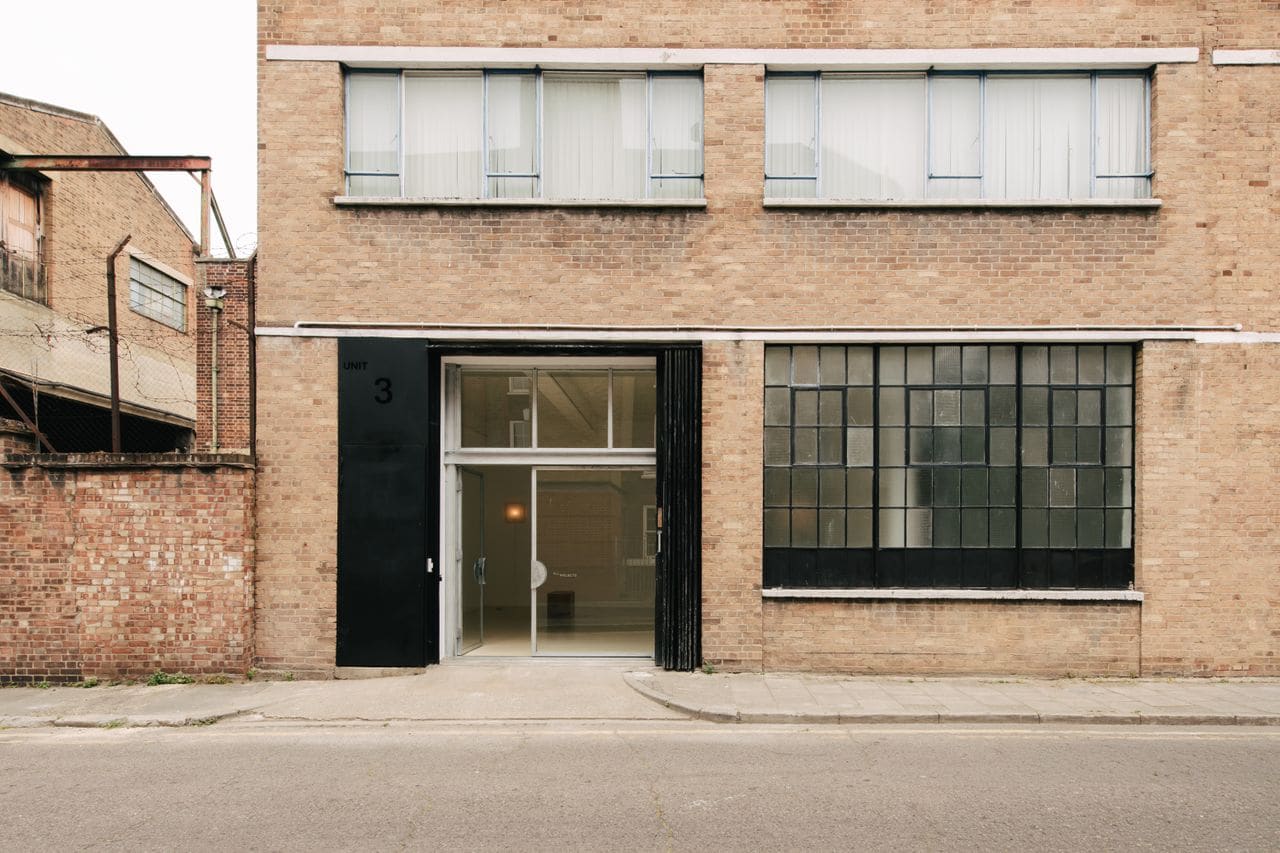
It is a familiar condition in east London: the utilitarian brick warehouse that holds, behind its plain facade, something unexpected. In Hoxton, EBBA has quietly opened All Projects, a gallery occupying the ground-floor unit directly beside the practice's own studio on the Whitmore Estate. The move is less real-estate opportunism than philosophical clarification. For founder Benni Allan, who established EBBA in 2017, the question has never been whether architecture can engage with art, fashion, music, or design. It has been how to structure that engagement without reducing it to ornament.
All Projects formalizes what the practice has pursued informally since its inception: collaboration that does not subordinate one discipline to another. Allan's stance, articulated when we first profiled the studio in 2021, was that EBBA is "not afraid of trying different things and use the process of making to help generate something that is least expected." The gallery extends that principle into physical space, offering a venue where the architect is neither client nor author, but co-participant.
A Flexible Canvas With Memory
The interior has been stripped back and painted white, a deliberate neutrality that accommodates rotating exhibitions, film screenings, and events. Yet EBBA has resisted the temptation to erase history entirely. Original surfaces have been refurbished and left visible, their textures and wear marks juxtaposed against new interventions: custom metal fixtures, all-timber furniture, and integrated sinks and storage designed by the studio. The effect is not polished showroom but working laboratory, a space that acknowledges its industrial past while asserting a contemporary material vocabulary.
This approach to adaptive reuse reflects a tectonic honesty that runs through EBBA's broader portfolio. Rather than clad over the existing warehouse fabric, the practice has chosen to work in dialogue with it, allowing brick, concrete, and steel to share the room with walnut, powder-coated steel, and gypsum board. The result is a layered legibility: you can read the building's former life even as you apprehend its current function.
Beyond the Studio Silo
At World Archi Design, we have been tracking the rise of architect-run cultural platforms, spaces that operate at the intersection of practice and discourse. All Projects fits within this lineage but distinguishes itself through its explicit rejection of the exhibition-as-portfolio model. The gallery is not a showroom for EBBA's built work. It is a venue for others: independent bookstores like Tenderbooks, cultural organizations such as the Architecture Foundation, and collaborators from the studio's extended network, including the listening bar Space Talk and the music festival Houghton.
This outward orientation matters. Too often, architect-run galleries become echo chambers, spaces where the same formal preoccupations circulate without friction. All Projects, by contrast, invites disciplinary collision. A fashion installation might occupy the same wall that later hosts a film screening or a publication launch. The gallery's motto, that culture does not operate in a silo, is operationalized through programming rather than stated as aspiration.
Material Palette as Editorial Voice
The interventions EBBA has introduced into the space function as a kind of editorial voice, subtle but coherent. The timber constructions, for instance, recall the practice's interest in craft-based fabrication and the legibility of joinery. The metal fixtures, slender and precise, suggest a vocabulary borrowed from industrial design but inflected with architectural rigor. Together, these elements frame whatever content occupies the gallery, providing a consistent tectonic backdrop without overwhelming it.
This is a delicate calibration. In adaptive reuse projects, particularly those involving cultural programming, there is always the risk that the architecture will either recede too far, becoming invisible infrastructure, or assert itself too strongly, competing with the exhibits. EBBA navigates this by treating the gallery as a designed neutral, a space with character but without agenda. The white walls offer flexibility; the retained surfaces offer memory; the custom furnishings offer a through-line.
Precedents and Departures
The lineage here includes David Chipperfield's conversion of the Neues Museum in Berlin, where historical fabric and contemporary insertion coexist in deliberate tension, and the more recent work of Assemble, whose artist-architect collective model blurs the boundary between making and curating. All Projects shares with these precedents a commitment to process over product, to collaboration over authorship. But where Chipperfield's interventions are monumental and Assemble's are participatory, EBBA's approach is quieter, more embedded in the daily operations of the studio.
The adjacency of gallery and workspace is not incidental. It collapses the distance between production and presentation, between the drawing board and the exhibition wall. This proximity allows for a feedback loop: ideas tested in the studio can migrate into the gallery, and conversations sparked by gallery programming can inform the studio's ongoing projects. It is a model that treats architecture not as a finished object but as an ongoing practice, one that benefits from contact with adjacent fields.
Programming as Position
The inaugural events at All Projects, hosted by Tenderbooks and the Architecture Foundation, signal the gallery's curatorial direction. Both organizations operate at the intersection of publishing, discourse, and spatial practice. Tenderbooks, an independent bookstore with a focus on art and architecture, brings a bibliographic sensibility; the Architecture Foundation, a long-standing advocate for design culture in the UK, brings institutional credibility and a commitment to public engagement.
Future programming will likely draw from EBBA's existing network, including collaborators from music and hospitality. The listening bar Space Talk, for instance, suggests an interest in acoustic space and the social rituals of gathering. Houghton, the music festival, points to large-scale event design and the choreography of crowd movement. These are not typical architectural commissions, but they are architectural problems, and All Projects offers a venue to examine them in a different register.
A Testing Ground, Not a Showcase
What distinguishes All Projects from other architect-run galleries is its refusal to function as a marketing exercise. The space does not exist to promote EBBA's built work or to attract new clients. It exists, instead, as a testing ground for ideas that may or may not result in buildings. This is a rare position in a profession increasingly driven by visibility and brand. By opening a gallery that is not about itself, EBBA has created a space for genuine experimentation, for projects that do not need to resolve into marketable outcomes.
This posture has implications beyond Hoxton. It suggests a model for architectural practice that is less transactional, less tied to the commission cycle, and more embedded in cultural production. It also raises questions about sustainability, both economic and programmatic. How does a practice support a non-commercial gallery over time? How does it balance the demands of client work with the open-ended commitments of cultural programming? These are questions without easy answers, but they are worth asking.
The east London warehouse, utilitarian and unassuming, has become a site for these questions. All Projects is not a monument or a manifesto. It is a room, carefully considered, open to what comes next.
Photo: Genevieve Lutkin
Save this story. A free account keeps your reading list and the 07:00 email in one place.
CREATE FREE ACCOUNT →SIGN IN