The Dung Economy, Revisited
Using animal excrement as a building component is ancient practice. Across millennia, humans have mixed cattle dung with clay and straw to form cob, stabilized earthen walls, and even insulated roofs. What changes over time is not the material itself but the cultural lens through which we view it. In Phang Nga province, southern Thailand, architect Boonserm Premthada has completed Goya, a tower constructed from bricks made entirely of elephant waste. The project treats dung not as a byproduct to be managed, but as a resource with tectonic and symbolic potential.
Each brick is handmade and sun-baked, measuring 33 centimeters in diameter and 5 centimeters thick. The composition is straightforward: grass, leaves, fruit remnants, and fibrous plant matter that elephants consume and expel. The resulting material is structurally adequate for low-load applications and carries minimal embodied energy, requiring no kiln firing. It took a full year to produce the bricks and assemble the tower, a timeline that reflects both the labor intensity of the process and the seasonal rhythms of elephant digestion.
Formal Language and Assembly
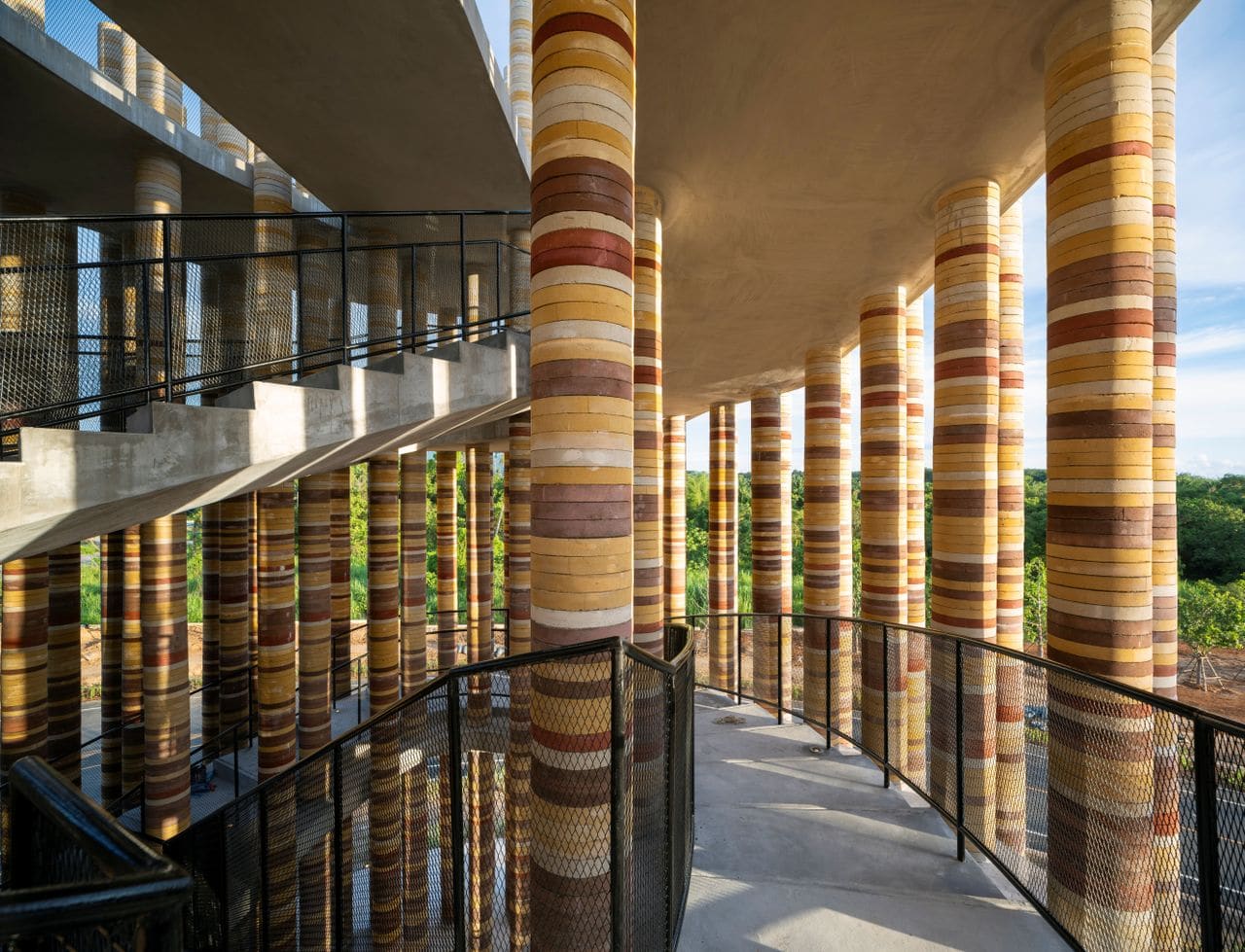
Goya reads as a cluster of cylindrical columns rising to varying heights, their silhouettes staggered across the site. The bricks are threaded onto central steel rods, a technique that recalls modular construction systems but with a distinctly organic material palette. Five pigmented variations create a banded, gradient effect along each column, a chromatic gesture that Premthada describes as inspired by layered ice lollies. The palette ranges from pale ochre to deep terracotta, echoing the tones of laterite and fired clay common in Southeast Asian vernacular building.
Visitors enter at grade and ascend a curved staircase that weaves between the towers. The spatial experience is intimate, with fenestration limited to the gaps between columns. Views open intermittently toward the surrounding landscape, a forested expanse punctuated by limestone karst formations. The massing is neither monumental nor minimal; it occupies a middle register, legible as architecture but retaining the handmade irregularities of its constituent parts.
Material as Cultural Index
Elephant dung has been repurposed for centuries in Thailand and neighboring regions. It is pulped for paper, composted for fertilizer, and even processed into insect repellent. One niche application involves coffee: undigested beans retrieved from elephant waste are fermented and roasted to produce Black Ivory Coffee, marketed as one of the world's rarest brews. Premthada's use of the material extends this tradition into the built environment, reframing waste as a medium for spatial production.
The choice is also legible within the architect's broader practice. His Elephant World project, completed in 2020, received the Best Sanctuary award at the Wallpaper* Design Awards. That project explored spatial typologies for elephant care and human interaction, employing rammed earth and bamboo. Goya continues this line of inquiry, but shifts focus from enclosure to monument, from shelter to marker.
Site and Myth
Phang Nga province lies in southern Thailand, a region where human settlement and elephant habitats have overlapped for centuries. The animals shaped forest clearings, trails, and water access points; in turn, human communities developed economic and ceremonial relationships with them. Today, elephants remain central to regional identity, even as habitat loss and tourism pressure complicate their presence.
At the heart of Phang Nga is Khao Chang, or Elephant Mountain, a limestone massif whose profile resembles a reclining elephant. Local legend holds that a male elephant fell there and turned to stone, a narrative that blends geology with myth. Goya is named after a female elephant born in the area, a gesture that ties the structure to both legend and living memory.
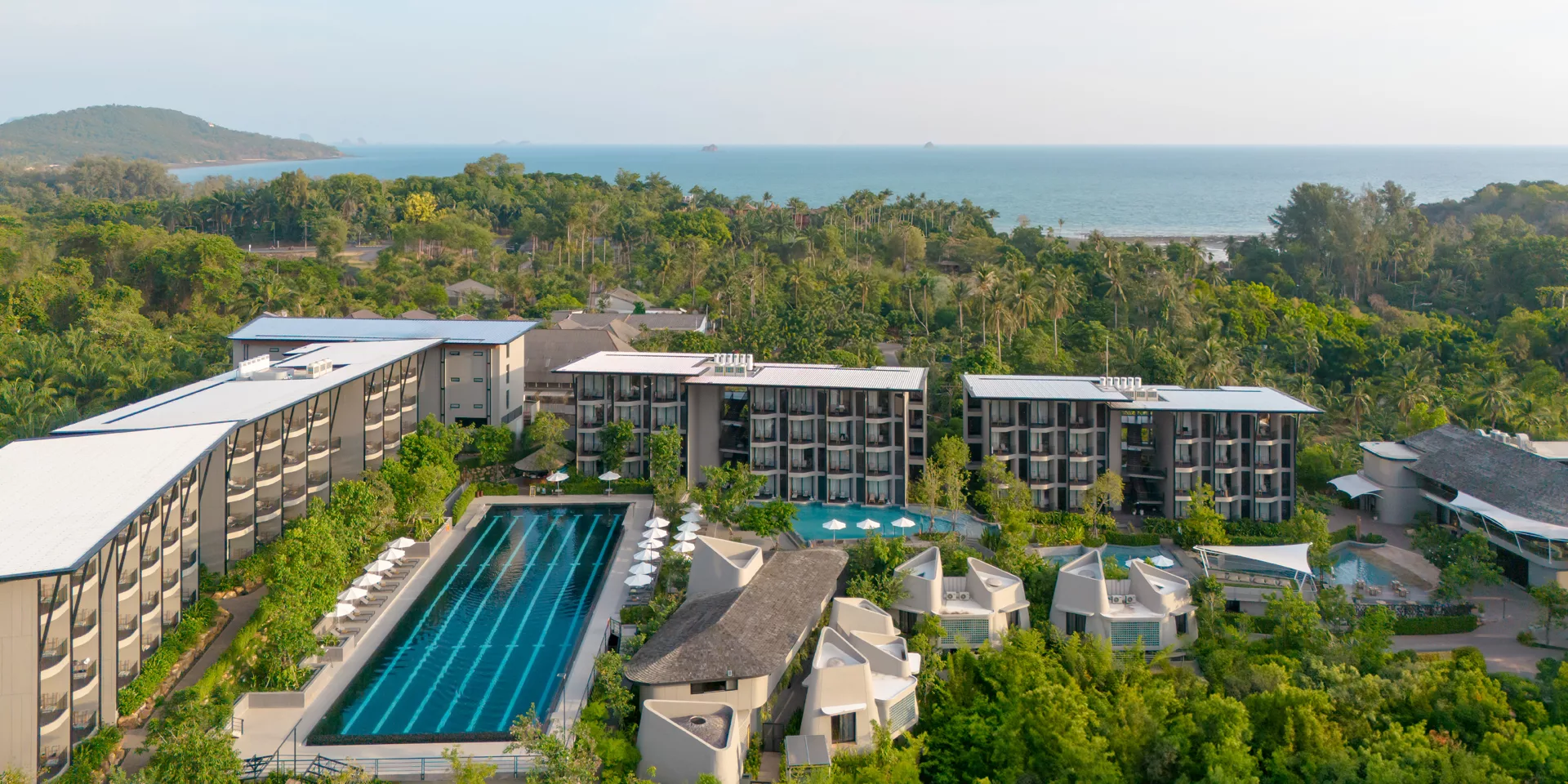
The tower stands at the entrance to Matalay, a resort development. Its function is primarily symbolic: a gateway object that signals the site's engagement with local ecology and heritage. It does not house program in the conventional sense. Instead, it operates as a promenade and viewpoint, a structure whose primary purpose is experiential rather than utilitarian.
Precedents and Parallels
Goya invites comparison with other projects that employ unconventional organic materials. Anna Heringer's METI School in Bangladesh, built with cob and bamboo, demonstrated that low-tech materials could achieve formal sophistication and climatic performance. Francis Kéré's work in Burkina Faso has long utilized compressed earth and laterite, materials abundant in their contexts and requiring minimal processing. In Thailand itself, the Earth Architecture program at Chiang Mai University has documented vernacular techniques using rice husk ash, bamboo, and stabilized earth.
What distinguishes Goya is its unapologetic embrace of a material often dismissed as abject. Dung carries cultural baggage; it is waste, associated with hygiene concerns and low status. By elevating it to the scale of architecture, Premthada forces a reconsideration of material hierarchies. The project does not hide its composition. The bricks retain their coarse texture and fibrous inclusions, visible evidence of their origin.
Limits and Questions
The project raises practical questions. Durability in tropical climates is a concern; organic binders and high humidity can accelerate degradation. The steel armature provides structural support, but the bricks themselves are vulnerable to erosion, insect activity, and mold. Maintenance protocols will determine whether Goya endures as a permanent landmark or functions as a temporary installation, a demonstration rather than a prototype.
There is also the question of scalability. Elephant dung is plentiful in certain contexts but not universally available. The material's viability depends on proximity to elephant populations, which are themselves under threat. If the method were to be adopted more widely, it would require stable, ethical supply chains, a challenge in regions where elephants are endangered or their habitats fragmented.
Finally, there is the symbolic dimension. Does the use of elephant waste honor the animal, or does it instrumentalize it further? Premthada's intent appears to be the former, framing the material as a collaborative output, evidence of a shared ecosystem. But intent does not always align with reception. How the structure is interpreted will depend on who encounters it and under what circumstances.
Circularity, Reimagined
At World Archi Design, we have tracked a growing interest in closed-loop material systems, from mycelium panels to hempcrete to recycled textile composites. Goya contributes to this discourse by proposing that waste streams need not be industrial. Biological byproducts, managed thoughtfully, can enter the architectural supply chain with minimal processing and low environmental cost.
The tower does not solve Thailand's housing crisis or provide a replicable model for mass construction. What it does offer is a provocation: a reminder that material innovation need not always look forward. Sometimes it means looking around, at what already exists, at what has always been there, waiting to be reconsidered.
Photo: Spaceshift studio
Save this story. A free account keeps your reading list and the 07:00 email in one place.
CREATE FREE ACCOUNT →SIGN IN