The Architecture of Absence
There's a particular kind of spatial clarity that emerges when you strip away connectivity. No router humming in the corner, no charging cables snaking across surfaces, no blue glow competing with firelight. Since 2020, Unplugged has been refining this aesthetic, building solar-powered timber cabins designed around a single, radical premise: three nights without your phone, placed within two hours of London or Manchester. The typology is minimal, the program deliberate. Guests arrive, lock their devices in a steel box, accept an emergency Nokia, and spend seventy-two hours with books, maps, board games, and whatever weather the landscape offers.
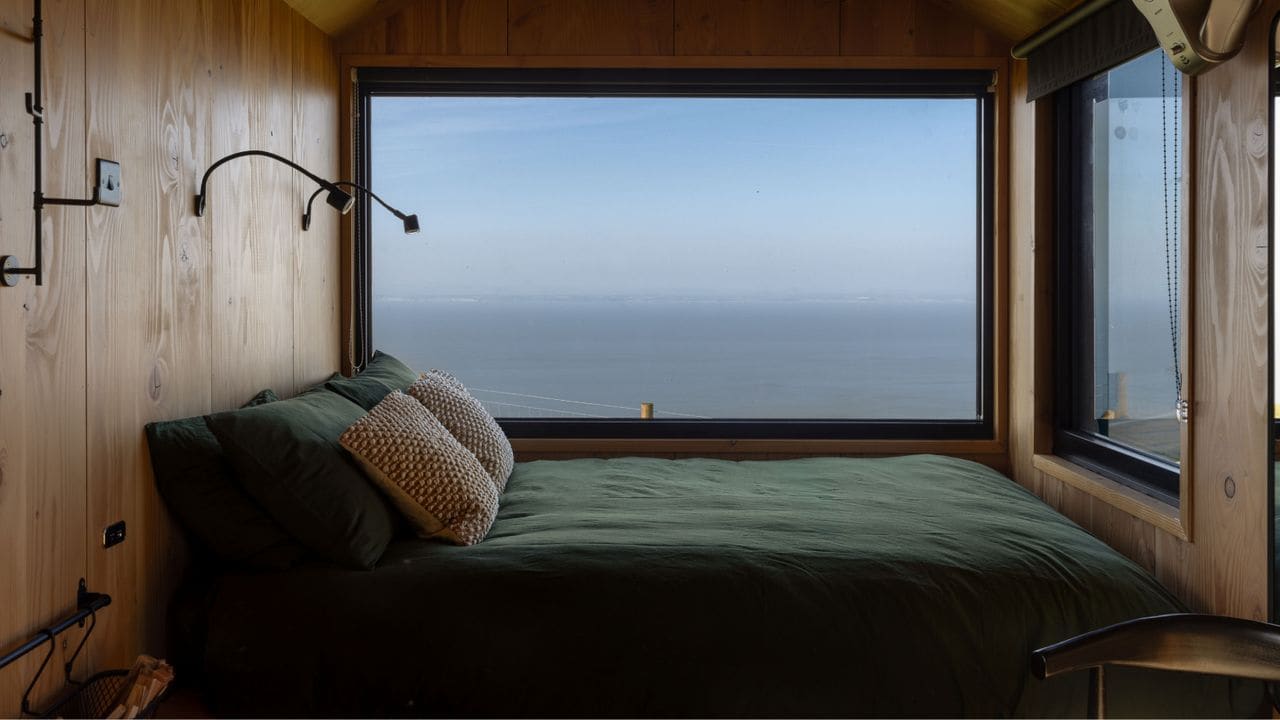
What began as a woodland proposition has now migrated to the coast. Barclay and Wilfred, the brand's first seafront structures, occupy elevated positions above Porlock in Somerset, their fenestration oriented toward open water and the distant line where the Celtic Sea meets the sky. The shift in setting does more than expand the brand's geographic footprint. It tests whether the same spatial and programmatic language, one developed for forest interiors and dappled light, can hold its power when confronted with horizontal vastness and salt wind.
Two Cabins, Two Approaches
Barclay sits at the end of a steep drive and a final uphill hike, a deliberate threshold that separates arrival from access. The effort is rewarded with unobstructed views over the coastline, a vantage point that feels earned rather than given. Wilfred takes a different route, approached through Exmoor National Park via what is reportedly the steepest A-road in the UK. The cabin overlooks the Celtic Sea, its position offering a slightly softer arrival but no less dramatic a prospect.
Both structures follow Unplugged's established material palette: timber cladding, compact footprint, minimal detailing. Inside, the program remains consistent: log burner, hot shower, Piglet in Bed linens, a curated selection of books and analog games, an instant camera. The cabins accommodate one or two guests, are fully enclosed, and welcome dogs. There are no communal spaces, no shared amenities. The model is resolutely individual, built around the assumption that solitude, or at least selective companionship, is a precondition for disconnection.
The design avoids nostalgia. These are not rustic retreats or vernacular reproductions. The cabins are contemporary structures that happen to exclude certain technologies. The aesthetic is closer to the stripped-down pragmatism of early Scandinavian summer houses than to the Arts and Crafts romanticism that often accompanies British rural architecture. Function dictates form, and the primary function here is withdrawal.
Coastal Context and Material Culture
Porlock's geography offers more than scenery. The pebble beaches at Porlock and Bossington provide textured ground rather than sandy expanses, a landscape that asks for boots rather than bare feet. Exmoor National Park frames the cabins within a broader network of trails, including walks at Heddon's Mouth and the Valley of Rocks. The area's topography, its steep gradients and sudden vistas, reinforces the sense of earned access that defines both cabins.
Local infrastructure supports the off-grid experience without undermining it. A wood-fired barrel sauna sits by the water, offering a ritualized form of warmth that aligns with the cabins' low-tech ethos. Seaside pubs and tea rooms provide social nodes, while Locanda on the Weir anchors the dining offer with a menu built around local and foraged ingredients. The surrounding culture, in other words, is sympathetic to the cabins' premise, offering analog pleasures that don't require Wi-Fi passwords or Instagram geotags.
This is not wilderness in the North American sense. It's a managed landscape, centuries old, shaped by agriculture and tourism, crossed by roads and footpaths. The cabins sit within this matrix, not apart from it. The disconnection they offer is selective, a temporary withdrawal rather than a permanent retreat. Guests are unreachable, but not lost.
Designing for Digital Detox
At World Archi Design, we've been tracking the rise of off-grid hospitality for several years, watching as the typology moves from boutique experiment to viable business model. What distinguishes the more successful iterations, Unplugged among them, is a clear understanding of what guests are escaping from and what they're escaping toward. The phone lockbox is not a gimmick; it's a spatial device, a way of externalizing the decision to disconnect so that willpower doesn't have to carry the entire load.
The three-night minimum is equally strategic. One night is too short to adjust; two nights allow adjustment but not immersion. Three nights create the possibility of a different rhythm, one where boredom becomes productive rather than anxious, where the absence of notification becomes normal rather than jarring. The cabins are designed to support this temporal shift. There are no clocks on the walls, no schedules to follow, no checkout times that fragment the day into billable increments.
The material choices reinforce the program. Timber cladding weathers visibly, marking the passage of seasons in a way that glass and steel do not. Log burners require attention, splitting wood and managing airflow, small tasks that anchor time in physical effort. Instant cameras produce single, un-editable images, removing the feedback loop of review and retake that defines smartphone photography. Each element is chosen not for its novelty but for its capacity to slow down interaction, to reintroduce friction into experiences that have been optimized for frictionlessness.
Precedents and Trajectories
Unplugged is not working in isolation. The off-grid cabin typology has precedents in Scandinavia, where summer houses have long functioned as seasonal escapes from urban density, and in the American tradition of the wilderness cabin, from Thoreau's Walden experiment to the contemporary tiny house movement. What differs here is the deliberate foregrounding of disconnection as the organizing principle, not simply a byproduct of remoteness.
The brand's expansion to the coast suggests a broader ambition. If the model works in woodland and above water, it can presumably adapt to other landscapes: moorland, mountain, estuary. The risk, as with any replicable typology, is that scale dilutes specificity. The cabins' power lies partly in their scarcity, their sense of being carved out from a world that defaults to connectivity. If off-grid becomes a category rather than an exception, the experience may flatten into another form of themed accommodation, disconnection as aesthetic rather than practice.
For now, the Somerset cabins feel like a natural evolution rather than a pivot. The views are different, the wind sharper, the light harsher. But the spatial logic remains intact. The cabins are still small, still spare, still oriented around absence as much as presence. Whether that logic can sustain further replication, across more sites and more varied contexts, remains an open question.
The Economics of Unreachability
Three-night stays start at £540 per cabin, a pricing structure that positions Unplugged within the mid-to-upper tier of UK domestic tourism. It's not cheap, but it's also not inaccessible. The cost reflects the cabin's materials, its solar infrastructure, and the land it occupies, but it also reflects the value proposition: in a world where constant availability is the default, being unreachable has become a luxury good.
This raises questions about who gets to disconnect and under what terms. Off-grid hospitality, for all its rhetoric of simplicity and return, is still hospitality, still a market transaction. The guests who can afford three nights in a Somerset cabin are likely the same guests whose jobs and social positions allow them to disappear for seventy-two hours without consequence. Disconnection, in this context, is not a rejection of privilege but an expression of it.
At the same time, the cabins offer something more than escapism. They propose a different relationship to technology, one based on intentionality rather than reflex. The phone lockbox is not a prohibition but a boundary, a way of creating conditions under which other forms of attention become possible. Whether those conditions can be sustained beyond three nights, or translated into daily life, is a question the cabins cannot answer. But they at least pose it, and in doing so, they participate in a larger conversation about what architecture can do when it's asked to design not just for presence, but for withdrawal.
Save this story. A free account keeps your reading list and the 07:00 email in one place.
CREATE FREE ACCOUNT →SIGN IN