The Age Question in Heritage Policy
Most preservation frameworks operate on an unspoken timeline: a building must reach a certain age before it qualifies for legal protection. Fifty years is the common benchmark in many jurisdictions, a temporal buffer meant to separate the "historic" from the merely "old." Yet this threshold, however practical for bureaucratic purposes, creates a paradox. By the time a structure becomes eligible for listing, market pressures, deferred maintenance, or political expediency may have already sealed its fate.
Uzbekistan's recent move to include dozens of modernist buildings from the 1960s through 1980s on its national heritage register upends this calculus. The Panoramic Cinema, Tashkent Circus, and Palace of Peoples' Friendship are now formally recognized alongside older monuments, despite being constructed within living memory. For years, these structures occupied an ambiguous zone: too recent to be considered historic, too Soviet to inspire nostalgia in a post-independence republic seeking new identities.
Modernism's Second Life in Central Asia
Soviet modernism in Central Asia represents a distinct architectural lineage, shaped by both Moscow's centralized planning apparatus and the material realities of seismic zones, extreme climates, and local craft traditions. The buildings that emerged during this period were not simple imports of International Style orthodoxy. Instead, they synthesized precast concrete technology with regional motifs, massive fenestration with deep overhangs for solar control, and monumental massing with pedestrian-scaled public spaces.
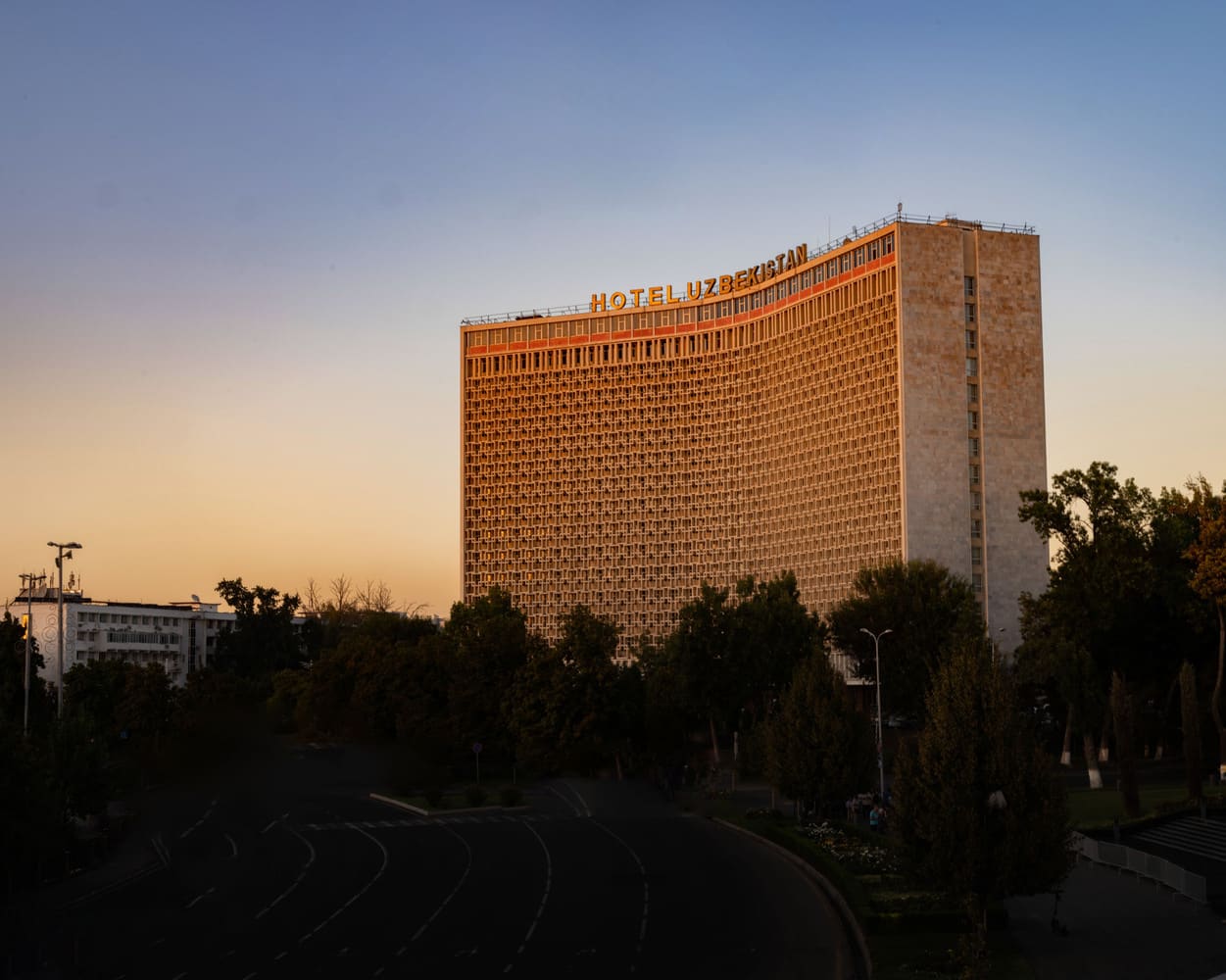
The Hotel Uzbekistan in Tashkent exemplifies this hybridity. Its facade employs a rhythmic grid of concrete brise-soleil, a climatic response as much as a formal gesture. The ground plane opens to arcaded passages reminiscent of the city's historic mahallas, even as the tower asserts a vertical presence typical of mid-century civic architecture. These buildings were designed to signal modernity, progress, and Soviet power, yet they borrowed heavily from vernacular spatial logics that predated the Union by centuries.
At World Archi Design, we've been tracking the reassessment of Cold War-era modernism across the former Soviet republics. While many nations have demolished or neglected these structures, viewing them as uncomfortable reminders of occupation or authoritarianism, Uzbekistan's decision to formalize their protection suggests a more nuanced historiography. The architecture is no longer read solely as ideological imposition but as a layer of the city's tectonic and cultural evolution.
The Dilemma of Recent Heritage
The challenge Uzbekistan confronts is not unique. Heritage systems worldwide struggle with the question of recency. How do you protect what your parents built, when the culture has not yet decided whether it deserves reverence or erasure? The 1960s and 1970s are particularly fraught decades. Brutalism, metabolist megastructures, and late modernist civic centers often lack the popular affection accorded to Art Deco or Victorian architecture. Their materials weather poorly, their spatial ambitions frequently misalign with contemporary urban uses, and their aesthetic is polarizing.
Yet waiting for consensus is a risky strategy. Adaptive reuse is far easier when a building's structural and spatial integrity remain intact. Once demolition begins, or once interiors are gutted for piecemeal renovation, the architectural argument becomes theoretical rather than experiential. The Panoramic Cinema and Tashkent Circus are not abstract case studies; they are active urban spaces with social memory embedded in their concrete and terrazzo.
The formal listing of these buildings accomplishes two things. First, it creates a legal framework that can slow or halt demolition, buying time for public discourse and design intervention. Second, it signals a shift in national narrative: the Soviet period, however contested, is now understood as part of Uzbekistan's architectural patrimony rather than an aberration to be erased.
Precedents and Parallels
Uzbekistan's approach has precedents elsewhere, though few post-Soviet states have moved as decisively. In the Baltics, select modernist structures have received heritage status, but the process remains piecemeal and politically sensitive. Russia itself has been inconsistent, demolishing significant constructivist and modernist landmarks in Moscow while sporadically listing others. The Hotel Druzhba in Yalta, a striking example of Soviet futurism, has faced decades of neglect despite international advocacy.
Western Europe offers a different model. The United Kingdom began listing postwar structures in the 1980s, recognizing the National Theatre and other Brutalist icons well before they reached the fifty-year mark. France has similarly extended protection to grands ensembles and experimental housing projects from the 1960s, reframing them as patrimoine rather than blight. These decisions were not universally popular, but they established a principle: heritage value is not solely a function of age.
What distinguishes Uzbekistan's effort is scale and speed. Rather than listing individual buildings on a case-by-case basis, the country has moved to protect entire cohorts of modernist architecture in a single legislative gesture. This wholesale approach reflects both urgency and confidence, a recognition that the window for preservation is narrow and that the cultural argument has already been won, at least within heritage institutions.
Material and Tectonic Challenges
Protecting Soviet modernism is not simply a matter of legislative will. These buildings present significant material challenges. Precast concrete panels, a hallmark of the era's industrialized construction, are prone to spalling and water infiltration. Curtain walls and metal cladding systems, often proprietary and no longer manufactured, complicate facade restoration. Interior finishes, terrazzo floors, and custom lighting fixtures have frequently been replaced or removed, eroding the spatial coherence that made the buildings legible in the first place.
The Tashkent Circus, with its hyperbolic paraboloid roof and cantilevered seating bowl, is a structural tour de force. But maintaining that geometry requires specialized engineering knowledge and materials compatible with the original construction. Adaptive reuse proposals must balance contemporary performance standards, seismic codes, and accessibility requirements with the preservation of the building's tectonic logic.
This is where heritage listing becomes most valuable. It creates a regulatory environment in which these technical challenges can be addressed systematically, with public funding and expert oversight, rather than left to ad hoc developer decisions. It also opens the door to international collaboration, connecting Uzbek preservation architects with peers in Europe, Asia, and North America who have tackled similar projects.
The Forward Argument
The question Uzbekistan's decision raises is not whether these buildings are old enough to matter, but whether heritage policy should be reactive or anticipatory. Waiting for structures to age into protection is a passive stance, one that assumes cultural value will become self-evident over time. But value is constructed, not discovered. It emerges through scholarship, public engagement, adaptive reuse, and the slow accretion of new meanings.
By listing modernist buildings before consensus has fully formed, Uzbekistan is making a forward argument: that the architecture of the recent past is as worthy of study, debate, and preservation as any other period. This does not mean every 1970s apartment block deserves protection, but it does mean that significance should be assessed on architectural, urban, and cultural terms rather than deferred indefinitely.
The Palace of Peoples' Friendship, with its soaring interior volume and intricate mosaic work, is now a datum in Tashkent's architectural history, not an anomaly awaiting judgment. The Panoramic Cinema, with its cantilevered projection booth and wraparound glazing, is recognized as a spatial experiment, not a relic of a discredited regime.
Across the projects we've covered this year, from postwar housing estates in Europe to metabolist interventions in Japan, a pattern emerges: the buildings that survive are those that receive institutional support early, before the market or public opinion turns decisively against them. Uzbekistan's decision to act now, rather than wait another generation, may be the most pragmatic heritage strategy of all.
Save this story. A free account keeps your reading list and the 07:00 email in one place.
CREATE FREE ACCOUNT →SIGN IN