The Tyranny of the Fixed Programme
Concert halls have spent centuries perfecting a particular kind of rigidity. Programmes announced weeks in advance, seats assigned by row and number, applause timed to the silence between movements. The architecture reinforces this: grand foyers that funnel audiences toward a single moment of collective attention, plush seating that discourages movement, acoustic shells that privilege the stage over everything else. It is a spatial contract designed around the event, not the person.
What happens when you strip that contract away?
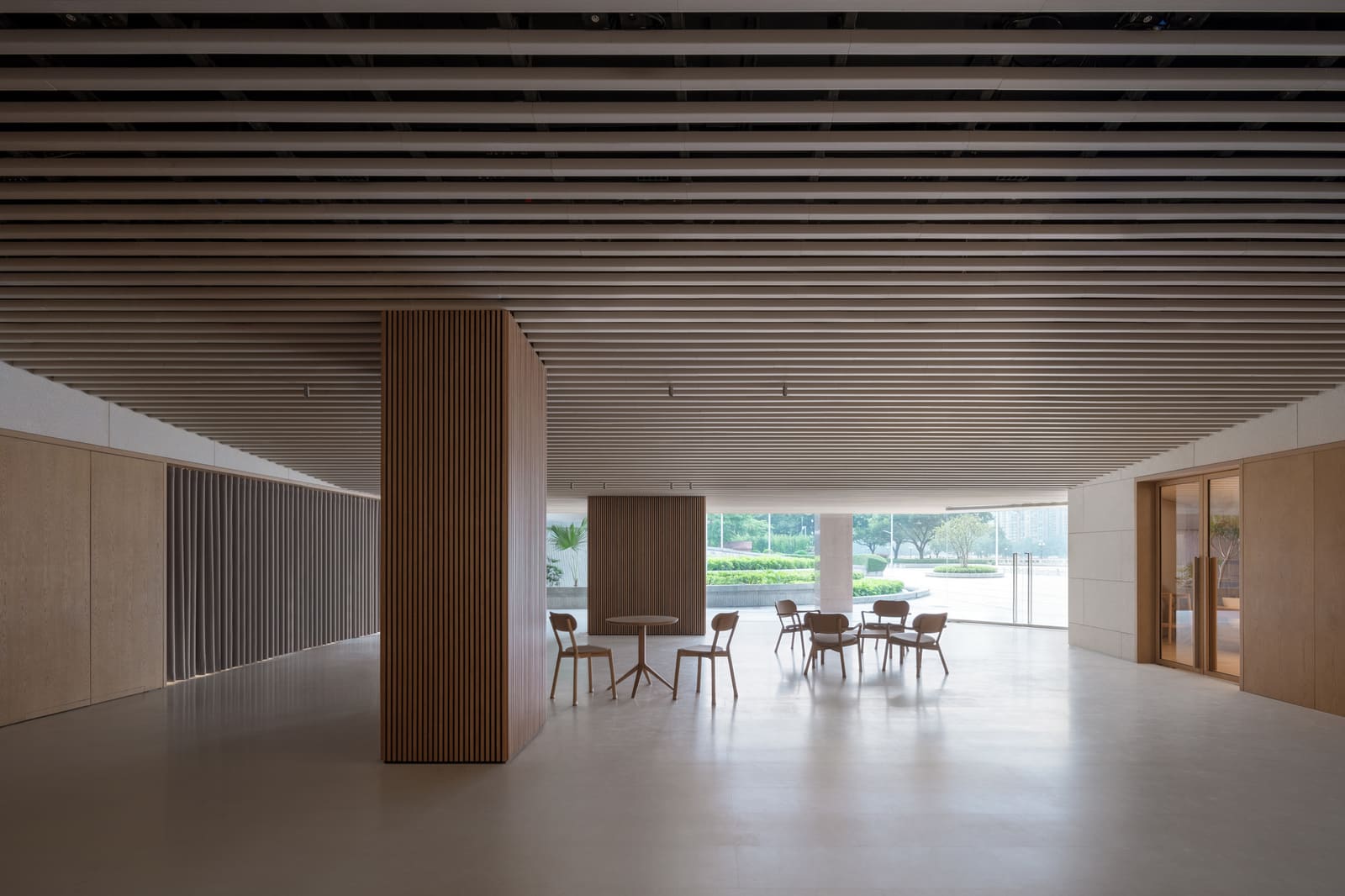
Cold Lab's recent project for Dynaudio in Guangzhou poses exactly this question. Completed in 2025 and spanning 480 square metres, the showroom refuses the premise that high-fidelity listening demands ceremonial distance. Instead, lead architects Zhiwei Ou, Jianxi Lai, and Hongdi Lin have designed a space where sound becomes part of the everyday fabric, not an occasion requiring advanced booking and formal dress.
At World Archi Design, we've been tracking a broader shift in how designers approach acoustic environments. The Dynaudio Lounge represents a quieter rebellion: not against performance itself, but against the assumption that listening must always be orchestrated.
Spatial Fluidity as Acoustic Strategy
The plan abandons the proscenium model entirely. Rather than organizing the interior around a single focal point, Cold Lab distributes listening zones throughout the space, each calibrated for different modes of engagement. Some areas invite prolonged immersion, others accommodate brief encounters. The layout allows visitors to drift between sonic experiences without the pressure of a timed programme or assigned seating.
This fluidity extends to the material palette. Working with Kvadrat textiles, Karimoku wood furnishings, and pieces from Ishinomaki Laboratory, the architects have layered surfaces that absorb, reflect, and diffuse sound in varying degrees. The result is a series of micro-climates, each with its own acoustic signature. Yosemine provided the acoustic engineering, ensuring that these zones remain distinct without bleeding into one another.
The choice of materials speaks to a vernacular of domesticity rather than institutional grandeur. Where concert halls deploy heavy drapery and gilded mouldings to signal cultural capital, the Dynaudio Lounge opts for the tactile warmth of natural wood and woven fabric. It reads less like a temple to high culture and more like a well-curated living room scaled up.
The Politics of Informality
There is something inherently democratic about refusing to fix a programme. When performance schedules dictate access, they also determine who feels welcome. The concert hall's temporal structure, its insistence on punctuality and duration, excludes those whose lives do not align with evening showtimes or weekend matinees. By contrast, a space designed for drop-in engagement lowers the threshold for participation.
Cold Lab's design acknowledges this without grandiosity. The absence of a stage does not signal the absence of intentionality. Instead, the architects have embedded choice into the spatial experience. Visitors decide when to arrive, how long to stay, and where to position themselves. This is not chaos; it is a carefully calibrated openness.
The precedent here is less architectural than social. We might think of the difference between a formal dining room and a kitchen island, between a lecture hall and a seminar table. The Dynaudio Lounge borrows from these more egalitarian typologies, applying their logic to the consumption of sound.
Material Transparency and Acoustic Honesty
One of the more subtle gestures in the project is the visibility of the acoustic infrastructure. Rather than concealing speakers and wiring behind walls and false ceilings, Cold Lab allows elements of the audio system to remain legible. This transparency serves a dual purpose: it demystifies the technology, and it reinforces the showroom's function as a space for learning as much as listening.
The collaboration with Weifang Detai Security Services suggests an attention to the logistics of public access, another nod to the project's commitment to everyday use. Security in a showroom is not merely about protecting inventory; it is about managing flow and ensuring that the space remains welcoming rather than surveilled.
The 2025 completion places the project within a wave of retail and cultural spaces rethinking formality in the wake of prolonged public health restrictions. Audiences have grown accustomed to consuming culture on their own terms, at home, on demand. The challenge for physical spaces is to offer something that justifies the trip without resorting to spectacle.
Beyond the Showroom Model
What Cold Lab has achieved here extends beyond the brief. Yes, this is a showroom for a high-end audio brand, and yes, it must ultimately serve commercial ends. But the design resists the typical showroom grammar of product display and sales pressure. Instead, it proposes a third space, one that borrows from the gallery, the lounge, and the living room without collapsing into any single category.
This hybridity is the project's greatest strength. It refuses to be pinned down, much like the listening experience it facilitates. In a city as dense and fast-paced as Guangzhou, the provision of open-ended, unscripted public space is itself a radical act. The Dynaudio Lounge does not demand that you arrive with a plan; it invites you to wander in and discover what you came for only after you've stayed awhile.
The Unscripted Encounter
We return to the initial provocation: what is lost when every cultural experience must be scheduled? The concert hall's formality is not inherently oppressive, but it does impose a particular relationship between audience and art. The Dynaudio Lounge offers an alternative, one where listening becomes less about the event and more about the encounter.
Cold Lab's work here suggests that high-quality acoustic design does not require the pomp of the concert hall. It requires, instead, a willingness to let go of control, to trust that people will find their own way into the experience. In an era of algorithmic curation and optimized schedules, that kind of trust feels increasingly rare. The Dynaudio Lounge makes a quiet case for its value, one unscheduled visit at a time.
Save this story. A free account keeps your reading list and the 07:00 email in one place.
CREATE FREE ACCOUNT →SIGN IN