The Fixture No One Wants to Design
There exists a curious blind spot in contemporary interiors. Architects and designers will spend weeks debating the tactility of a door handle or the profile of a light switch, yet the toilet remains sequestered in a kind of aesthetic quarantine. It is functional, certainly. Necessary, undeniably. But desirable? That has never been part of the brief. The high end of the market has long been dominated by Japanese manufacturers, whose smart toilets offer heated seats, ambient lighting, and water jets calibrated to surgical precision. What they rarely offer is beauty in the sculptural sense: massing, proportion, the kind of presence that commands a room rather than recedes into it.
Hugo Volpei noticed this gap while standing inside one of London's most photographed bathrooms. The egg-shaped pods at Sketch have become a pilgrimage site for a certain subset of design tourists, their Instagram feeds flooded with images of those gleaming, two-meter-high enclosures. Yet inside each pod sat the same generic white fixture found in a chain hotel or suburban renovation. The architecture was theatrical; the toilet itself was invisible. Volpei began to ask a different question: what if the fixture, not just its housing, could be the protagonist?
From Business School to Bathroom Provocateur
Volpei's route into sanitaryware was anything but conventional. A graduate of HEC, he had shown early entrepreneurial instincts, reselling customized T-shirts as a child and nurturing ambitions of becoming an architect in his teens. Trone emerged from his final-year thesis in 2018, launched without industry contacts or manufacturing connections. His research process began with a Google search: "toilet manufacturing process." The first prototype was modeled by a childhood friend. It was, by any measure, a scrappy beginning.
The brand's inflection point came via Big Mamma, the restaurant group behind some of Europe's most high-traffic hospitality venues. The brief was unforgiving: seven custom toilets in six months. Volpei brought in an engineer to translate sketches into production-ready forms, and the gamble paid off. The client roster has since expanded to include LVMH, Marriott International, and The Berkeley, a trajectory that speaks less to conventional marketing than to the simple fact that the fixtures photograph well and perform a kind of spatial magic: they make people stop, look, and reconsider what a bathroom can be.
A Catalog That Refuses to Whisper
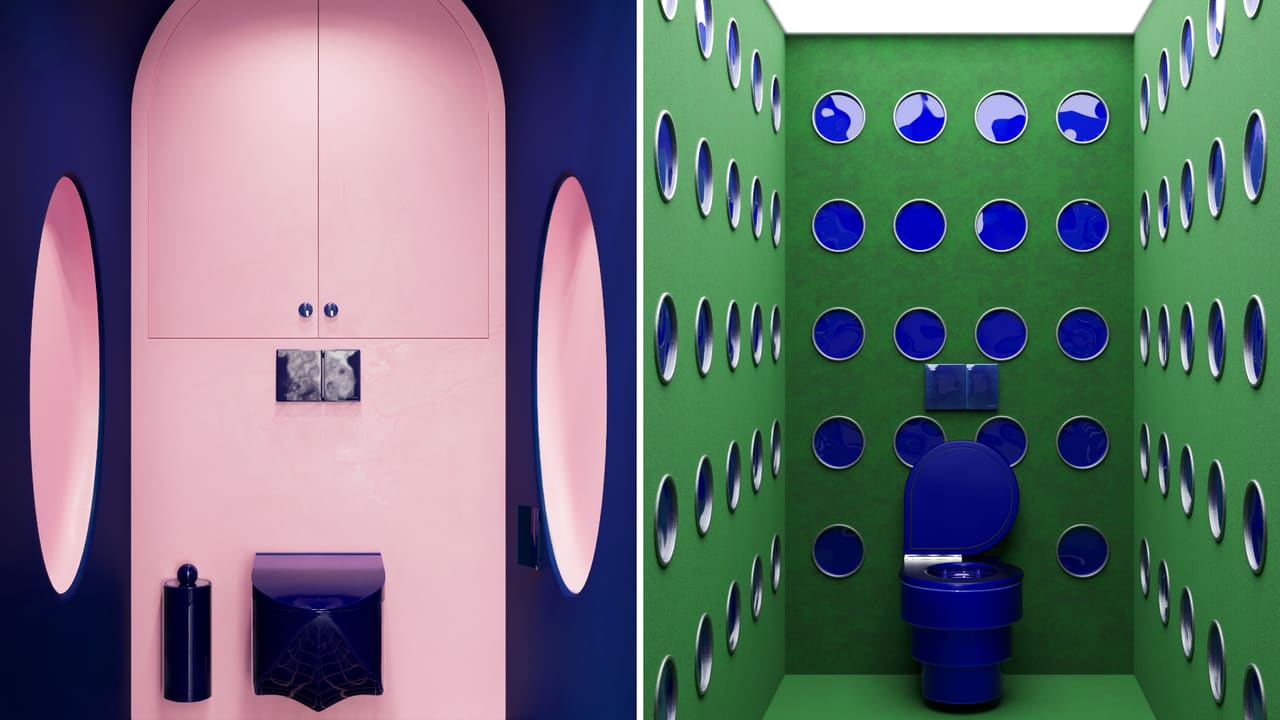
The Trone collection now spans toilets, basins, flush plates, taps, and accessories. The aesthetic toggles between sleek minimalism and unabashed playfulness, with colorways that range from powder pastels to saturated primaries. The forms themselves require a second glance to decode: stepped bowls, asymmetric lids, transparent cisterns that expose the mechanics typically hidden behind porcelain. Three flagship toilet designs anchor the range. Callipyge features amorphous curves and glazed ceramic in saturated hues. Icone pairs a sculptural silhouette with terrazzo-flecked finishes. Altesse, the newest arrival unveiled at Milan Design Week earlier this year, offers Trone's answer to the Japanese smart toilet, but stripped of the over-engineering that has left more than one user in an inadvertent standoff with rogue bidet jets.
With the lid closed, Altesse reads less as sanitaryware and more as a smooth, wall-mounted pod. The technology is present but discreet: a remote tucked behind a ceramic panel, no blinking LEDs or touch-sensitive surfaces fighting for attention. The basins are equally sculptural. Orbe takes the form of a doughnut, its central void framing the drain. Ritual channels water into a funnel-shaped vortex, a gesture that borders on the theatrical but stops short of kitsch.
The Challenge of Making the Mundane Cool
Volpei has observed that in France and across much of Europe, the toilet remains a subject of nervous laughter rather than serious design discourse. Creating desire around an object that has never been positioned as desirable is, he notes, the real challenge. It is also where Trone's strategy diverges from the sanitaryware establishment. The brand name itself translates to "throne." Altesse means "highness." Callipyge is an adjective describing well-shaped buttocks, borrowed from classical sculpture terminology. The humor is intentional, a way of disarming the discomfort that still clings to bathroom design.
This irreverence is not mere branding flourish. It signals a broader shift in how certain designers are approaching the domestic program. For decades, the bathroom has been treated as a service space, a zone of hygiene and efficiency where aesthetics were secondary. Trone's proposition is that even the most utilitarian fixture can carry formal ambition. The toilet does not need to hide. It can be colored, contoured, composed. It can be, in the truest sense, designed.
Precedent and Context
The impulse to elevate the bathroom fixture is not without precedent. In the early twentieth century, manufacturers like Kohler and American Standard introduced colored porcelain and Art Deco detailing, treating the bathroom as a stage for domestic modernity. Later, the Memphis Group and postmodern designers would experiment with pattern and form in sanitaryware, though these remained largely conceptual provocations rather than market products. What distinguishes Trone is its commercial viability. These are not one-off installations or gallery pieces. They are serially produced, code-compliant, and installed in high-traffic hospitality environments where durability matters as much as aesthetics.
The comparison to the Japanese smart toilet is instructive. Brands like Toto and Inax have redefined user experience through technology, but their formal language remains largely consistent: white, streamlined, clinical. Trone inverts that hierarchy. Technology is present but subordinate. Form leads. The result is a fixture that photographs as compellingly as it functions, a distinction that matters in an era where the bathroom has become a space of self-presentation as much as hygiene.
The Bathroom as Canvas
At World Archi Design, we have tracked a growing willingness among architects and interior designers to treat service spaces with the same formal rigor once reserved for living areas. Bathrooms are no longer afterthoughts but opportunities for material experimentation, spatial drama, and yes, even humor. Trone fits squarely within this shift, offering fixtures that refuse to recede into the background. Whether that constitutes good design depends, as always, on context. In a minimalist apartment, a Callipyge toilet in saturated cobalt might read as jarring. In a maximalist hospitality interior, it becomes a punctuation mark, a moment of sculptural surprise.
What is undeniable is that Volpei has identified a niche that larger manufacturers have largely ignored. The market for high-design sanitaryware exists, but it has been underserved, constrained by an industry that prioritizes engineering over aesthetics and treats color as a risky deviation from the safe neutrality of white. Trone's success suggests that there is appetite for something different, for fixtures that embrace rather than apologize for their presence.
Where the Throne Sits Now
The brand's trajectory raises questions about where bathroom design might head next. If the toilet can be sculptural, what about the bidet, the urinal, the shower drain? Trone's catalog already includes flush plates and taps, each treated with the same formal attention as the flagship toilets. The logic, once established, can extend to every element of the bathroom program. Whether other manufacturers follow suit remains to be seen. The sanitaryware industry is notoriously conservative, with long production cycles and risk-averse distribution channels. Trone's model, nimble and design-forward, may prove difficult to replicate at scale.
For now, the brand occupies a particular position: too playful for the corporate specification market, too polished for the avant-garde fringe. It appeals to clients who want something that photographs well, performs reliably, and sparks conversation. In hospitality, where bathrooms have become Instagrammable destinations in their own right, that combination holds real value. Whether it translates to the residential market, where budgets are tighter and tastes more conservative, is another question entirely.
What Volpei has demonstrated is that the toilet, long relegated to the margins of design discourse, can hold its own as sculptural object. It can be colored, contoured, and yes, even cool. Whether that makes it worth spending a penny on is, ultimately, a question of priorities. But for those willing to treat the bathroom as seriously as the living room, Trone offers a compelling case that even the humblest fixture deserves a moment in the spotlight.
Credit: Trone
Save this story. A free account keeps your reading list and the 07:00 email in one place.
CREATE FREE ACCOUNT →SIGN IN