The Claim: A Style for the Liberal Century
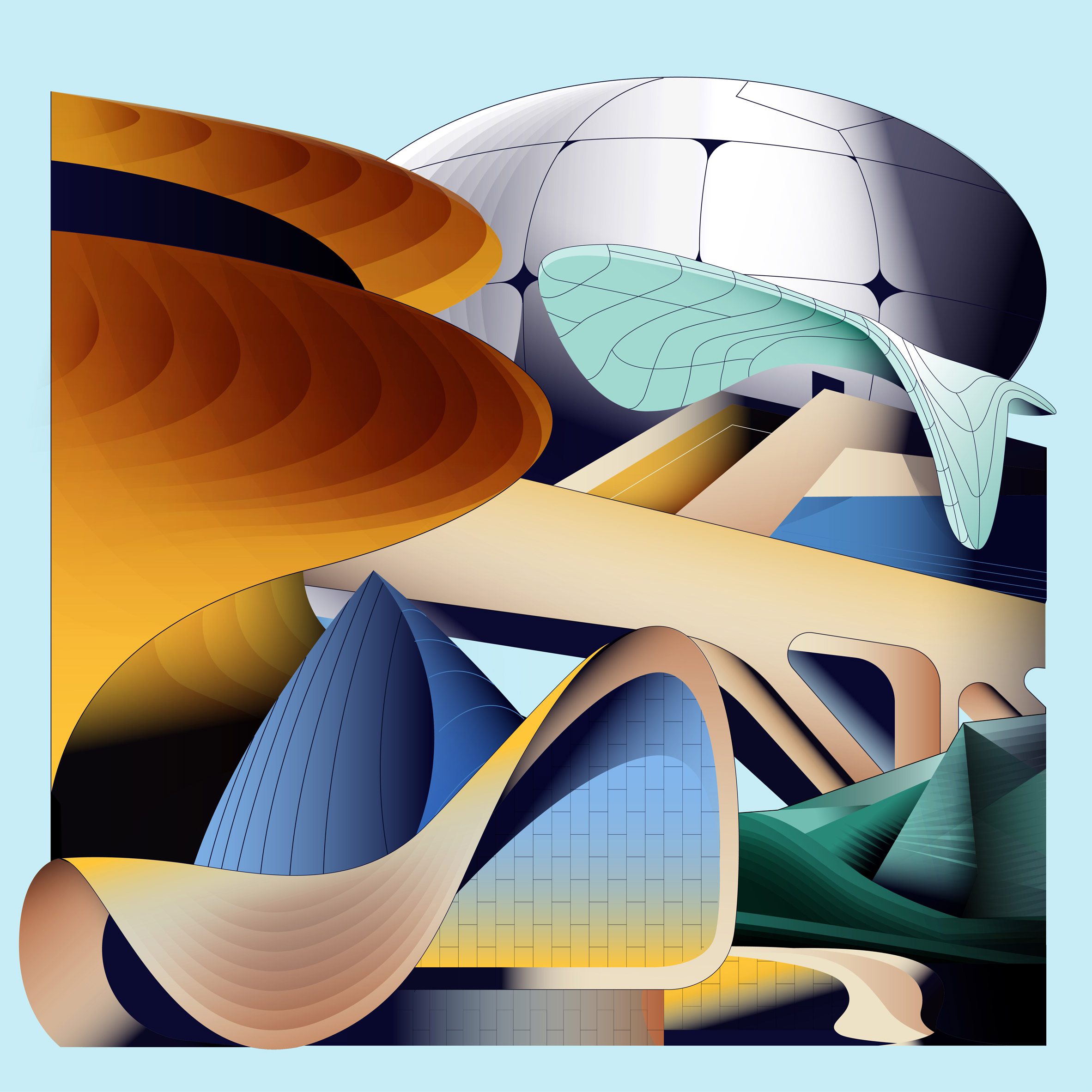
What does it mean for an architectural theory to declare itself the defining idiom of an entire era? Parametricism—coined by architect Patrik Schumacher in the mid-2000s—has done precisely that, framing its algorithmic curves and data-driven morphologies not merely as aesthetic preference but as the spatial embodiment of liberalism itself. Across the projects we've covered this year, from Zaha Hadid Architects' sinuous museums to the proliferation of script-generated facades in Asia, parametricism's signature vocabulary—differentiation, correlation, systemic articulation—has moved from avant-garde provocation to recognizable lingua franca. Yet the theory's reach raises a question: can a design philosophy claiming universality survive the ideological contradictions of the century it seeks to define?
Parametricism emerged at the confluence of computational design tools (Grasshopper, Rhino scripting) and neoliberal urbanism, positioning itself as architecture's response to complexity, networked economies, and fluid social relations. Its proponents argue that the style's non-repetitive, differentiated surfaces mirror the variability of contemporary life—every panel unique, every joint calibrated to structural and environmental data. Critics, however, see in its undulating geometries a technocratic spectacle divorced from materiality, labor, and the vernacular conditions that shape most of the built world.
The Architect's Paradox: Too Fast, Too Slow
In a recent conversation, Schumacher himself revealed an unexpected ambivalence. The architect behind Zaha Hadid Architects' most iconic projects expressed dissatisfaction with the pace of parametricism's adoption—not because it's too slow, but because its formal vocabulary is being deployed without the theoretical rigor he insists is essential. For Schumacher, parametricism is not a skin-deep aesthetic but a comprehensive design ontology, requiring practitioners to abandon orthogonal grids, repetitive modules, and Cartesian spatial hierarchies entirely. What troubles him is the emergence of "parametric-lite" work: buildings with organic facades layered over conventional planning, or algorithmically generated ornament applied as cladding rather than integrated into structural logic.
This tension mirrors a broader pattern in architectural discourse. Styles often lose their ideological coherence as they scale—consider how postmodernism's ironic historicism devolved into pastiche, or how high-tech's structural expressionism became developer-friendly curtain walls. Parametricism's risk is similar: its computational tools are now accessible enough for widespread adoption, yet its theoretical demands (continuous differentiation, systemic articulation of all elements from urban scale to detail) remain intellectually and economically prohibitive for most projects.
Precedent: From Baroque to Blob
Parametricism's formal language—smooth, warped surfaces; non-repetitive patterns; topological continuity—invites comparison with Baroque architecture's dynamic geometries and integrated ornament. Both privilege visual complexity and spatial flow; both emerged during periods of technological expansion (calculus and perspective in the 17th century, computational design in the 21st). Yet where Baroque served ecclesiastical and absolutist power, parametricism positions itself as the architecture of liberal pluralism.
More immediately, parametricism descends from the "blob" architecture of the 1990s—Greg Lynn's embryological forms, Asymptote's fluid interiors—but claims to transcend it through systematic rigor. Where blobs were often singular formal gestures, parametricism insists on multi-scalar coherence: the same algorithmic logic should govern urban massing, facade articulation, and interior details. Projects like Zaha Hadid Architects' Heydar Aliyev Center in Baku (2012) exemplify this ambition, with continuous surfaces folding from plaza to roof, unifying structure, envelope, and landscape. Yet such projects also expose parametricism's dependence on monumental programs and authoritarian clients—hardly the pluralist liberalism the theory claims to represent.
Material Realities and Digital Abstractions
Parametricism's emphasis on digital workflows—scripts generating form, CNC fabrication translating files to physical components—has reshaped construction logistics. Complex geometries once prohibitively expensive are now feasible through robotic milling, 3D printing, and mass-customized panelization. Yet this computational fluency can obscure material constraints. Parametric facades often rely on high-embodied-carbon materials (aluminum, composites) and labor-intensive assembly, raising sustainability questions the theory rarely addresses.
Moreover, parametricism's anti-orthogonal ethos can create spatial ambiguities. In conventional Cartesian planning, walls, floors, and ceilings establish clear boundaries; parametric interiors, with their warped surfaces and ambiguous thresholds, can disorient as much as they delight. This is not inherently negative—spatial ambiguity has long been a tool for challenging norms—but it does complicate the theory's claim to universal applicability. Not every program benefits from continuous differentiation; sometimes repetition and legibility serve users better than algorithmic novelty.
The Discourse Gap: Theory vs. Practice
At World Archi Design, we've observed a widening gap between parametricism's theoretical literature and its built manifestations. Schumacher's writings—dense with jargon borrowed from systems theory and Niklas Luhmann's sociology—position parametricism as a totalizing worldview, applicable to everything from housing to infrastructure. Yet most built examples remain cultural institutions (museums, performing arts centers) or corporate headquarters—monumental commissions where formal experimentation is bankrolled by prestige or state capital.
The theory's application to everyday typologies—schools, clinics, social housing—remains scarce. This is partly economic: algorithmic design requires skilled labor and computational resources; differentiated components cost more than standardized ones. But it's also ideological. Parametricism's emphasis on differentiation and elite authorship (the architect as algorithm-master) sits uncomfortably with participatory design processes or low-tech, incremental construction methods common in the Global South.
Cultural Context: Liberalism's Spatial Grammar?
The claim that parametricism embodies "the architecture of liberalism itself" warrants scrutiny. If liberalism prizes individual autonomy, pluralism, and market flexibility, does parametricism's formal language—fluid, differentiated, non-hierarchical—truly reflect those values? Or does its reliance on opaque algorithms and expert authorship contradict liberal transparency?
One could argue that parametricism's anti-typological stance (rejecting standardized building types in favor of bespoke solutions) aligns with neoliberal market logic, where everything is customizable and nothing is universal. Yet liberalism also depends on shared institutions, legible public spaces, and accessible built environments—qualities not obviously served by architecture that privileges visual complexity over spatial clarity.
Historically, architectural styles have rarely mapped cleanly onto political ideologies. Modernism claimed to be the architecture of democracy, yet served fascist and socialist regimes alike. Parametricism's liberal pretensions may prove similarly contingent, its forms adaptable to whatever power structures commission them.
The Question of Legacy
Whether parametricism becomes the defining style of the 21st century—as Schumacher predicts—or remains a niche idiom dependent on specific technological and economic conditions, its influence on architectural discourse is already undeniable. It has normalized computational design workflows, expanded the formal repertoire available to practitioners, and provoked necessary debates about the relationship between digital tools and tectonic expression.
Yet its theoretical ambitions may ultimately limit its reach. A style that demands total systemic coherence, rejects typological precedent, and requires algorithmic fluency will struggle to become vernacular. Architecture's most pervasive idioms—whether Georgian terraces or modernist housing blocks—succeeded not through theoretical purity but through adaptability, economy, and ease of replication. Parametricism's anti-repetitive ethos, by definition, resists such scalability.
What we may be witnessing is not the emergence of a universal style but the fragmentation of architectural culture into parallel practices: one computational and elite, the other pragmatic and incremental. If parametricism defines the 21st century, it will likely do so the way Beaux-Arts defined the 19th—as the language of monumental exceptions, not everyday life.
Save this story. A free account keeps your reading list and the 07:00 email in one place.
CREATE FREE ACCOUNT →SIGN IN