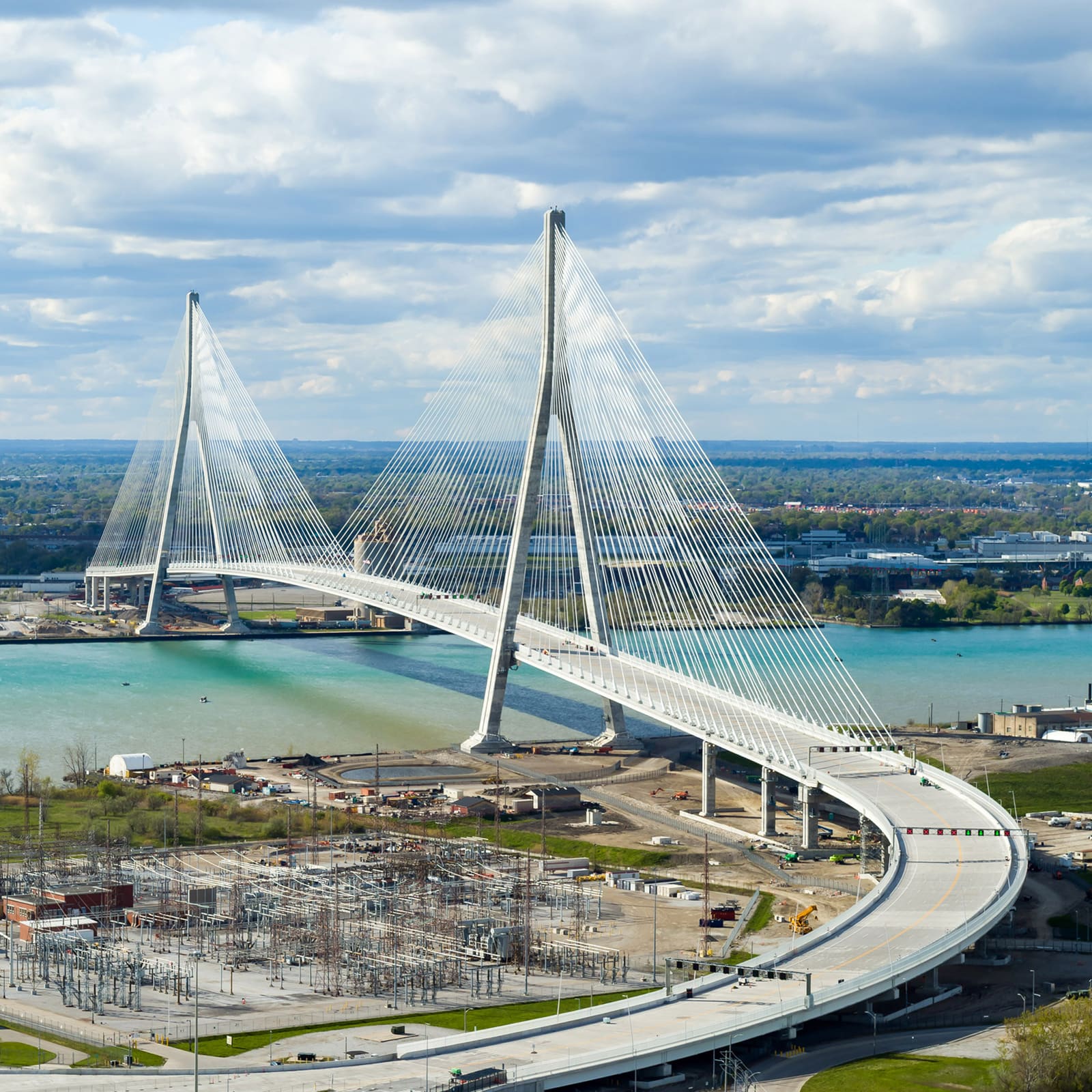
The Gesture Frozen in Steel
There is a particular kind of ambition that reveals itself not in ornament but in restraint. The Gordie Howe International Bridge, which opened to public traffic in late July 2026, demonstrates this principle across 720 feet of vertical reach. Its twin towers, designed by AECOM under the direction of bridge architect Erik Behrens, trace an arc meant to evoke the sweep of a hockey stick mid-slapshot, a reference to the Canadian-born Detroit Red Wings legend whose name the structure bears. But where a slapshot is violent and swift, the bridge is patient, almost delicate in its profile against the Detroit River.
The span connects Detroit to Windsor, Ontario, the first new crossing between Michigan and Ontario in more than six decades. According to the Windsor-Detroit Bridge Authority, which coordinated the project, the main span is now the longest of any cable-stayed bridge in North America. What strikes the eye, however, is not simply scale but the apparent weightlessness of the deck as it hangs from a network of stay cables. Behrens has described the aesthetic appeal as lying in the "extreme slenderness" of the gently curving deck, which together with the cables creates an impression of transparency. It is a tectonic language that speaks to precision rather than mass, to tension rather than compression.
At World Archi Design, we have long observed that the most compelling infrastructure projects are those that negotiate not only physical geography but also the symbolic and political landscapes they inhabit. The Gordie Howe Bridge is a case study in both.
Spanning a Trade Corridor and a Diplomatic Rift
The bridge stretches across the Detroit River, linking two cities that together form one of the busiest trade corridors in North America. The project includes six bridge lanes, 16 toll lanes, and a total of 60 inspection lanes split between Canadian and US border facilities. A toll-free multi-use pedestrian path runs the length of the span, a gesture toward civic access that is increasingly rare in mega-infrastructure.
The scale of the border inspection facilities reflects the economic weight of the crossing. The Windsor-Detroit Bridge Authority has stated that the project now includes the largest ports of entry along the Canada-US border. This is not merely a bridge; it is a logistical apparatus designed to process the flow of goods, vehicles, and people at a pace that matches the demands of contemporary trade.
Yet the opening of the bridge has been anything but smooth. Planning began in the 2000s, and construction took more than seven years. But the final months leading up to the opening were marked by diplomatic friction. In 2026, US President Donald Trump attempted to block the bridge's opening, demanding that Canada hand over additional ownership of the structure to the United States. The bridge is currently jointly owned by Canada and the State of Michigan, though Canada agreed to finance the construction. Under the original 2012 crossing agreement, toll revenues were to flow to Canada once the debt had been recouped. Trump's intervention and threats of tariffs forced a renegotiation of the deal structure, and Canada subsequently disinvited the United States from the official opening ceremonies held on July 24, 2026. The Windsor-Detroit Bridge Authority, however, remained committed to opening the bridge to traffic on July 27, and it has since been in use.
This episode underscores a recurring tension in cross-border infrastructure: the project may be technical, but its realization is always political. The bridge is a physical object, but it is also a treaty, a revenue stream, and a symbol of sovereignty.
The Tectonic Language of Slenderness
From a design perspective, the Gordie Howe Bridge belongs to a lineage of cable-stayed spans that prioritize visual lightness. The towers, which rise to 220 meters, are among the tallest structures in the Detroit-Windsor region. Their gentle curve is not merely decorative; it is a formal strategy that softens the vertical mass and integrates the towers into the horizontal sweep of the deck.
Cable-stayed bridges have become the dominant typology for long spans over the past half-century, largely because they offer a balance between structural efficiency and aesthetic clarity. Unlike suspension bridges, where the deck hangs from cables draped over towers, cable-stayed bridges use cables that run directly from the towers to the deck, creating a more direct load path. This allows for a thinner deck and a more transparent profile, qualities that AECOM has exploited in this project.
The design also recalls precedents such as the Millau Viaduct in France, designed by Foster + Partners and structural engineer Michel Virlogeux, which similarly emphasized slenderness and the visual dissolution of mass. In both cases, the goal is not to dominate the landscape but to inhabit it with minimal disruption. The Gordie Howe Bridge achieves this through its restrained color palette, its avoidance of decorative flourishes, and its reliance on the inherent geometry of the cable-stayed system.
The reference to Gordie Howe's slapshot is subtle, perhaps too subtle to be legible to most users of the bridge. But it functions as a parti, a conceptual anchor that informed the tower design. This is a common strategy in infrastructure projects, where the scale and complexity of the work can make it difficult to impose a coherent formal idea. The slapshot becomes a mnemonic device, a way of organizing decisions about curvature, proportion, and rhythm.
Infrastructure as Civic Space
The inclusion of a toll-free pedestrian and cyclist path is one of the more progressive aspects of the project. In an era when infrastructure is often designed exclusively for vehicular traffic, the decision to provide a dedicated multi-use path signals a recognition that bridges can serve as civic spaces, not merely conduits for commerce.
This is not a new idea. The Brooklyn Bridge, completed in 1883, included an elevated pedestrian promenade that quickly became one of New York's most beloved public spaces. More recently, the Øresund Bridge connecting Denmark and Sweden has become a symbol of regional integration, in part because it accommodates multiple modes of transit. The Gordie Howe Bridge follows this tradition, though it remains to be seen whether the path will be used primarily by recreational cyclists or by commuters seeking an alternative to vehicular crossing.
The pedestrian path also raises questions about the experience of crossing. A bridge is not simply a means of getting from one place to another; it is a spatial event, a moment of suspension between two territories. The Gordie Howe Bridge, with its length and its elevation, offers users an extended view of the Detroit River and the industrial landscapes on either side. This is a different kind of crossing than the utilitarian tunnel or the congested highway. It is slower, more deliberate, and more open to observation.
The Political Life of Mega-Infrastructure
The diplomatic turbulence surrounding the bridge's opening is a reminder that infrastructure projects of this scale are never purely technical. They are shaped by financing agreements, international treaties, and the shifting priorities of elected officials. The Gordie Howe Bridge was conceived as a binational project, a symbol of cooperation between the United States and Canada. But the final months before its opening revealed the fragility of that cooperation.
The renegotiation of the toll revenue agreement is particularly significant. Infrastructure financing is often structured as a long-term bet: a government or consortium fronts the capital costs, then recoups the investment through tolls or other user fees over a period of decades. The original 2012 agreement between Canada and Michigan reflected this logic, with Canada assuming the financial risk in exchange for future toll revenues. Trump's intervention disrupted this arrangement, forcing a renegotiation that may alter the economic calculus of the project.
This is not an isolated case. Across the world, infrastructure projects are increasingly subject to political renegotiation. In Italy, the collapse of the Morandi Bridge in Genoa in 2018 led to a lengthy legal and political battle over responsibility and compensation, culminating in a 12-year prison sentence for the former head of the country's motorway operator. In Finland, the completion of the country's longest bridge in Helsinki proceeded without major controversy, but only because the project was entirely domestic. Cross-border projects, by contrast, are always vulnerable to shifts in diplomatic relations.
What Comes Next
The Gordie Howe Bridge is now open, and it will likely serve as a critical artery for trade and travel between the United States and Canada for decades to come. But its opening also raises questions about the future of cross-border infrastructure. Will the diplomatic tensions that surrounded this project become more common as nations reassert control over their borders? Will the financial model that made this bridge possible remain viable in an era of rising construction costs and uncertain toll revenues?
For architects and engineers, the Gordie Howe Bridge offers a case study in the challenges of designing at the intersection of politics, economics, and physical geography. It is a reminder that infrastructure is never neutral, that every bridge is also a negotiation, and that the most enduring structures are those that can adapt to the changing demands of the societies they serve.
The bridge's slender profile and restrained detailing suggest a design philosophy that values clarity and efficiency over monumentality. This is an approach that aligns with contemporary trends in infrastructure design, where the goal is not to impose a singular vision but to create systems that are resilient, adaptable, and open to multiple uses. Whether the Gordie Howe Bridge will be remembered as a triumph of binational cooperation or as a symbol of diplomatic friction remains to be seen. For now, it stands as a testament to the enduring power of infrastructure to shape the landscapes we inhabit and the connections we maintain.
Credit: Windsor-Detroit Bridge Authority
Save this story. A free account keeps your reading list and the 07:00 email in one place.
CREATE FREE ACCOUNT →SIGN IN