Project Info
Project Name: Photography Seoul Museum of Art (Photo SeMA)
Location: Dobong-gu, Seoul, South Korea
Architects: Jadric Architektur (Austria) + 1990uao (Korea)
Client: Seoul Museum of Art (SeMA)
In Seoul’s northeastern district of Dobong-gu, a new cultural landmark has quietly but powerfully made its presence felt. The Photography Seoul Museum of Art — officially opened on May 29, 2025 — stakes out Chang-dong as a growing node in the city’s cultural map. Designed by the Viennese firm Jadric Architektur in collaboration with Korean studio 1990uao, this is Korea’s first public museum dedicated solely to the medium of photography.

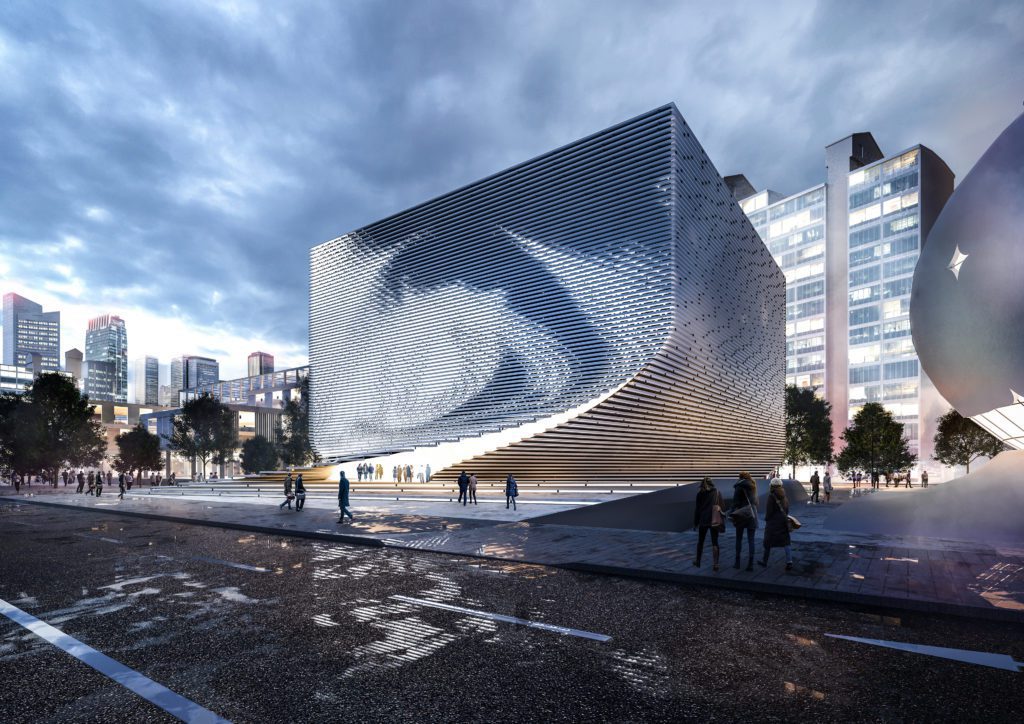
A monolithic façade of horizontal bands captures light and shadow, echoing photography’s art of framing
An Architecture That Frames Light, Movement, and Memory
Much more than a container for exhibitions, the building itself becomes part of the story. Occupying about 7,048 square meters across six levels (four above ground, two below), the museum twists and shifts in form, a play on volume that seems to freeze a moment like a photograph in architectural form.
Wrapped in precast concrete panels laid in horizontal bands that change subtly with angle and lighting, the façade is both monolithic and kinetic. The design references the iris of a camera, the way a lens frames, opens and closes, responds to light. This metaphor is not only literal but experiential: as visitors move around the building, the forms shift, light and shadow play, surfaces reveal different textures — much like discovering nuance in a photographic print.
At street level, a sweeping concrete canopy shelters a generous, glazed foyer. Grand steps and a stepped plaza knit the architecture into its urban context, inviting people not only to enter, but to linger. The building as “walk-in object” is a deliberate gesture toward social space — both public and introspective, collective and private.

By night, the twisting volume becomes a sculptural lens, grounding Dobong-gu’s cultural landscape
Interior Spaces: Between Archive, Exhibition, and Reflection
Inside, the program is as layered as the exterior. There are four exhibition halls, plus a photo library, educational rooms, a darkroom, and storage vaults (one for still images, another for moving images).
The spatial order supports both the historical and the experimental. The inaugural displays include “The Radiance: Beginnings of Korean Art Photography”, showcasing seminal works from the 1920s through the 1990s by masters such as Jung Hae-chang, Lim Suk Je, Lee Hyung-rok, Cho Hyun-du, and Park Young-sook. At the same time, “Storage Story” invites contemporary artists to reflect on the museum itself — its archive, its structure, its identity.
Lighting is engineered deliberately — filtered, nuanced, sometimes direct, often diffused — to support photographic display and to encourage moments of introspection. The “white cube” flexibility is maintained, yet many spaces recall photographic darkrooms — in tone, in sloped surfaces, in how volumes are shaped.

Storage Story” sets the tone—an archive brought alive through light, space, and reflection
Culture, Access, and Context: More Than Just Buildings
This museum does more than fill a gap in Seoul’s cultural institutions; it carries a social purpose. Operated as part of Seoul Museum of Art (SeMA), Photo SeMA joins a network of branches and spaces working to bring art, archive, and community together.
With over 20,000 works and archival materials, the collection gives a deep view into photography’s roots in Korea — its early formal experiments, its documentary impulse, its evolving relationship to urbanization and modernity.
Moreover, the museum offers free admission to many programs, education, workshops, and public events. Its architects and curators envision not a distant monument, but a living space — for learning, for reflection, for both locals and visitors.

Darkroom-like galleries frame both history and experiment, turning looking into an experience
Why It Matters
Photo SeMA is significant in a few overlapping registers:
- Historically, it cements photography as a central art form in Korea’s public cultural identity.
- Architecturally, it shows how design can capture and amplify what is at stake in a medium defined by light, exposure, framing, and duration.
- Culturally, it marks a commitment to making art accessible, archivally deep, and socially alive—in Dobong-gu, far from the glamor of downtown, signaling decentralization of Seoul’s cultural infrastructure.
- Experientially, visiting Photo SeMA is not just seeing art; it’s engaging in a choreography of light and space, where architecture enhances the meaning of what is shown.
In building Photo SeMA, Jadric Architektur and 1990uao have provided Seoul with more than a museum — they’ve given it a sculptural lens through which to see its past, present, and future. In an era saturated with screens and instantaneous images, this museum invites us back into light, texture, pause, and the slow, considered art of looking.
Save this story. A free account keeps your reading list and the 07:00 email in one place.
CREATE FREE ACCOUNT →SIGN IN