Project Info
Project Name: Monologue Café
Location: Gangwon-do, South Korea
Architects: SOSOKKI ANAC
Technical Team: WA20 Architects
General Contractor: Starsis
Landscape Architecture: Natural space
In the forested hills of Hongcheon, South Korea, a new café emerges not as a building, but as a relic - something that feels unearthed rather than constructed. Designed by SOSOKKI ANAC, Monologue Café is conceived as an architectural fiction: a fragment of a lost civilization, suspended between past and present.

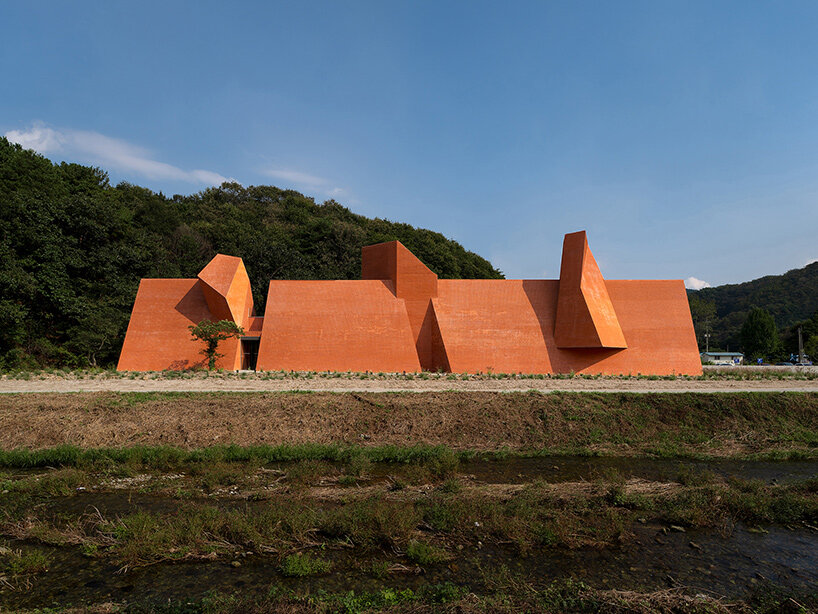
The monolithic mass of Monologue Café rises from the forested hills of Hongcheon like a relic of a forgotten civilization, its fortress-like geometry appearing carved rather than constructed
At the heart of the project lies a speculative narrative. The architects imagine a world reset where traces of an ancient monastery remain embedded in the earth. This premise shapes the café into a monolithic mass, evoking the solemnity and permanence of a fortress or ruin. Rather than presenting a single façade, the structure unfolds gradually, shifting in form as visitors move around it, like a story revealed in fragments. Its heavy geometry resists immediate comprehension, encouraging a slower, more deliberate reading of space.

Sharp, angular volumes intersect to create a sculptural composition, where each edge and shadow reinforces the café’s sense of weight, permanence, and quiet monumentality
The architectural language draws from stratification and memory. Folded brick planes and sharply defined volumes suggest layers of time compressed into a single object - an idea that transforms the building into a physical archive. The reference to defensive walls and ancient fortifications is unmistakable, yet abstracted, allowing the structure to feel both familiar and otherworldly. It stands firmly rooted in the landscape, as if shaped by geological forces rather than human hands.

Textured brick surfaces evoke layers of sediment and time, transforming the envelope into a tactile archive that suggests both erosion and endurance

A bold, angular brick mass emerges from the landscape, its sculpted planes catching the light while narrow openings punctuate the solid, fortress-like façade
Inside, the atmosphere is deliberately restrained. Eschewing overt commercial aesthetics, the café borrows from monastic architecture - quiet, contemplative, and grounded in material presence. Light enters through bold triangular apertures, cutting through the thick walls and framing curated views of the surrounding forest. These openings act as moments of pause, where nature becomes a living canvas that shifts with time, weather, and season.

Inside, the café adopts a monastic calm - minimal, dimly lit, and grounded in raw materiality, encouraging slow movement and introspection

Triangular openings puncture the thick walls, allowing natural light to slice into the interior while framing controlled views of the surrounding forest

As sunlight shifts throughout the day, sharp beams and deep shadows animate the interior, turning the architecture into a dynamic interplay of light and mass
Circulation through the building is equally intentional. Visitors move through a sequence of compressed and expanded spaces, where shadow and light alternate to heighten sensory awareness. Each turn reveals a new perspective, sometimes inward toward textured surfaces, sometimes outward toward the landscape, creating a rhythm that echoes the act of wandering through ancient ruins.

Monologue reads as an architectural artifact - an imagined remnant of a lost monastery, inviting visitors to inhabit a story shaped by memory, time, and landscape
More than a café, Monologue is envisioned as a total work of art. Architecture, interior design, branding, and visual storytelling converge into a singular narrative, guided by architect Gi-tae Chung. Every element contributes to the illusion of a discovered artifact, blurring the line between fiction and reality.
In an era where cafés often compete through visual spectacle or trend-driven design, Monologue offers something quieter yet more enduring. It positions architecture not as a backdrop, but as the protagonist - an immersive, almost archaeological experience that invites visitors to slow down, reflect, and inhabit a story carved in mass and memory.
PHOTO CREDIT: Seokgue Hong
Save this story. A free account keeps your reading list and the 07:00 email in one place.
CREATE FREE ACCOUNT →SIGN IN