When Industrial Heritage Resists the Wellness Aesthetic
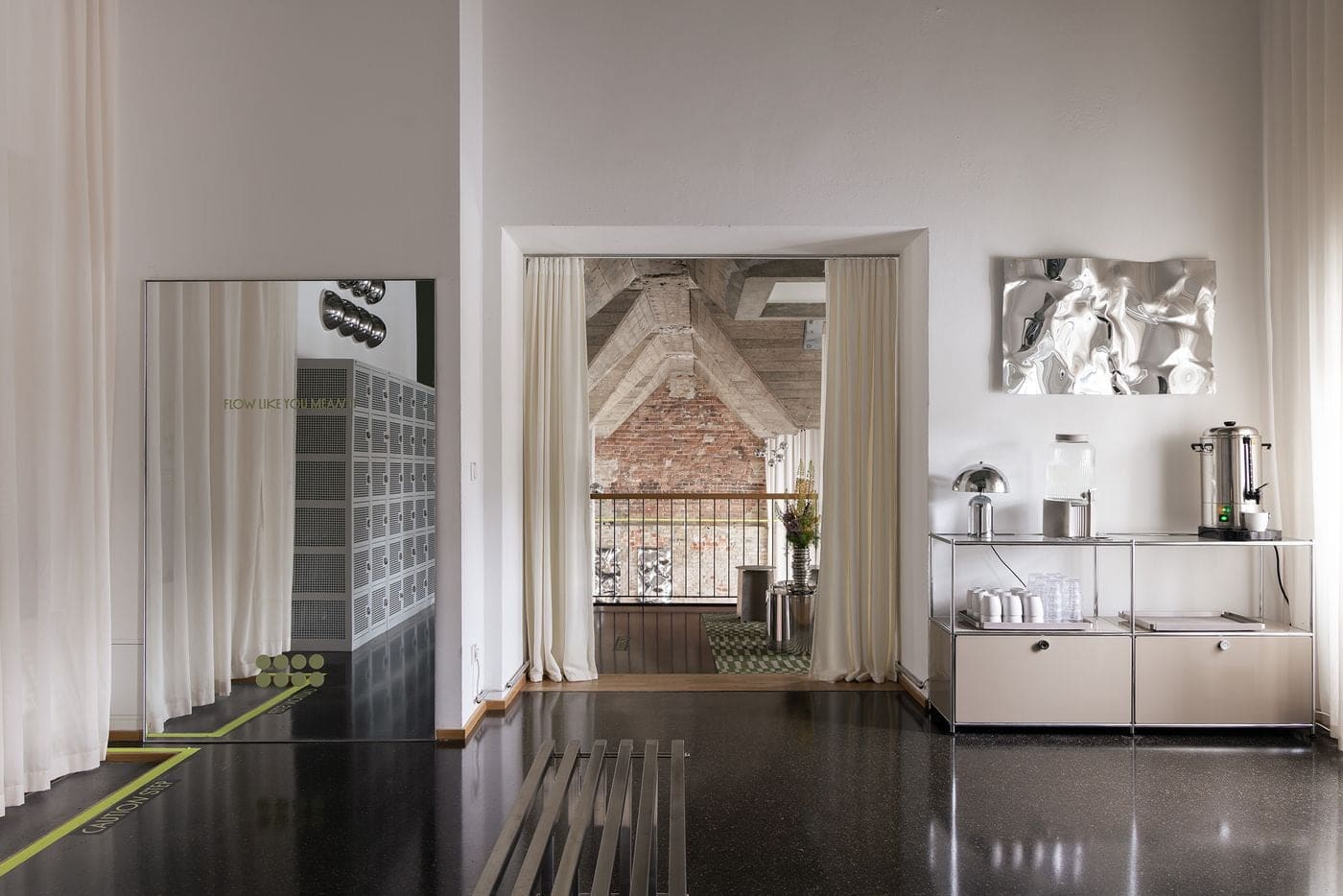
Walk into most contemporary yoga studios and you'll encounter a predictable palette: blonde timber, white walls, the occasional monstera. SHA-LA Waterfront, occupying a grain storehouse built around 1890 along Berlin's Spree River in Kreuzberg, takes a different approach. Designed by Hannah Roßhirt of Studio Hamara, the project refuses to sand down its industrial past in favor of wellness-industry homogeneity. Instead, it leans into the building's monumental scale, its weathered brick and concrete structure, and overlays these with a vocabulary that feels equal parts celestial and speculative: chrome spheres, rippling mirror-polished steel, organic forms that hover between sculpture and infrastructure.
The result is a hybrid space that holds industrial scruffiness and futuristic refinement in productive tension. It's an approach that aligns with a broader shift in adaptive reuse, one that values material honesty and historical legibility over erasure. In Kreuzberg, a district that has long navigated the friction between grit and gentrification, SHA-LA Waterfront reads as a spatial analogue to that negotiation.
A Cathedral for Movement
The main studio is the project's centerpiece, a cathedral-like volume defined by tall concrete columns and inverted pyramidal hoppers, remnants of the building's original grain-handling function. These hoppers, suspended overhead, establish an unusual vertical rhythm. Rather than conceal them, Roßhirt amplifies their presence with clusters of chrome spherical lights arranged in molecular formations. The effect is both industrial and otherworldly, as if the room were part warehouse, part planetarium.
Rippling mirror-polished steel panels animate the perimeter walls, catching and distorting ambient light in ways that recall the surface of the Spree just beyond the windows. Polished dark floors extend this liquid quality, creating a sense of depth that destabilizes the room's already imposing scale. Sheer cream curtains filter daylight, softening the hard edges of concrete and steel without diminishing their presence. The interplay between roughness and refinement is deliberate: the space doesn't ask you to forget where you are but rather invites you to see its industrial bones as part of the experience of stillness.
This approach to adaptive reuse has precedent. Herzog & de Meuron's Tate Modern retained the turbine hall's industrial scale to dramatic effect; Lacaton & Vassal's Palais de Tokyo preserved raw concrete and exposed services to honor the building's unfinished history. SHA-LA Waterfront operates in a similar vein, though at a smaller scale and with a different program. The question it poses is whether wellness spaces can carry historical memory without sacrificing their intended atmosphere. Here, the answer seems to be yes.
Layered Thresholds and Riverside Views
Beyond the main studio, the project unfolds as a sequence of thresholds. A mezzanine-level lounge overlooks the practice floor, functioning as both a communal pause between classes and a transitional zone to more intimate spaces. A sculptural daybed upholstered in forest green anchors the room, paired with a patterned carpet in complementary tones. Chrome tables, brushed metal stools, and a chrome floor lamp continue the material language established in the main studio, while sheer cream curtains provide a luminous backdrop. The aesthetic is consistent but not monotonous; each space feels calibrated to its function.
One of the smaller studios offers direct views over the Spree, integrating the river's presence into the rhythm of practice. This connection to the water is more than scenic; it grounds the space in its immediate context, reminding occupants that they are working within a specific urban fabric, not a generic wellness enclave. In a city as historically layered as Berlin, that specificity matters.
Changing rooms extend the same balance of utility and refinement. Beige tones and neatly organized amenities create a sense of order without clinical sterility. Chrome accents carry through, maintaining material continuity across public and semi-private zones. The design avoids the trap of over-styling; each element feels necessary rather than decorative.
Program as Social Infrastructure
SHA-LA, a Sanskrit term meaning "home," was founded by Joana Reicherts and Shahed Naji with an explicit emphasis on inclusivity and community. The Waterfront location extends that vision, folding dynamic yoga, breathwork, and sound healing into a broader program that includes teacher training, treatments, and community events. This programmatic breadth positions the studio as more than a place to practice asana; it functions as a social anchor, a space where wellness intersects with education and gathering.
This ambition aligns with a growing interest in wellness as a form of social infrastructure, particularly in cities where public space is contested and commercialized. SHA-LA Waterfront doesn't claim to be a public amenity, but its emphasis on community programming suggests an awareness of wellness spaces as potential sites of connection, not just consumption. Whether that potential is fully realized depends on how the space is activated over time, but the architectural framework supports it.
Material Continuity and Contemporary Craft
Roßhirt's material choices deserve closer attention. Chrome, often associated with mid-century optimism or retro-futurism, is deployed here not as nostalgia but as a contemporary material capable of capturing and transforming light. The spherical lights and mirror-polished panels create a sense of movement within stillness, a quality that resonates with the practice of yoga itself. The use of sheer curtains, meanwhile, recalls Japanese screens and the tradition of filtering rather than blocking light, a gesture toward Zen aesthetics without resorting to cliché.
The decision to retain exposed concrete and weathered brick speaks to a broader material ethic in contemporary adaptive reuse. Rather than treat existing fabric as something to be concealed or corrected, Roßhirt allows it to coexist with new interventions. This approach requires a degree of restraint; the temptation in adaptive reuse is often to over-design, to assert the new too forcefully. Here, the balance feels carefully negotiated.
Kreuzberg Context and Urban Memory
Kreuzberg's character, shaped by decades of migration, countercultural activity, and more recent waves of gentrification, provides an essential backdrop. The district's industrial heritage is both a source of identity and a site of tension, as former factories and warehouses are repurposed for creative and commercial uses. SHA-LA Waterfront participates in this transformation, but it does so with a degree of material honesty that acknowledges the building's past rather than erasing it.
The studio's location within a listed industrial complex built around 1890 situates it within a broader narrative of preservation and adaptation. The complex now houses a mix of commercial and workspace tenants, a common trajectory for Berlin's post-industrial sites. SHA-LA Waterfront contributes to this mix not by mimicking its neighbors but by offering a distinct spatial and programmatic proposition, one that values both historical legibility and contemporary function.
A Grounded Vision
SHA-LA Waterfront demonstrates that wellness spaces need not default to blandness. By embracing the building's industrial character and layering in futuristic detailing, Roßhirt has created an environment that feels both grounded and aspirational. The project suggests that adaptive reuse can accommodate programs traditionally associated with serenity and softness without sacrificing material integrity or historical memory.
In a city as architecturally diverse and historically complex as Berlin, SHA-LA Waterfront offers a model for how wellness and heritage might coexist. It's a space that invites reflection, not by erasing the past, but by folding it into the present.
Photo: Jordana Schramm
Save this story. A free account keeps your reading list and the 07:00 email in one place.
CREATE FREE ACCOUNT →SIGN IN