A Language of Restraint
There is a particular kind of confidence required to leave a canvas empty. The same applies to interiors, to objects, to the surfaces we inhabit daily. Ashiesh Shah understood this early. At ten years old, he convinced his mother to acquire a painting by Manjit Bawa, one of India's celebrated modernist artists. What drew him was not the subject but the negative space, the way a single figure could command an entire composition without decoration or justification. That instinct for restraint would become the foundation of his practice.
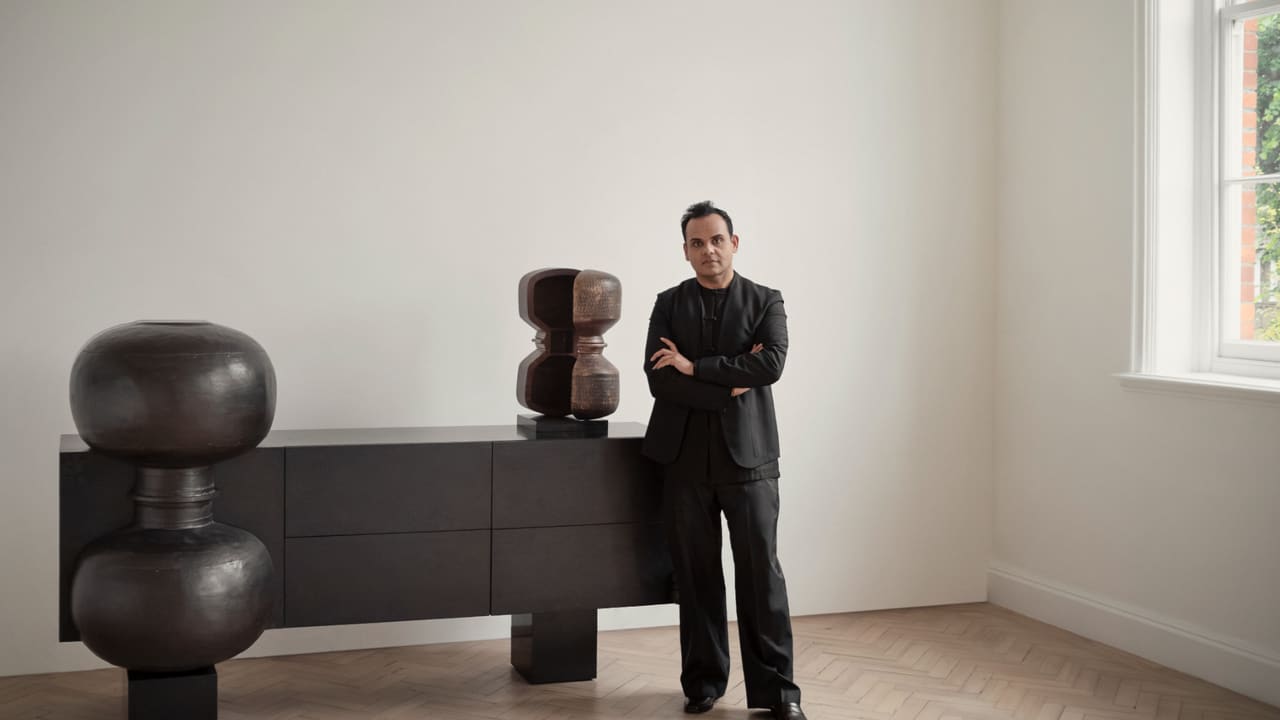
Today, Shah operates across architecture, interiors, collectible design, and curation. His studio, established in Mumbai in 2008 after studying Interior Architecture at Parsons in New York, has become synonymous with a particular aesthetic vocabulary: one rooted in wabi-sabi principles, natural materiality, and an aversion to visual noise. In 2022, Shah became the first Indian designer represented by The Invisible Collection, a Paris-based collectible design gallery. His first solo exhibition in the United Kingdom, Taamr, opened at Carpenters Workshop Gallery and runs through September 2026.
The Challenge of Communicating Quiet
Shah's early years in practice were marked by a recurring problem. Clients struggled to understand what they were looking at on mood boards. Stripped of pattern, overt color, and decorative flourishes, his proposals often read as incomplete. His solution was tactile. He began bringing materials directly into client meetings: slabs of stone, samples of plaster, objects that required touch rather than explanation. The work needed to be experienced, not decoded.
This approach shaped much of his residential portfolio, though certain retail commissions remain defining projects. The first Le Mill store in Mumbai, housed in a former warehouse, rejected the artificial lighting typical of Indian retail interiors at the time. Shah introduced roof glazing, allowing daylight to move through the space organically. For Raw Mango, a label known for handwoven textiles, he designed an environment defined by custom furniture, brass fixtures, and natural textures, deliberately avoiding wallpaper and applied decoration. The space functions as a counterpoint to the saturated visual language often associated with Indian textile retail.
Residential work includes the Indiabulls apartment in Mumbai, a layered interior that integrates contemporary art with handcrafted elements, and the Kolla penthouse in Hyderabad, a study in controlled materiality. These projects share a common thread: they refuse to equate luxury with abundance.
From Architecture to Sculptural Practice
Shah describes his trajectory as a gradual shift toward the scale and intimacy he always wanted. Architecture, he notes, allowed him to sculpt with light, shaping how illumination moves through a built environment rather than simply arranging walls. Product design offered a more intimate expression of the same impulse.
The Liminal bench marked his entry into collectible objects. It was followed by the Naga chair, cast in aluminum with a dark bronze finish and upholstered in elephant grass, and the Channapatna collection, a series of furniture and lighting pieces that reinterpret a traditional wooden toy-making craft from Karnataka. The Channapatna light, developed in collaboration with master craftswoman Noor Salma, is composed of turned, naturally lacquered beads, a technique pushed beyond its conventional application.
These objects are not decorative translations of craft. They represent sustained collaborations with artisans, relationships built over years of experimentation and failure. Shah describes a turning point in these partnerships: the moment when craftspeople stop waiting for direction and begin proposing ideas themselves. That shift, he argues, is when the work becomes genuinely collaborative rather than extractive.
Taamr and the Question of Cultural Memory
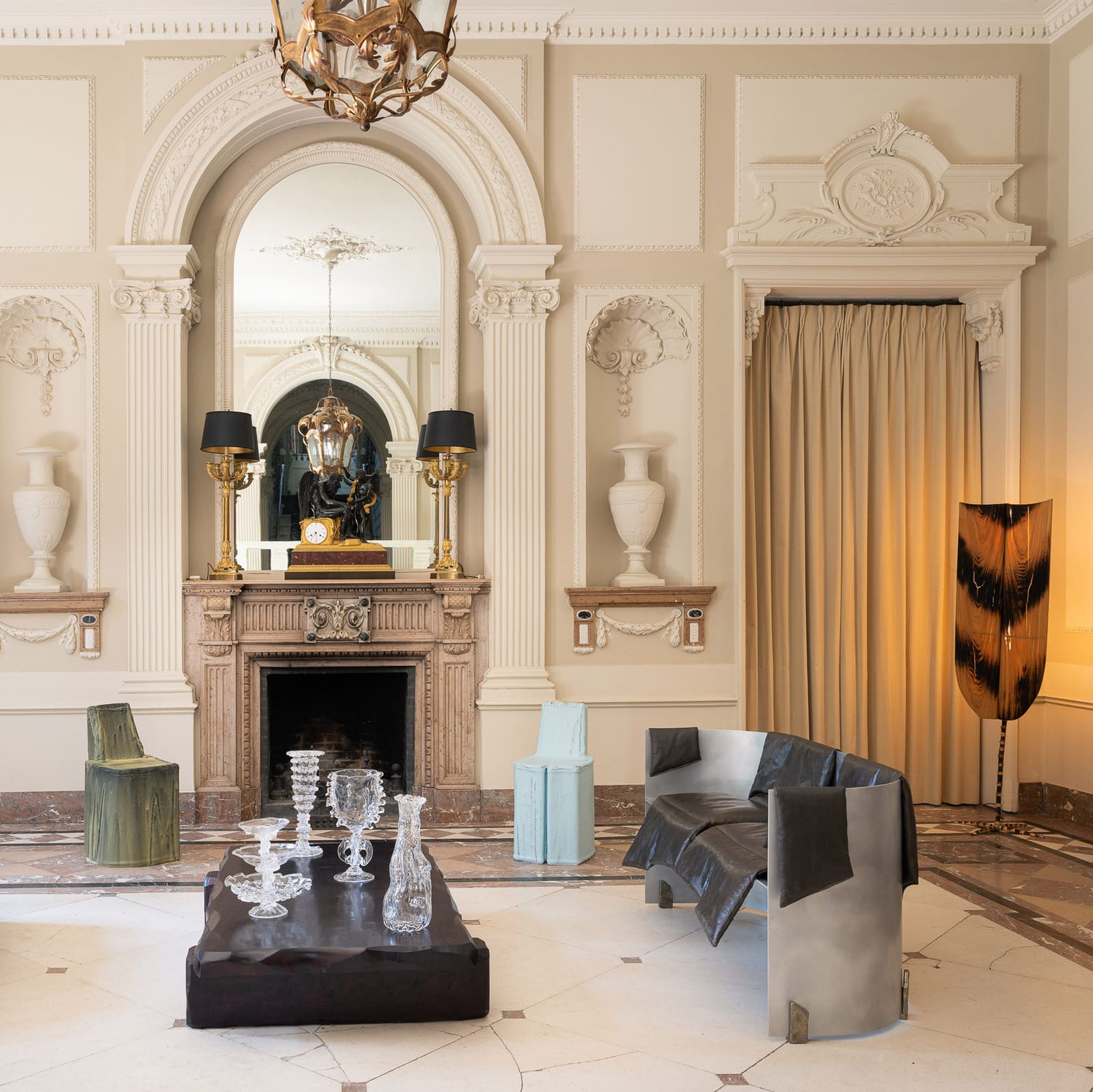
The Taamr exhibition at Carpenters Workshop Gallery explores how materials carry memory. Copper, handcrafted mirrors, rudraksha beads, and reclaimed objects form the core of the show. Each piece interrogates whether familiar forms can be reimagined without severing their connection to tradition. It is a question Shah has been asking for nearly two decades, and one that remains unresolved by design.
The exhibition arrives at a moment when Indian design is receiving increased international attention, often framed through the lens of maximalism and color. Shah's work offers a different entry point. It suggests that Indian design can also speak through subtraction, through the careful calibration of material and void.
The Artisan as Co-Author
At World Archi Design, we have been tracking the rise of designer-artisan collaborations across Asia, and Shah's model stands out for its insistence on long-term partnership rather than one-off commissions. He describes working alongside craftspeople to push techniques into unfamiliar territory, a process that requires mutual trust and a willingness to fail repeatedly before arriving at a resolved form.
This approach has implications beyond individual projects. As global interest in handmade objects grows, often accompanied by concerns about cultural appropriation and fair compensation, Shah's practice offers a case study in sustained engagement. The artisans he works with are not anonymous hands executing a designer's vision; they are co-authors whose expertise shapes the final outcome.
The Channapatna collection exemplifies this. Traditional toy-making techniques, typically applied to small-scale figurines, are recontextualized as furniture components. The lacquering process remains unchanged, but the scale and application are entirely new. This is not preservation through museum display; it is preservation through evolution, ensuring that the craft remains economically viable and creatively relevant.
Looking Forward Without Forgetting
Shah is currently working on several large-scale residences across India, alongside a collaboration with Spanish designer and sculptor Nacho Carbonell. The partnership represents an interesting pairing: Carbonell's work is often characterized by organic, almost primordial forms, while Shah's leans toward geometric discipline. How the two vocabularies will intersect remains to be seen.
When asked about legacy, Shah reframes the question. He does not hope to be remembered as a singular creative voice. Instead, he wants the craft itself to endure, for someone encountering a piece decades from now to be able to read the hand that made it, the material it came from, and the tradition it drew upon. It is a perspective that positions the designer as steward rather than auteur, a role that requires a particular kind of humility.
The Precedent Question
Shah's investment in negative space and material honesty invites comparison to several lineages. There are echoes of Japanese minimalism, certainly, but also resonances with the work of Axel Vervoordt, the Belgian designer and antiquarian whose interiors similarly privilege patina and restraint over novelty. Closer to home, Shah's practice can be read alongside figures like Bijoy Jain of Studio Mumbai, whose architectural work foregrounds craft and collaborative making, though Jain's aesthetic leans more heavily into raw, unfinished surfaces.
What distinguishes Shah is his willingness to operate across scales and contexts without diluting the core vocabulary. Whether designing a penthouse interior, a retail environment, or a collectible bench, the same principles apply: restraint, materiality, and a refusal to mistake decoration for depth.
Why This Matters Now
The global design conversation is increasingly attuned to questions of sustainability, cultural preservation, and equitable collaboration. Shah's practice addresses all three, not through manifestos or marketing language, but through the work itself. His objects and interiors demonstrate that craft-based design can be contemporary without being nostalgic, globally relevant without erasing regional specificity.
As Indian design gains visibility on the international stage, Shah's trajectory offers an alternative to the expected narratives. His work does not perform Indianness through motif or palette. Instead, it embeds cultural knowledge within process and material, creating objects that carry their origins without announcing them.
The question of whether craft can outlast celebrity is not rhetorical. In an industry increasingly driven by designer brands and signature aesthetics, Shah's position is countercultural. It suggests that the most enduring work is that which becomes legible through technique rather than authorship, where the hand of the maker is more important than the name on the label.
That philosophy will be tested in the coming decades. As Shah's practice expands internationally and his objects circulate through galleries and collections, the challenge will be maintaining the collaborative relationships that give the work its integrity. Scale and intimacy are not always compatible. But if the past eighteen years are any indication, Shah understands that some things cannot be accelerated, and that the best design often emerges from the slowest processes.
Save this story. A free account keeps your reading list and the 07:00 email in one place.
CREATE FREE ACCOUNT →SIGN IN