A Material Shift
Designers rarely pivot cleanly from one medium to another without leaving fingerprints of their former practice. Laurids Gallée, whose body of work is anchored in the tactile fluidity of polymer resin, has spent years coaxing that synthetic material into something approaching the ephemeral - objects that look as though they might still be cooling, surfaces that capture and diffuse light in ways traditionally reserved for glass. His experiments with wood and aluminium have been occasional, almost tentative. But resin remains his home territory, a medium he treats less as a solid and more as a frozen moment in a pour.
So when Moser, the 170-year-old Czech crystal house, invited Gallée to design a collection in glass, the proposition was not simply a commission. It was a confrontation with a material that refuses improvisation. Crystal glass does not tolerate the kind of playful malleability that defines Gallée's resin work. It demands precision, heat discipline, and an intimate knowledge of how molten silica behaves under pressure. The resulting collection, Axis, is less a translation of Gallée's aesthetic into glass than a negotiation between his instinct for colour and transparency and the unforgiving logic of glassblowing.
Geometry as Discipline
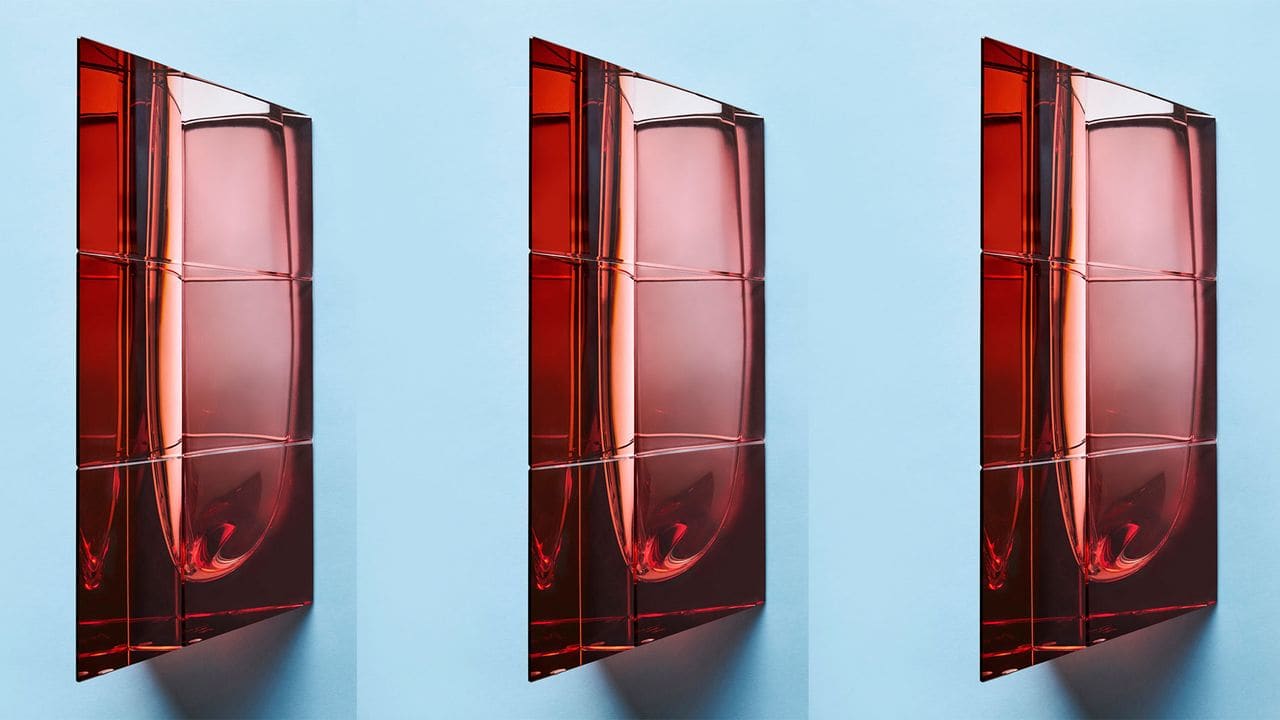
Axis is composed of vessels - vases, tumblers, saucers, a carafe - that share a formal language rooted in early twentieth-century modernism. The pieces are defined by a grid of incised cuts, a pattern that recalls the faceted geometries of Art Deco and the rationalist impulse of Bauhaus glassware. But where those historical precedents often prioritized symmetry and repetition, Gallée's approach introduces a subtle tension. The cuts are not merely decorative; they function as structural articulation, dividing the surface into planes that catch light at different intensities.
The vase, according to Moser, presented the most acute technical challenge. Blown into a mould characterized by a sharp interior angle, the piece reconciles an angular exterior with a rounded core - a duality that requires the glassblower to maintain uniform wall thickness while navigating competing geometries. Only the most experienced craftspeople in the Moser workshop can execute the form, and even then, the success rate is not guaranteed. The vase is, in this sense, a performance piece: a demonstration of what happens when design ambition meets the physical limits of hand production.
Rosalin and the Gradient as Narrative
Colour in glass is never incidental. It is the result of metallic oxides introduced into the melt, and in the case of Moser, it carries historical weight. The house's signature Rosalin hue - a warm, brick-toned pink - was developed in the 1920s and has since become a material signature, a chromatic fingerprint that distinguishes Moser crystal from the cooler, more neutral palette of Bohemian competitors.
In Axis, Gallée exploits the optical properties of Rosalin to create a gradient effect. The thickest sections of each vessel, typically the base, register as a deep, almost terracotta tone. As the wall thins toward the rim, the colour softens into a pale blush, a transition that occurs not through applied surface treatment but through the simple physics of light passing through varying thicknesses of tinted glass. The gradient becomes a kind of vertical narrative, anchoring each piece in mass at the bottom while dissolving into delicacy at the top.
This is a technique Gallée has employed in his resin work, where he layers pigmented polymer to achieve similar tonal shifts. But in glass, the effect is more pronounced. The material's higher refractive index means that light bends more sharply, amplifying the colour transition and adding a dimension of depth that resin, for all its versatility, cannot quite replicate.
The Mould, the Breath, and the Cut
Moser's production process remains largely hand-driven, a fact that shapes not only the aesthetic of Axis but also its economic positioning. Each piece begins as a gather of molten crystal on the end of a blowpipe, introduced into a steel mould that defines the external form. The glassblower must then regulate air pressure and rotation speed to ensure even distribution of material, a task complicated by the angular profile of the mould. Any hesitation or irregularity in breath control results in asymmetry or, worse, structural failure as the piece cools.
Once the form is stabilized and annealed, the surface is subjected to cutting - a subtractive process in which rotating abrasive wheels incise the grid pattern into the glass. The cuts must be deep enough to create visual contrast but not so deep as to compromise the wall integrity. In the vase, where wall thickness varies significantly from base to rim, this balance becomes particularly precarious.
The interplay between the blown form and the cut surface is central to Axis. Blowing is an additive, almost sculptural act; cutting is analytical, architectural. Together, they produce a tension that runs through the entire collection: the roundness of the interior volume against the faceted exterior, the warmth of Rosalin against the coolness of geometric precision.
Precedent and Position
Gallée's work with Moser invites comparison to other contemporary designers who have engaged with historical glass houses. Scholten & Baijings, for instance, have collaborated with both Venini and J. & L. Lobmeyr, introducing chromatic experimentation and pattern play into traditional forms. Faye Toogood's work with Bitossi has similarly bridged craft heritage and contemporary sculptural sensibility. But where those collaborations often emphasize surface decoration or colour blocking, Axis foregrounds the tectonic - the structural and material logic of the object itself.
There is also a kinship with the work of Aldo Bakker, whose glass vessels for Karakter prioritize volumetric purity and the optical effects of thick-walled forms. Like Bakker, Gallée treats the vessel not as a container but as a solid mass that happens to be hollow, a body whose primary function is to mediate light.
At World Archi Design, we have been tracking a broader shift in collectible design toward what might be called "material honesty" - a rejection of surface embellishment in favour of exploiting the intrinsic properties of a given medium. Axis sits comfortably within this trend, even as it engages with a craft tradition that has historically leaned toward ornamentation.
The Economics of Limited Production
Moser has positioned Axis as a limited edition, with the vase retailing at approximately $11,500. This pricing reflects not only the labour intensity of hand production but also the collection's status as a bridge object - part functional vessel, part collectible sculpture. The tumblers and saucers, while less technically demanding than the vase, are priced accordingly, targeting a market segment that values craft provenance and material rarity over mass-market accessibility.
This is not a new strategy for Moser, which has long operated at the intersection of luxury tableware and art glass. But the collaboration with Gallée signals a willingness to engage with designers whose practices exist outside the traditional decorative arts sphere. Gallée's background in lighting and experimental furniture brings a different set of references to the table - references rooted in spatial experience and material phenomenology rather than the conventions of the dining room.
The limited-edition model also allows for a degree of technical risk-taking that would be untenable in a mass-production context. The vase, with its high failure rate and reliance on master-level blowing skill, could not be economically viable in a larger run. By constraining the edition size, Moser creates space for the kind of boundary-pushing that Gallée describes as central to the project.
What Remains After the Mould Cools
There is a temptation, when writing about collaborations between contemporary designers and heritage manufacturers, to frame the work as either a revival or a rupture - either the designer breathes new life into a dormant tradition, or they disrupt it entirely. Axis resists both narratives. It is neither nostalgic nor iconoclastic. Instead, it operates as a kind of calibration, a test of how far a particular set of techniques and material constraints can be pushed before they cease to function.
Gallée's comment about pushing technical limits is revealing. It suggests a design process driven not by a predetermined formal vision but by a curiosity about where the material will break. This is a fundamentally exploratory approach, one that treats the workshop as a laboratory and the craftsperson as a collaborator in discovery rather than an executor of instructions.
The result is a collection that feels both resolved and provisional - resolved in the sense that each piece is a fully realized object, provisional in the sense that it points toward further possibilities. What happens if the angle is sharpened further? What if the gradient is inverted, with the deepest colour at the rim rather than the base? What if the grid pattern is abandoned entirely in favour of a different kind of surface articulation?
These are not questions that Axis answers. But they are questions it makes visible, and in doing so, it performs a function that is often overlooked in discussions of collectible design: it models a way of working that values inquiry over conclusion, process over product. That Moser, a house with nearly two centuries of tradition behind it, was willing to support such an approach speaks to a flexibility that is rare in heritage manufacturing. And that Gallée, a designer with no prior experience in glass, was willing to enter a medium where his usual methods would not apply, speaks to a willingness to unlearn that is equally uncommon.
In the end, Axis is less about what Laurids Gallée brings to glass than about what glass demands of Laurids Gallée. The collection is a record of that demand, and of the forms that emerge when a designer chooses to meet it on its own terms.
Save this story. A free account keeps your reading list and the 07:00 email in one place.
CREATE FREE ACCOUNT →SIGN IN