When Buildings Become Policy
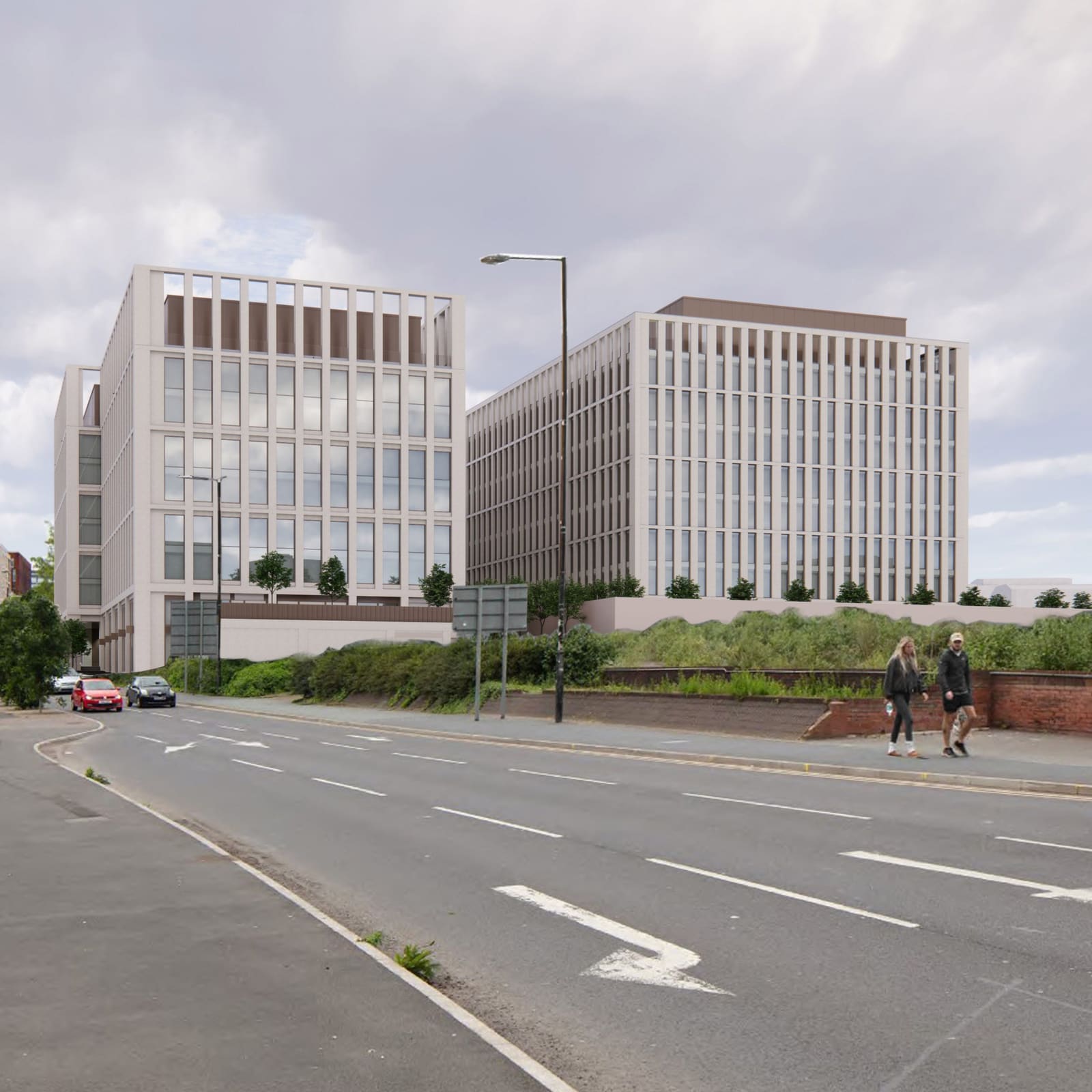
The idea that architecture can redistribute power is as old as capitals themselves. From Brasília's modernist symmetry to Naypyidaw's isolated grandeur, governments have long believed that relocating administrative functions might reshape how authority flows. The Manchester Digital Campus, now under construction in the Ancoats neighborhood, offers a fresh test case. Designed by infrastructure specialist AtkinsRéalis, the complex will house roughly 8,800 civil servants across approximately 84,000 square meters of workspace, split between two structures rising from what was once a retail park on brownfield land.
The project carries unusual symbolic weight. It has been designated as the future home of a northern extension of the prime ministerial office, a move intended to shift decision-making authority away from Westminster. Groundworks began recently, with core construction anticipated through 2028 and full completion slated for 2032. Whether a purpose-built campus can genuinely alter centuries of centralized governance, or whether it simply replicates London's institutional gravity in a different postal code, remains an open question.
Massing and Materiality in a Post-Industrial Context
Ancoats itself carries architectural memory. The district was the epicenter of Manchester's nineteenth-century cotton mill industry, a landscape of brick warehouses and canal-side logistics that powered early industrialization. Today, it is a mixed-use neighborhood undergoing rapid transformation, with adaptive reuse projects and new residential blocks layered over the old industrial fabric.
AtkinsRéalis's scheme responds with a deliberately neutral parti: two blocky volumes clad in a gridded facade system punctuated by repetitive fenestration. Early visualizations suggest a restrained, almost generic, corporate aesthetic. There is little of the tectonic drama that characterizes recent civic buildings, such as Adjaye Associates' textured masonry work or Herzog & de Meuron's expressive skin systems. Instead, the design language reads as intentionally recessive, prioritizing interior flexibility and operational efficiency over external iconography.
This restraint may be strategic. Government architecture in Britain has historically oscillated between monumental classicism and bureaucratic pragmatism. The Manchester Digital Campus aligns with the latter tradition, echoing the functional modernism of post-war civil service estates rather than the symbolic ambitions of parliamentary buildings. The gridded envelope, likely incorporating standardized curtain-wall assemblies, suggests ease of procurement and construction speed over bespoke detailing. In a project driven by capacity and timeline, such choices are defensible, though they risk producing environments that feel generic rather than place-specific.
Spatial Organization and the Question of Scale
Housing nearly 9,000 workers presents considerable spatial challenges. At that density, the campus approaches the scale of a small university or corporate headquarters. Precedents include Norman Foster's Bloomberg European headquarters in London, which accommodates around 4,000 staff across a highly integrated floorplate, or OMA's CCTV headquarters in Beijing, designed for roughly 10,000 occupants within a single looped structure.
The Manchester Digital Campus divides its program across two discrete buildings, a move that introduces both opportunities and friction. Separate volumes allow for phased occupation and departmental differentiation, but they also risk fragmenting the collaborative synergies the project ostensibly seeks to foster. Philippa Harvey, the senior responsible owner for the campus, has emphasized that the facility is intended to enable cross-departmental collaboration and embed government functions within the regional digital sector. Achieving that ambition will depend heavily on how circulation, shared amenities, and inter-building connectivity are resolved - details not yet publicly disclosed.
The site's former life as a retail park suggests a suburban typology: surface parking, big-box volumes, and car-oriented access. Transforming that into a dense, walkable workplace will require significant urban design intervention. Successful civic campuses, such as Mecanoo's Kaohsiung Marine Cultural & Pop Music Center or BIG's Google Bay View, integrate landscape, pedestrian networks, and public programming to avoid insularity. Whether AtkinsRéalis's scheme incorporates comparable strategies remains to be seen.
Precedent and the Politics of Relocation
Government decentralization through architecture has a mixed track record. Brasília, designed by Oscar Niemeyer and Lúcio Costa, succeeded in relocating Brazil's capital but struggled to cultivate the inclusive civic culture its planners envisioned. Sejong City in South Korea, purpose-built to house national ministries, has attracted civil servants but remains poorly integrated with the country's economic and cultural centers. Canberra, Australia's federal capital, took decades to develop critical mass and remains distant from Sydney and Melbourne's gravitational pull.
The Manchester Digital Campus operates within a different model. Rather than relocating an entire government, it proposes a dual-center approach, with London retaining primacy while Manchester hosts specialized digital and data functions. This hybrid structure mirrors corporate strategies - think dual headquarters or regional hubs - but applying it to national governance introduces complexity. Will decision-making genuinely shift, or will Manchester become a satellite office, perpetually deferring to Westminster?
Temporary occupation of Heron House, an existing office building in central Manchester, underscores the transitional nature of the project. The building currently houses Government Communications Headquarters staff, and it will serve as an interim base until the campus opens. This phased approach allows operational continuity but also highlights the long timeline: a decade from conception to completion is not unusual for large civic projects, yet it tests political patience and institutional commitment.
Regional Integration and the Digital Sector
One rationale for siting the campus in Manchester is proximity to the North West's digital and technology industries. The region has cultivated a growing tech sector, with clusters in MediaCityUK, the Manchester Science Park, and emerging innovation districts. Co-locating government digital teams with this ecosystem could, in theory, facilitate recruitment, knowledge exchange, and public-private collaboration.
Yet physical proximity does not guarantee integration. Successful innovation districts, such as Kendall Square in Cambridge, Massachusetts, or the 22@Barcelona district, depend on porous boundaries, mixed-use programming, and active interfaces between institutions, startups, and public space. If the Manchester Digital Campus operates as an enclosed, secure government facility - common for civil service buildings - its ability to engage the surrounding digital community will be limited.
The architectural challenge here is permeability. Can the design incorporate public-facing ground floors, shared conference facilities, or open courtyards that invite interaction without compromising security? Precedents like the Oslo Government Quarter by Nordic Office of Architecture demonstrate that transparency and security are not mutually exclusive, but they require deliberate design strategies: layered access zones, materiality that signals openness, and programming that extends beyond internal use.
Materiality, Sustainability, and the Unseen
No detailed sustainability strategy has been disclosed, though any large-scale government project in Britain will face stringent carbon and energy performance standards. The gridded facade system, if executed with high-performance glazing and integrated shading, could support passive environmental control. The brownfield site offers an opportunity for remediation and urban regeneration, avoiding greenfield development.
Material choices will also signal intent. Brick, common in Manchester's industrial heritage, would tie the project to local architectural identity. Precast concrete or metal panels, more typical of contemporary office construction, would emphasize efficiency and replicability. The tension between contextual sensitivity and programmatic pragmatism runs through the project's visual language.
At this stage, the renders suggest the latter: a building that could sit comfortably in any post-industrial city, from Birmingham to Brussels. That universality may be the point - a statement that government infrastructure need not monumentalize itself, that functionality and modesty are valid civic virtues. Yet there is also a risk of placelessness, of producing environments that fail to inspire the collaboration and innovation they are meant to enable.
The Long Game
Completion in 2032 places the Manchester Digital Campus on a timeline that will outlast several electoral cycles. Institutional architecture of this scale requires sustained political will, cross-party support, and public buy-in. The project's success will ultimately be measured not by its formal qualities but by whether it alters the geography of power in meaningful ways: where decisions are made, whose voices are heard, and how regional perspectives shape national policy.
Architecture alone cannot decentralize governance. But it can create the spatial conditions - proximity, scale, accessibility - that make new patterns of work and decision-making possible. Whether AtkinsRéalis's design rises to that challenge, or whether it becomes another competent but unremarkable office park, will depend on the details still to come: the quality of its public realm, the flexibility of its interiors, and the willingness of institutions to inhabit it in ways that break from established hierarchies.
At World Archi Design, we have tracked numerous projects that promised to reshape how cities and institutions function. Some succeeded by embedding themselves deeply in local context and programming. Others, despite architectural ambition, remained isolated from the communities they were meant to serve. The Manchester Digital Campus sits at that crossroads, its final form still taking shape beneath the cranes.
Credit: Shutterstock
Save this story. A free account keeps your reading list and the 07:00 email in one place.
CREATE FREE ACCOUNT →SIGN IN