The Scale Problem in Reverse
Architecture typically begins small and grows large: sketch to model to built form. But what happens when you compress an entire landscape back down to tabletop scale? At World Archi Design, we've been tracking the resurgence of miniature practice across disciplines, from diorama installations to speculative ecologies. The current exhibition at Jardí Botànic de Barcelona inverts the usual trajectory: fourteen landscape architects have created ceramic vessels containing living Mediterranean plant communities, each no larger than a breadbox, each carrying the weight of a regional climate strategy.
The show, running through early October as part of Barcelona's UNESCO-UIA World Capital of Architecture programming, takes its conceptual DNA from a 1926 collaboration among architect Nicolau M. Rubió i Tudurí, ceramicist Llorenç Artigas, and painter Raoul Dufy. That trio coined the term jardinets de saló, literally "parlour gardens," for their series of glazed ceramic containers holding miniature planted landscapes. One of those original pieces, first shown at Bernheim-Jeune galleries in Paris the following year, now shares the botanical garden's fourteen hectares with these new commissions. The subtitle, "Dreams from the Rooftop," frames the rooftop as laboratory: a testing ground for resilient urban horticulture in an era when every horizontal surface counts.
Climate as Curator
The exhibition's organizing principle is homoclimatic zoning. Barcelona's Botanical Garden, designed by Carlos Ferrater, Josep Lluís Canosa, and Beth Figueras for the 1992 Olympics, arranges its plantings by Mediterranean-climate analogs: California, Chile, South Africa, Australia, and the Mediterranean basin itself. Each ceramic installation sits within the garden sector that mirrors its creator's home region, so a piece by an Australian designer rests among Southern Australian species, a Californian work among chaparral cousins.
This is more than curatorial convenience. It's an argument about legibility. When McGregor & Coxall's Adrian McGregor, Peter Stutchbury, and Phil Harris from Troppo Architects contribute models from Southern Australia, their miniature planting palettes echo the full-scale eucalypts and acacias surrounding them. The visitor reads the ceramic work and the landscape simultaneously, understanding the translation between scales as a kind of tectonic compression.
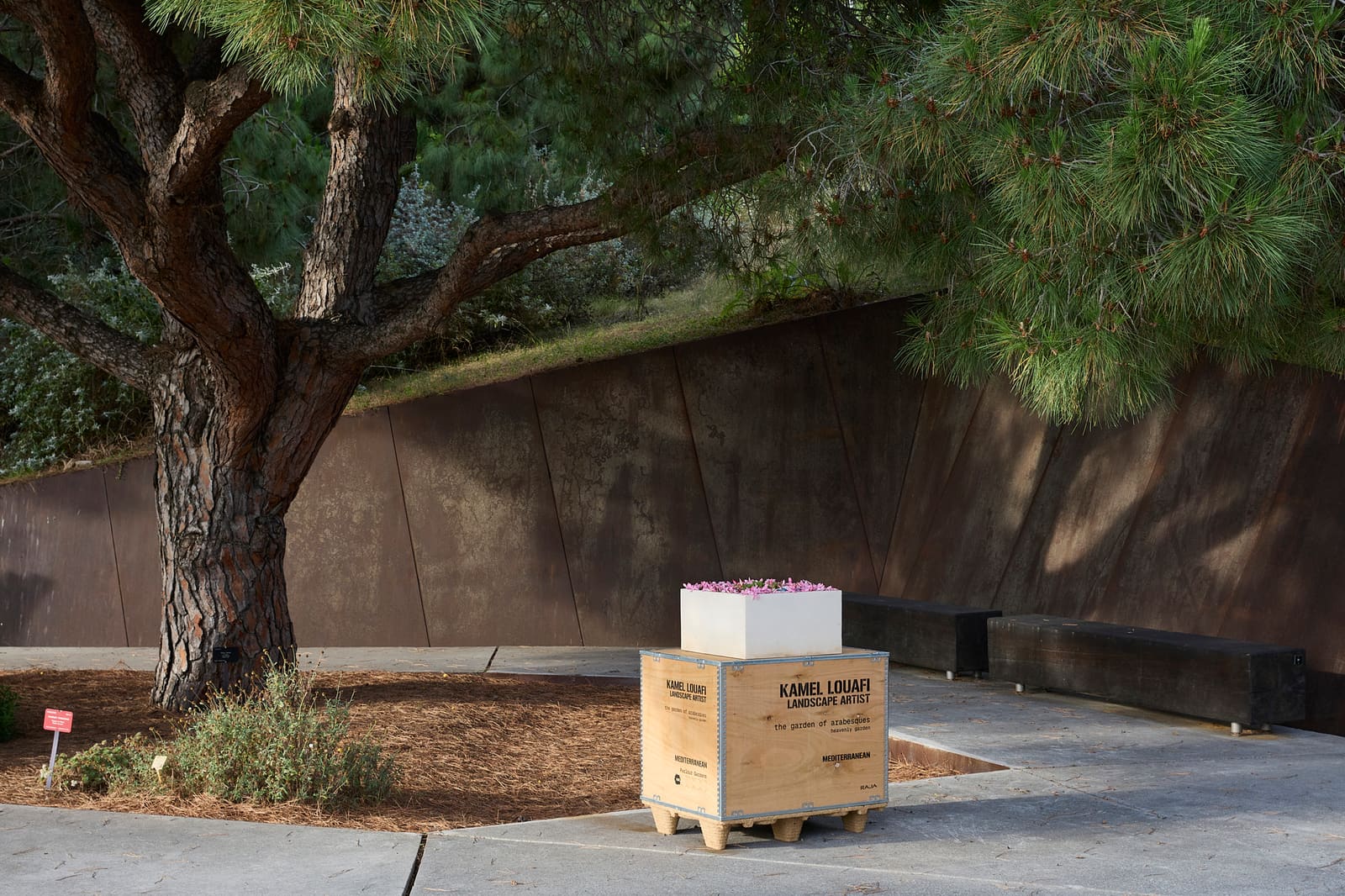
From Africa, Gareth Doherty of the NUS Critical Landscapes Design Lab and the team of Tarna Klitzner and Lovell Friedman from TK Landscape Architecture offer two interpretations. California sends three: James Corner of Field Operations, Adam Greenspan of PWP Landscape Architecture, and Walter Hood of Hood Design Studio. The Mediterranean zone, predictably, claims the largest cohort: Catherine Mosbach of Mosbach Paysagistes, Thomas Doxiadis of Doxiadis+, Jala Makhzoumi with Abdul-Halim Jabr, Kamel Louafi of Louafi Landschaftsarchitekten, and Teresa Moller of Teresa Moller Paisajista.
Craft Meets Digital Fabrication
Each piece adheres to a strict format: 45 × 45 × 25 centimeters, including both the ceramic container and the living planting scheme. The designers specify not only the vessel's form but also the plant species and their maintenance protocols. Production takes place in Barcelona, marrying advanced clay-jet 3D printing with traditional glazing and firing techniques. The result is a hybrid object: digitally generated form clad in artisanal finish, planted with species that will grow, shift, and require pruning over the exhibition's four-month run.
This is not static sculpture. Each garden evolves according to its author's specification, a living artwork subject to seasonal change, microclimatic variation, and the skill of the garden's horticultural staff. The pieces sit directly on their wooden transport crates, an installation choice that emphasizes portability and process. There's no pedestal, no vitrine. The crate becomes plinth, a nod to the logistical reality of moving fragile, planted ceramic between studio, kiln, and garden.
The technical challenge is considerable. Clay-jet printing allows for complex geometries, overhangs and voids that would be difficult to throw by hand. But ceramic shrinks as it dries, cracks under uneven cooling, and demands precise glaze chemistry to achieve waterproofing. Add living plants, which require drainage, root space, and light, and you have a design problem that straddles industrial design, horticulture, and material science.
Rooftop as Manifesto
Why rooftops? The exhibition's subtitle gestures toward a broader discourse. In dense urban cores, horizontal surfaces above grade have become the last frontier for green infrastructure. From the High Line's elevated planting beds to the extensive green roofs mandated by cities like Copenhagen and Stuttgart, the rooftop has shifted from leftover space to strategic asset. It manages stormwater, mitigates heat island effect, sequesters carbon, and provides habitat in landscapes otherwise hostile to non-human life.
But rooftops also impose constraints: shallow soil depth, wind exposure, weight limits, waterproofing requirements. The plants that thrive there tend toward the Mediterranean palette: drought-tolerant, low-growing, adapted to thin substrates and intense sun. Sedums, grasses, succulents. The same species that populate these ceramic miniatures.
In this sense, the exhibition models a specific proposition: that the rooftop garden is not a compromise but a distinct typology, with its own aesthetic and ecological logic. The miniature becomes a testing ground, a way to iterate planting combinations, observe root behavior, and refine maintenance protocols before scaling up. It's speculative design rendered tangible, a future you can water with a spray bottle.
Precedent and Legacy
Rubió i Tudurí's original jardinets de saló emerged from the same cultural moment that produced the Barcelona Pavilion, the Weissenhof Estate, and Le Corbusier's villa projects: an interwar modernism obsessed with mass production, standardization, and the domestication of nature. The parlour garden was modern ornament, a way to bring landscape into the bourgeois interior without the mess of soil or the labor of gardening. It was nature as object, controlled and contained.
A century later, the stakes have shifted. Climate instability, biodiversity collapse, and urban densification have made the question of how we live with plants less decorative and more existential. The new ceramic works inherit the formal language of their 1926 predecessors but carry a different conceptual load. They are not simply representations of landscape but prototypes for it, proposals for how cities might green their hardscape one rooftop at a time.
The exhibition closes in early October with a symposium on technology and beauty, drawing contributors from multiple continents. It's a fitting end for a project that bridges craft tradition and digital tooling, horticultural knowledge and architectural speculation. Whether these miniature landscapes will influence full-scale practice remains to be seen. But as design artifacts, they make a compelling case: that sometimes the best way to think big is to build small.
Seeing the Garden Whole
Walking the Botanical Garden's pathways, moving from California chaparral to South African fynbos to Chilean matorral, the visitor encounters each ceramic piece as both object and argument. The Australian models, grouped in their native plant zone, ask what it means to design for fire-adapted ecosystems. The Mediterranean installations, surrounded by olive and rosemary and lavender, explore water scarcity and xerophytic beauty. The Californian works, set among manzanita and ceanothus, test the limits of engineered soil mixes and irrigation efficiency.
This is landscape architecture at the scale of the hand, but the ideas it contains operate at the scale of the city. The exhibition's curators, Marina Cervera of the Barcelona International Landscape Biennial and NablaBCN, James Hayter formerly of IFLA and Oxigen, and José Luis Cortés formerly of the UIA, have assembled a roster of practitioners known for large-scale public work. Seeing them design at 1:1 scale with living material compresses the distance between concept and execution. There is no rendering, no construction document. The designer plants the species, adjusts the composition, observes the growth. The feedback loop tightens.
In an era when landscape architecture increasingly operates through simulation, modeling software, and multi-year construction timelines, the ceramic garden offers a different tempo. It's immediate, tactile, and accountable. If the planting fails, you see it within weeks. If the composition lacks balance, there's no hiding behind photorealistic visualization. The miniature demands honesty.
And perhaps that's the real provocation here: not the nostalgic return to 1926 craft, but the insistence that landscape design can be tested, refined, and experienced at a scale where failure is cheap and iteration is fast. The rooftop garden, whether ceramic or full-scale, becomes a site for experimentation precisely because it's small enough to risk getting wrong.
Save this story. A free account keeps your reading list and the 07:00 email in one place.
CREATE FREE ACCOUNT →SIGN IN