The Overlooked Corner
Urban design often fixates on the monumental: the plaza, the park, the civic square. Yet cities are stitched together by smaller moments - the threshold between building and street, the leftover triangle where two roads meet, the narrow strip that nobody quite claims. These interstitial spaces, dismissed as too small or too awkward, often hold the greatest potential for transformation.
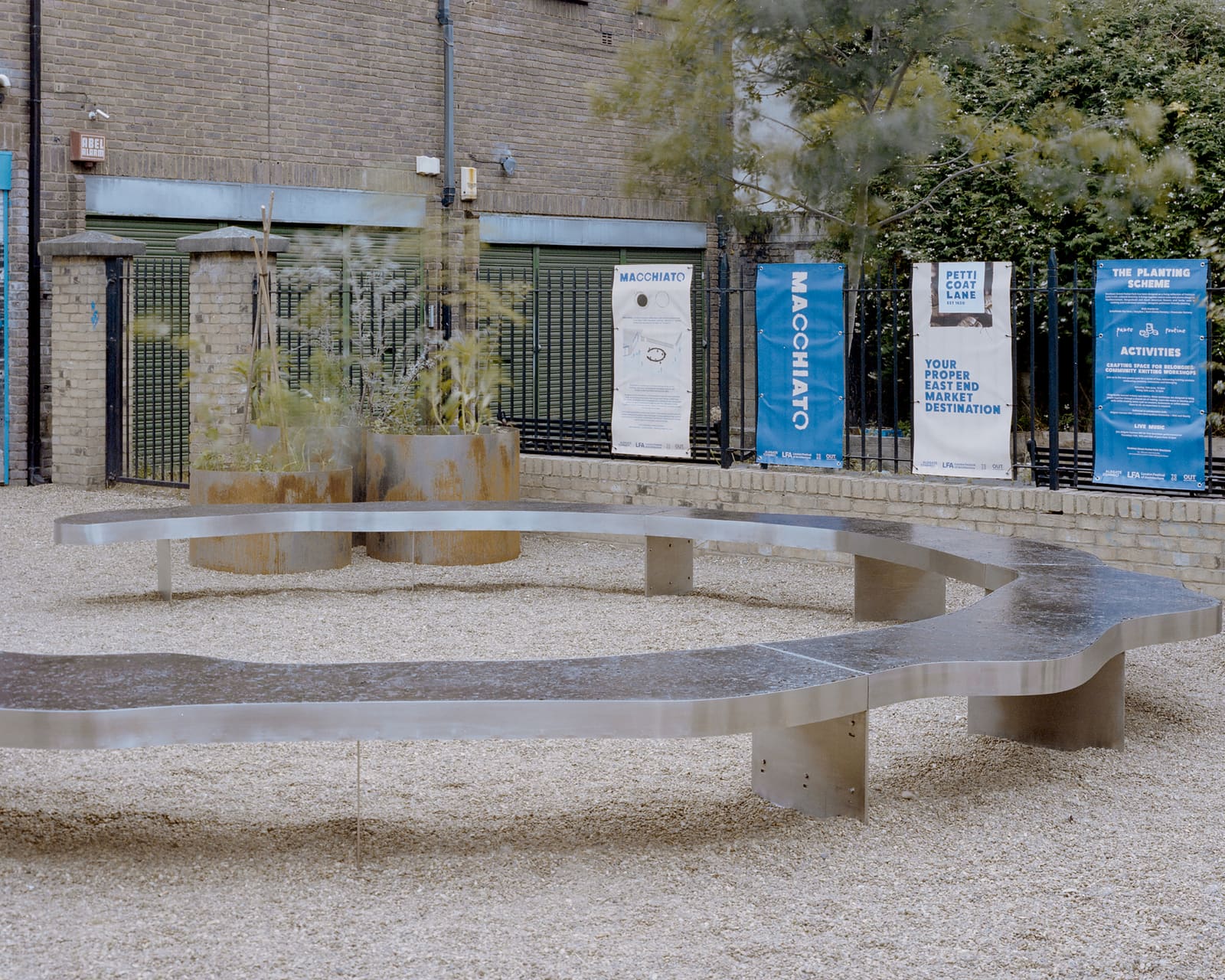
Macchiato occupies precisely such a space. Situated along Petticoat Lane in London, the 120-square-meter installation sits in front of The Colombian Coffee Company, a patch of ground that pedestrians have walked past for years without a second glance. Francesco Nardacci and Alessandro Minotti of OUT Architecture saw something else: an opportunity to test whether a corner could become a destination.
Commissioned for the London Festival of Architecture 2026 by Aldgate Connect BID, the project belongs to a lineage of tactical urbanism - lightweight, temporary interventions that reimagine how cities function. But where many festival installations lean toward spectacle, Macchiato pursues a quieter ambition: to create a place where people might actually linger.
A Vocabulary of Pause
The design language is restrained. Rather than imposing a singular form, OUT Architecture composed the park from a kit of parts - seating elements, planters, and modular structures fabricated by Red Collective and Jamps Studio. The landscape design, developed in collaboration with Susanna Grant of LINDA and Will Scholey of Scholey Garden Design, integrates planting that softens the hard edges of the streetscape without attempting to simulate a countryside idyll.
This approach reflects a broader shift in how architects think about public space in dense urban contexts. The vocabulary is not pastoral but civic - less about escape and more about accommodation. The seating arrangements encourage both solitary pause and small-group conversation, a flexibility that acknowledges the unpredictable rhythms of street life.
Petticoat Lane, historically a market street, carries layers of cultural memory. The area has been shaped by successive waves of migration, from Huguenot weavers to Bangladeshi traders. Any intervention here must negotiate that complexity. Macchiato does so by offering infrastructure rather than narrative - it provides the stage but allows the neighborhood to write the script.
Material Choices and Fabrication Logic
The production involved two specialist studios, each contributing distinct expertise. Red Collective, known for work at the intersection of digital fabrication and craft, brought precision to the structural components. Jamps Studio, with a background in bespoke furniture and installation work, handled the more tactile elements - surfaces meant to be touched, leaned against, sat upon.
Material selection was guided by durability and maintenance rather than novelty. The palette avoids the trap of "pop-up" aesthetics, where temporary installations announce their own ephemerality through flimsy construction or garish color. Instead, the components feel considered, as though they might belong to a longer-term vision for the street.
This is strategic. Temporary projects often serve as testing grounds for more permanent change. If Macchiato succeeds - if people use it, if it shifts how pedestrians move through the area - it makes the case for future investment. The design must therefore perform double duty: it has to work now, and it has to suggest what could come next.
Petticoat Lane and the Politics of Pause
Choosing this location was not neutral. Petticoat Lane is a commercial artery, a place where time is transactional. People come to buy, to sell, to move through. The street does not naturally invite pause - storefronts compete for attention, foot traffic is brisk, space is contested.
Introducing a pocket park here is an argument about urban priorities. It claims that even on a market street, there should be room for activities that are not directly economic. Sitting, talking, watching - these are not productive in the conventional sense, yet they constitute much of what makes city life livable.
The project also engages with the broader conversation about who has the right to occupy public space. In London, as in many global cities, privatization has steadily eroded genuinely public ground. Benches are removed to deter loitering, plazas are managed by corporate landlords, and the definition of acceptable behavior narrows. Macchiato, by contrast, is permissive. It does not prescribe how the space should be used, and therein lies its radicalism.
Precedent and Context
Pocket parks have a long history, from Paley Park in New York - a seminal 1960s example that demonstrated how a small site could deliver outsized public benefit - to more recent experiments in tactical urbanism across European cities. What distinguishes the current generation of these interventions is their self-awareness. They understand that they are not solutions but provocations, ways of asking what else a street might be.
OUT Architecture's approach recalls the work of studios like Assemble and Aberrant Architecture, practices that blend design with social engagement and often operate outside conventional commission structures. These are architects who treat the city as a laboratory, where hypotheses about public life can be tested at 1:1 scale.
The collaboration with landscape designers Grant and Scholey also signals a disciplinary convergence. Increasingly, the boundary between architecture and landscape architecture blurs in projects of this scale. The question is not where the building stops and the garden begins, but how materials, planting, and structure together create an environment.
The Festival as Laboratory
The London Festival of Architecture has, over its history, served as a platform for experimental public work. Unlike biennales or museum exhibitions, it situates architecture directly in the everyday city, making it legible to audiences who would never visit a gallery. This democratizes critique - success is measured not by critical reviews but by whether people show up, sit down, and stay.
Macchiato benefits from this context. It is not asked to be permanent or comprehensive. It can afford to be modest, to test a single idea rather than solve all problems. Yet this modesty should not be mistaken for lack of ambition. The project asks whether design can create the conditions for spontaneous social life, a question that sits at the heart of urbanism.
What a Corner Can Do
At 120 square meters, Macchiato will not reshape London. It will not solve the housing crisis, alleviate congestion, or address inequality. But it might change how a few hundred people experience a single street corner. It might offer a place to rest between errands, to meet a friend, to observe the flow of the city from a position of stillness.
This is not a small thing. Urban quality is often a matter of accumulation - dozens of small interventions that, together, shift the character of a neighborhood. Macchiato contributes to that process. It demonstrates that transformation does not require vast budgets or years of planning. Sometimes it requires only attention: noticing a corner that no one else has claimed, and imagining what it might become.
Credit: Federico Farinatti
Save this story. A free account keeps your reading list and the 07:00 email in one place.
CREATE FREE ACCOUNT →SIGN IN