For centuries, buildings were designed as static objects - carefully planned, beautifully constructed, yet fundamentally unchanging once completed. Today, the rise of the Internet of Things (IoT) is transforming that paradigm. Architecture is evolving into a dynamic, responsive system where buildings can monitor their own performance, understand occupant behavior, and react to environmental changes in real time.
At the center of this transformation are IoT sensors: small, interconnected devices embedded throughout buildings that continuously collect and transmit data. These sensors can detect occupancy, movement, air quality, temperature, humidity, noise levels, daylight intensity, structural stress, and energy consumption. When connected to centralized software platforms, the information creates a living digital ecosystem that architects, engineers, and facility managers can use to optimize performance and improve human experience.
The implications extend far beyond convenience or automation. IoT technology is fundamentally changing how architects conceive buildings - not simply as forms in space, but as intelligent environments capable of learning and adaptation.
Designing With Data Instead of Assumptions
Historically, architects designed spaces based largely on predicted patterns of use. Offices were organized according to assumed workflows, public spaces based on estimated circulation, and environmental systems sized according to generalized standards. Once occupied, however, many buildings behaved differently than expected.
IoT technology introduces a powerful feedback loop into this process. Sensors embedded within finished buildings provide architects with continuous, measurable insight into how spaces actually perform. Designers can now analyze which meeting rooms remain unused, where occupants naturally gather, how daylight fluctuates throughout the day, or how indoor air quality changes depending on occupancy density.
This shift allows architecture to become increasingly evidence-based. Instead of relying solely on precedent or intuition, architects can refine future projects using real operational data gathered from existing buildings.
In workplace design, for example, occupancy sensors have revealed that many traditional office layouts waste significant floor area due to underutilized desks and oversized meeting rooms. These findings have accelerated the development of more flexible, activity-based workspaces that better reflect contemporary working patterns.
Retail architecture is also evolving through data-informed design. Sensors tracking customer movement can identify high-traffic areas, optimize circulation paths, and influence storefront placement. In museums and cultural institutions, visitor analytics help shape exhibition layouts and improve crowd management.
Architecture is no longer ending at construction completion. Buildings themselves are becoming ongoing research tools.

Photo Credit: Apple
Sustainability Through Responsive Systems
One of the most significant impacts of IoT-integrated architecture lies in environmental performance. Buildings account for a substantial percentage of global energy consumption and carbon emissions, making operational efficiency a critical concern for architects worldwide.
Smart sensor systems allow buildings to reduce waste by responding precisely to real-time conditions instead of operating on fixed schedules. Lighting systems can dim automatically in unoccupied rooms or adjust according to available daylight. HVAC systems can regulate airflow and temperature based on occupancy density, outdoor climate conditions, or indoor air quality readings.
This responsive approach dramatically improves energy efficiency. Instead of heating or cooling entire floors continuously, buildings can target only actively used areas. Smart façades equipped with sensors can adjust louvers, blinds, or electrochromic glass to reduce solar heat gain while maintaining natural light.
The relationship between architecture and climate is becoming increasingly interactive. Buildings are no longer passive shells resisting the environment; they are active participants constantly negotiating with it.
Some advanced projects even integrate predictive analytics powered by machine learning. By analyzing historical data patterns alongside weather forecasts and occupancy trends, systems can anticipate building needs before they occur - cooling spaces before peak occupancy or optimizing ventilation ahead of changing environmental conditions.
The result is architecture that not only consumes fewer resources but operates with greater precision and resilience.
Human-centered Architecture and Occupant Wellbeing
As buildings become smarter, the focus is also shifting toward human wellbeing. IoT technology enables architects to create environments that respond more directly to occupant comfort, health, and behavior.
Indoor air quality sensors can monitor carbon dioxide levels, particulate matter, humidity, and volatile organic compounds in real time, helping maintain healthier interior environments. Circadian lighting systems can adjust color temperature and intensity throughout the day to support natural sleep-wake cycles and improve productivity.
In healthcare architecture, sensor systems are increasingly used to monitor patient movement, optimize room conditions, and improve operational efficiency. In residential projects, smart systems allow occupants to personalize lighting, temperature, acoustics, and shading preferences according to individual needs.
This personalization reflects a broader transformation in architectural thinking. Rather than designing uniform environments for generalized users, architects are beginning to create adaptive spaces capable of responding to diverse behaviors and preferences.
The experience of architecture becomes increasingly fluid and individualized.

Photo Credit: Rensselaer Polytechnic Institute
Digital Twins: Extending Design Beyond Construction
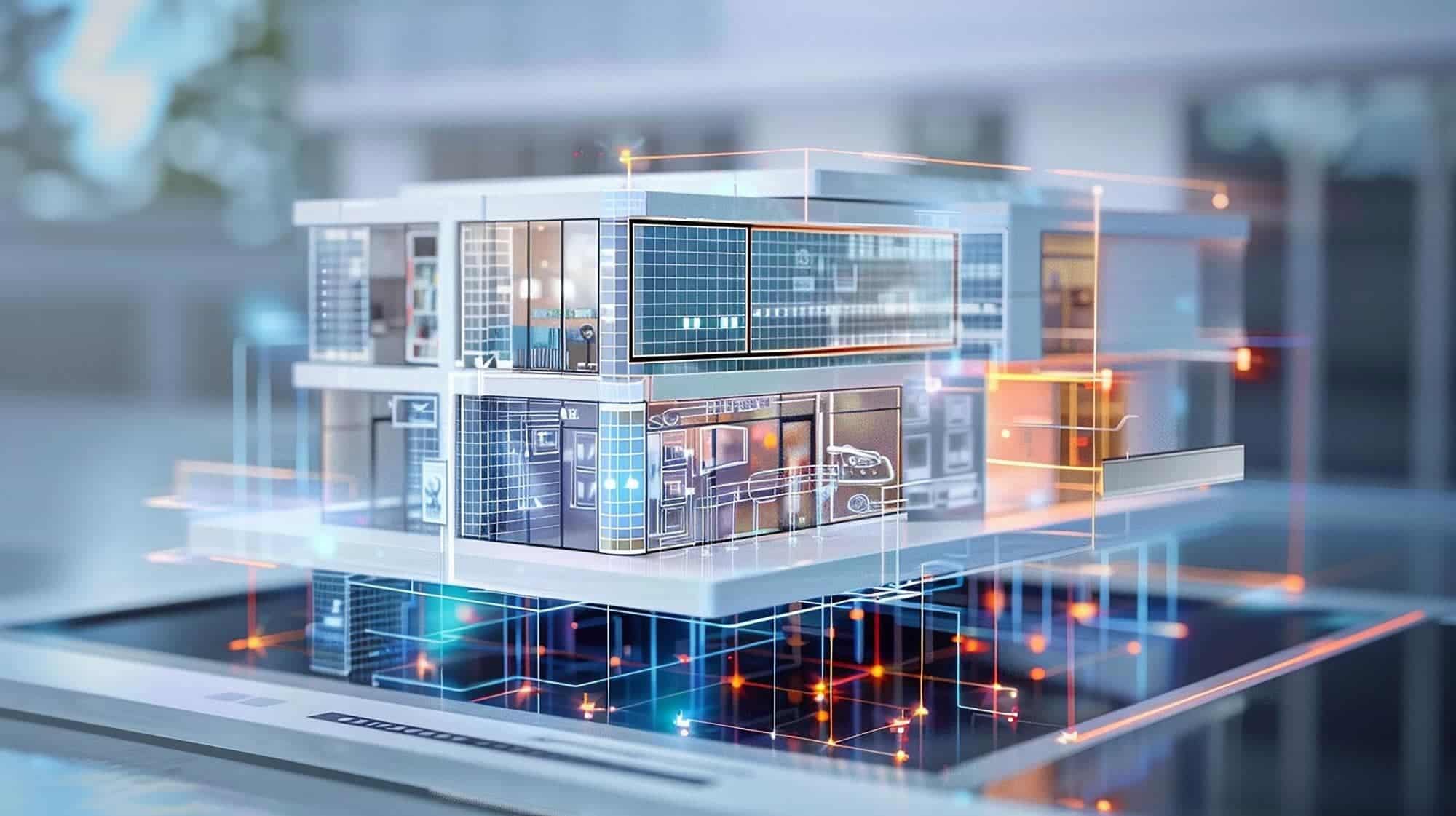
Among the most transformative developments enabled by IoT technology is the rise of digital twins - highly detailed virtual replicas of physical buildings connected to live operational data.
Unlike static 3D models, digital twins evolve continuously alongside the building itself. Sensor networks feed real-time information into the digital model, allowing architects and operators to visualize performance, detect inefficiencies, and simulate future scenarios.
This creates entirely new possibilities for long-term building management. Structural issues can be identified before they become critical. Maintenance can shift from reactive to predictive. Architects can test renovation strategies digitally before implementing physical changes.
Digital twins also extend the architect’s role far beyond the traditional design phase. Instead of handing over a finished building, architects may continue participating in performance optimization throughout the building’s lifecycle.
The boundary between design and operation is beginning to dissolve.
Construction Technology and Smarter Building Processes
IoT integration is not only changing finished buildings, it is also reshaping the construction process itself.
On construction sites, sensors can monitor material conditions, track equipment usage, and improve safety management. Concrete curing sensors ensure structural integrity by monitoring temperature and moisture levels during the curing process. Wearable devices can track worker location and identify potential safety hazards in real time.
These technologies improve efficiency, reduce material waste, and help streamline increasingly complex construction workflows.
IoT systems also complement the growing use of prefabrication and modular construction. Factory-built components embedded with smart technologies can arrive on site preconfigured and ready for integration, improving quality control while accelerating assembly timelines.
As architecture becomes more technologically sophisticated, the distinction between digital infrastructure and physical construction continues to blur.
Case Study: The Edge, Amsterdam
A leading example of IoT-driven architecture is The Edge, the Deloitte headquarters designed by PLP Architecture. Often described as one of the world’s smartest office buildings, The Edge uses thousands of embedded sensors to monitor lighting, occupancy, temperature, and energy use in real time.
The building automatically adjusts lighting and climate systems based on occupancy, reducing unnecessary energy consumption while improving user comfort. Employees can also connect to the building through a mobile app to locate available workspaces and personalize environmental settings.
Sustainability is central to the project’s design. A large glass atrium maximizes natural daylight, while solar panels help the building generate more energy than it consumes annually. Smart ventilation systems continuously adapt airflow according to indoor conditions, creating a healthier and more efficient workplace.
More than a high-tech office, The Edge demonstrates how architecture is evolving into a responsive environment that actively learns from and adapts to the people using it.

Photo Credit: Edge
Challenges of Designing Intelligent Buildings
Despite its enormous potential, smart architecture also introduces significant challenges.
Data privacy and cybersecurity have become critical concerns as buildings collect increasing amounts of occupant information. Architects and developers must carefully consider how data is stored, protected, and ethically managed.
Interoperability presents another obstacle. Many smart systems are developed by different manufacturers using incompatible platforms, making integration difficult. Without standardized frameworks, buildings risk becoming fragmented collections of disconnected technologies rather than cohesive intelligent environments.
There is also the question of technological obsolescence. While buildings may last decades or centuries, digital systems evolve rapidly. Architects must design infrastructure flexible enough to accommodate future technological upgrades without requiring complete reconstruction.
Most importantly, architects must ensure that technology enhances rather than overwhelms human experience. Smart systems should operate seamlessly in the background, supporting comfort, sustainability, and usability without turning buildings into overly complex machines.
Technology alone does not create meaningful architecture.
The Future of Responsive Cities
As IoT technology continues to evolve, its influence is expanding beyond individual buildings toward entire urban systems. Smart districts and connected cities are beginning to integrate sensor networks into transportation, utilities, public infrastructure, and environmental monitoring.
Buildings may soon communicate directly with power grids, transportation systems, and neighboring structures to optimize energy use and urban efficiency collectively. Real-time environmental data could influence everything from pedestrian routing to emergency response planning.
For architects, this signals a profound shift in professional responsibility. Designing buildings increasingly means designing nodes within larger networks of information, infrastructure, and human interaction.
Architecture is becoming less about creating isolated objects and more about shaping responsive ecosystems. The buildings of the future will not simply stand in cities, they will actively participate in them.
Save this story. A free account keeps your reading list and the 07:00 email in one place.
CREATE FREE ACCOUNT →SIGN IN