The Object That Refused to Change
Walk into almost any Chinese restaurant in America and you'll see them: the same symmetrical red or white lanterns, suspended above tables or strung along walls. They've become visual shorthand, a kind of decorative Morse code signaling "Chinese" without variation or nuance. For Aaron and Irisa Chan-Kawabi, founders of the Brooklyn studio Kawabi, those ubiquitous objects posed a question that extended far beyond lighting design. How does a cultural form move across borders, and what gets lost or frozen in translation?
The lantern, in its original context, carries weight. In Chinese folklore, these objects are talismanic, beacons that guide ancestral spirits home and ward off harm. But in the diaspora, the lantern often becomes a caricature of itself, reduced to a single aesthetic gesture. The Chan-Kawabis recognized something personal in that flattening. Irisa, born in China and raised in Massachusetts, and Aaron, born in Brooklyn to parents from Hong Kong, saw their own experiences reflected in the gap between the lantern's original significance and its American iteration.
Their response was to design lanterns that didn't replicate tradition but instead embodied the complexity of living between cultures. The result is a body of work that treats heritage not as a fixed inheritance but as raw material for invention.
Making Without a Template
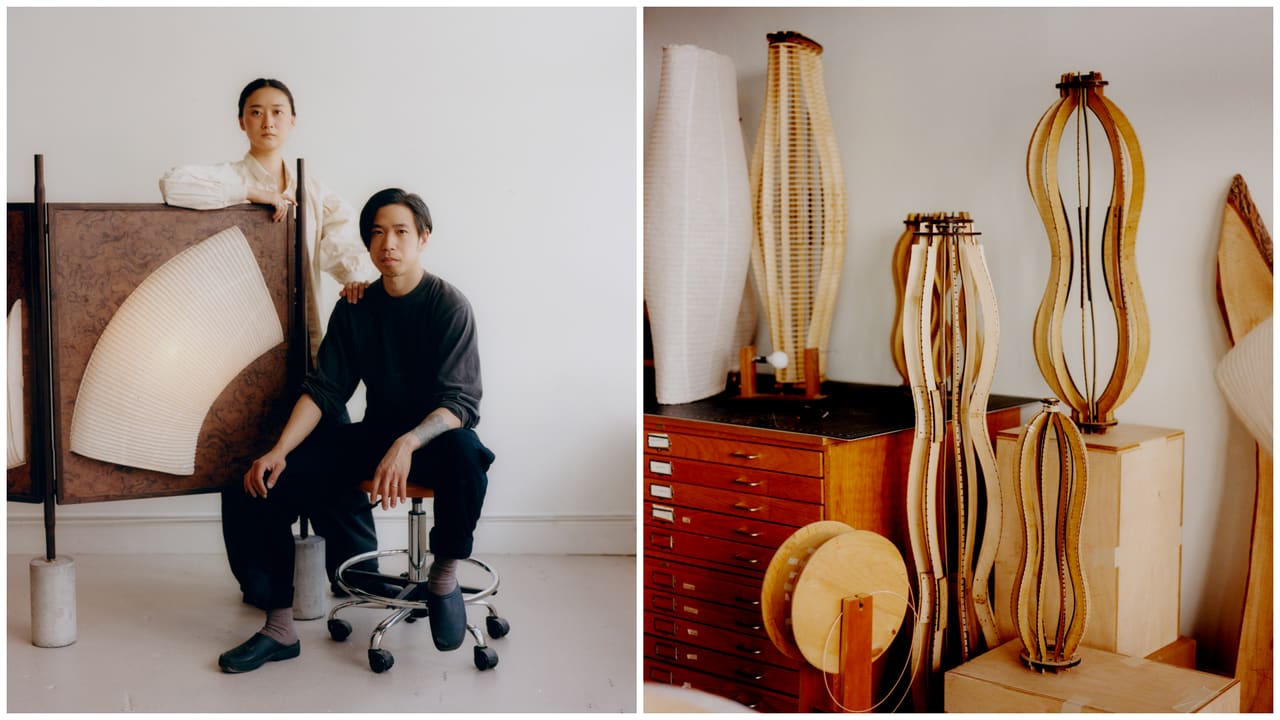
Kawabi launched in 2024, though the partnership began years earlier. Aaron and Irisa met on their first day at Parsons School of Design, where they maintained what Irisa describes as a "friendly rivalry." After graduation, they worked separately, Irisa as a product designer and Aaron as a fabricator, before merging their practices. Their approach to design is deliberate and hand-driven, with each piece made in their studio. Aaron describes the process as intuitive, saying they often don't fully understand what they're creating until they step back and critique it together.
The first lamp they produced, the Souvenir lamp, came out of necessity. Furnishing their home, they found nothing that resonated, so they built their own. The Souvenir suspends kozo paper, a traditional Japanese material, within a wood frame. The asymmetry is intentional, a departure from the rigid geometry of the lanterns they encountered in souvenir shops. Subsequent pieces reference bonsai trees, legumes, and folding screens, each one a hybrid of influences rather than a faithful reproduction of any single tradition.
Their technique draws from Japanese lantern-making methods, but also from the humble one-dollar paper shades found in hardware stores. This mixing isn't about fusion for its own sake. It's a reflection of how diasporic identity actually works: not as a clean synthesis of two cultures, but as an improvised negotiation between them.
The Archive That Isn't There
Irisa and Aaron describe their lamps as "cross-cultural relics," objects that document a relationship and a set of personal histories. But those histories are incomplete. Irisa notes that before starting Kawabi, they were preoccupied with lost stories, the gaps left by grandparents who passed away and relatives who chose not to speak about difficult memories. Design became a way to fill those silences, not with definitive answers but with speculative forms.
For Aaron, the stakes are even more layered. His half-Japanese grandfather was born in Canton during the Japanese occupation, a fact that complicates his relationship to Japanese techniques. Using kozo paper and Japanese joinery isn't about claiming a heritage he fully belongs to; it's about creating a different relationship to that history than the one his elders experienced. The work becomes a way to hold complexity without resolving it.
This approach distinguishes Kawabi from studios that treat cultural heritage as a branding exercise. There's no exoticization here, no attempt to package tradition for a design-literate audience. Instead, the lamps function as artifacts of a process, records of two people thinking through what they've inherited and what they choose to carry forward.
Collaboration as Expansion
Kawabi's newest collection, Amica, marks a shift in method. A collaboration with ceramic artist Christopher Merchant, the series explores what happens when the studio welcomes another material and another perspective into its process. Merchant's ceramics introduce a tactile density that contrasts with the delicacy of paper and wood, creating objects that feel more grounded, less ethereal.
The collaboration also tests the studio's principles. If Kawabi's work is fundamentally about the Chan-Kawabis' personal histories, can it expand to include someone else's voice without losing coherence? The answer, at least in Amica, seems to be yes. The collection retains the studio's interest in asymmetry and hybridity while pushing into new formal territory.
Other pieces in Kawabi's portfolio continue to explore the boundaries of the lantern typology. A walnut triptych embeds paper lanterns within a rigid wood structure, creating a tension between containment and fragility. The piece functions as furniture and lighting simultaneously, refusing to settle into a single category. It's a formal strategy that mirrors the studio's broader project: resisting easy classification, staying mobile.
Reclamation Without Nostalgia
Irisa frames Kawabi's work as an act of reclamation, though not in the way that term is often used. She's not interested in recovering a pure, unadulterated version of Chinese culture. Instead, she's claiming the right to define what heritage means from within the American context. "Heritage is part of the story," she says, "but our home is here."
That statement cuts against the grain of much contemporary discourse around cultural identity, which often privileges authenticity and rootedness. Kawabi's lamps don't assert authenticity. They assert something more interesting: the right to be unresolved, to borrow and adapt without seeking permission, to make objects that belong fully to neither the culture of origin nor the culture of residence.
This is a conversation that remains underdiscussed in design, even as the field becomes more globally interconnected. Diasporic designers are often asked to represent their heritage in ways that are legible and consumable, to serve as cultural translators. Kawabi refuses that role. Their lamps are not explanations. They're questions.
The Studio as an Ongoing Experiment
At World Archi Design, we've been tracking how younger studios are rethinking the relationship between craft and identity, and Kawabi offers one of the more compelling models we've encountered. The work is small in scale but ambitious in scope, using the lantern as a vehicle for exploring memory, dislocation, and belonging.
What makes the studio's output resonate isn't its technical virtuosity, though the craftsmanship is evident. It's the willingness to let the work remain open-ended, to treat each lamp as part of a larger inquiry rather than a finished statement. Aaron and Irisa are designing objects, but they're also designing a language for talking about who they are and where they come from. That language is still being written, and the lamps are the syntax.
In a field that often prizes clarity and resolution, Kawabi's commitment to ambiguity feels radical. The studio isn't trying to reconcile the contradictions of diasporic life. It's building a practice that makes space for them.
Credit: Jingyu Lin
Save this story. A free account keeps your reading list and the 07:00 email in one place.
CREATE FREE ACCOUNT →SIGN IN