The Territory of a Chair
In some households, a chair is never neutral ground. Growing up, Yinka Ilori learned that each seat belonged to someone, and occupying another person's chair felt like trespassing an invisible threshold. That childhood memory, where furniture carried unspoken codes of ownership and respect, now underpins an entire design practice. At World Archi Design, we've observed how designers increasingly treat domestic objects as cultural repositories, but few have made the relationship as explicit as Ilori does in his forthcoming monograph Chairman, scheduled for release this autumn through ORO Editions.
The 120-page volume documents more than ten years of work, presenting chairs not as static design solutions but as evolving narratives. Newly commissioned photography appears alongside archival documentation and studio process shots, tracking pieces from their origins as abandoned street finds through successive stages of transformation. The book also features contributions from poet and filmmaker Julianknxx, curator Jareh Das, designer Martino Gamper, and furniture designer Jane Atfield, each examining the work through different lenses: material culture, environmental responsibility, authorship, and diasporic experience.
A Design Language Formed Between Two Worlds
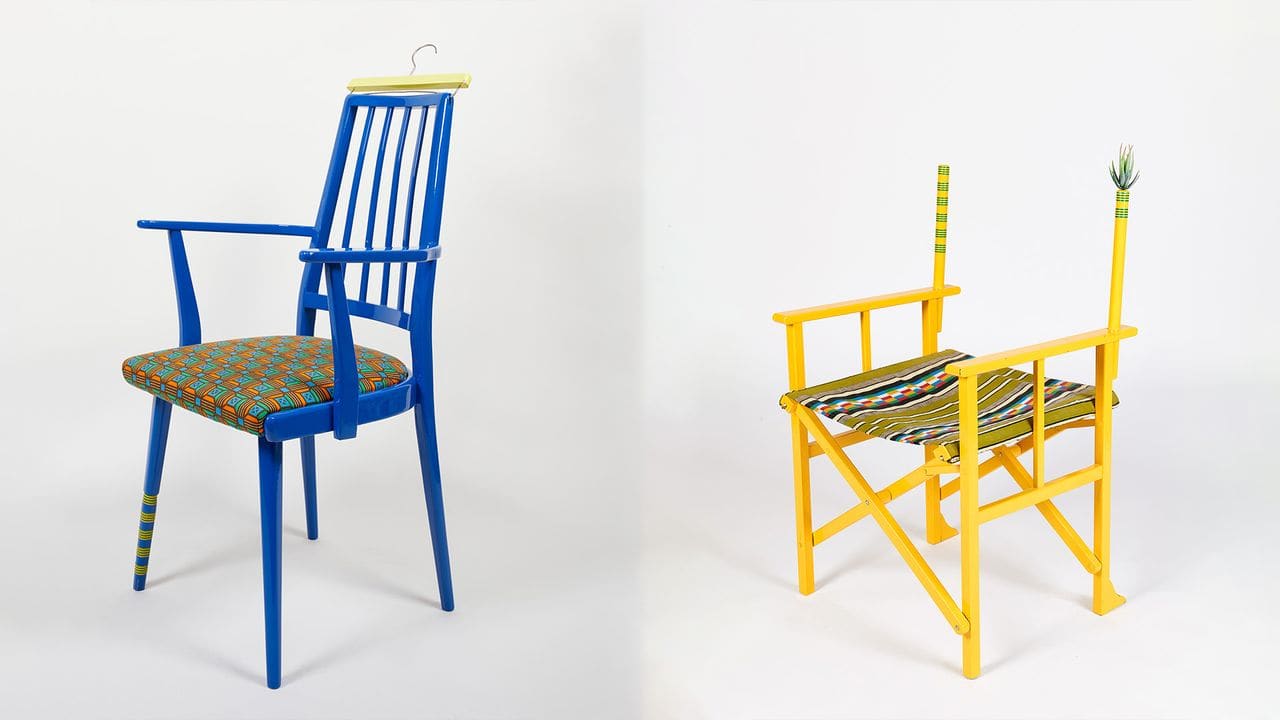
Ilori's methodology begins with salvage. He sources secondhand chairs from London's pavements and charity shops, selecting pieces that carry traces of British domestic life. What follows is a process of radical reinterpretation: arms are lengthened, legs shortened and reattached at new angles, backrests rotated to face unexpected directions. The original form remains legible, yet its meaning and sometimes its usability shifts entirely.
The interventions draw from a dual inheritance. British furniture typologies provide the structural foundation, while Nigerian textiles, bold chromatic choices, and oral storytelling traditions supply the decorative and conceptual layers. Ilori describes colour and pattern as arriving late in the process, comparable to dessert following a main course. This sequencing suggests a tectonic approach: first the bones, then the skin.
Many works originate with parables Ilori absorbed as a child. Rather than attempting literal translation, he extracts a single element - a word, a gesture, a character - and develops a physical vocabulary for it. A giraffe's elongated neck, for instance, might inform an exaggerated vertical proportion. The storytelling is allusive rather than descriptive, leaving room for multiple readings.
Authority, Scale, and the Politics of Sitting
The book's title references Ijoko Agba, a work Ilori completed in 2013. Translated as "Big Man's Chair," the piece engages with the Nigerian concept of the chairman: a figure of respect and authority. The work merges British furniture construction with African textile traditions, embodying Ilori's own navigation between two cultural contexts.
Another early piece, Oba Kekere (Small King), employs Aso Oke fabric from Ondo State, the birthplace of Ilori's late mother. He deliberately shortened one leg, then compensated with additional wood to restore balance. The resulting low profile evokes a child's seat, prompting questions about hierarchy and who gets assigned diminished status within social structures.
Osumare, the Yoruba word for rainbow, emerged from conversations about sexuality, masculinity, and faith. A friend's disclosure of long-suppressed feelings prompted Ilori to consider how judgement operates when others deem certain experiences illegitimate. The chair's lowered backrest physically manifests that burden of external evaluation.
Function as an Open Question
Not all of Ilori's chairs are practical. Some lose legs; others gain hooks positioned where they serve no obvious purpose. For Ilori, function exists as a variable rather than a fixed requirement. A chair might be sat upon, contemplated as sculpture, or interrogated as an object that refuses conventional use. The ambiguity is intentional, allowing viewers to determine their own relationship to the work.
Let There Be Light, completed in 2013, and If Chairs Could Talk from 2015 both play with these boundaries. The latter title makes the premise explicit: if these objects could articulate their own histories, what would they say? The question resonates with broader discussions in contemporary design about object agency and the narratives embedded in material culture.
Among the more recent works, Transparency Akoyawo I addresses the migration experiences of Ilori's parents. Rough apertures cut through the chair's body are filled with resin, exposing what Ilori describes as concealed pain and resilience. MCM textiles in brown, black, pink, and blue-grey wrap the surface, referencing lives constructed across multiple geographies.
Precedents and Context
Ilori's approach shares lineage with several design movements. The use of found furniture recalls the adaptive reuse practices of Studio Job and the Campana Brothers, though Ilori's work is more explicitly narrative. His integration of textile traditions aligns with designers like Doshi Levien, who similarly draw from non-Western craft histories to expand the vocabulary of contemporary furniture.
The deliberate impracticality of some pieces positions them closer to the critical design practices of Anthony Dunne and Fiona Raby, where function takes a backseat to provocation. Yet Ilori's work maintains a warmth and accessibility that distinguishes it from the cooler, more conceptual tenor of much speculative design. His chairs invite personal interpretation rather than demanding theoretical decoding.
Material as Archive
What makes Ilori's practice particularly compelling is its treatment of material as archival. Each chair becomes a site where personal history, cultural memory, and craft technique converge. The choice to work with discarded objects adds another temporal layer: these are pieces that have already lived one life, now given a second existence that acknowledges rather than erases that past.
This approach to materiality aligns with emerging thinking in conservation and adaptive reuse, where the history of an object or building is preserved through visible intervention rather than seamless restoration. The seams show. The additions are legible. The result is a kind of material palimpsest, where multiple timelines coexist within a single object.
A Broader Practice
The book arrives during an active phase of Ilori's career. This summer, he launched a forty-piece furniture and homeware collection with Dunelm, designed around themes of community, shared heritage, and accessible price points. The collaboration represents a significant scale shift, translating ideas developed through one-off pieces into production objects.
His first solo London gallery exhibition also opened recently at Cristea Roberts Gallery. Titled Joy Through Resistance: He Who Laughs Last, Laughs Best, the show expanded beyond furniture to include new paintings, prints, sculpture, and an immersive sound installation. The work demonstrates how Ilori's core concerns - identity, migration, cultural hybridity - can manifest across multiple media.
What the Archive Reveals
Chairman offers more than a retrospective. By gathering work from across a decade and framing it through multiple critical perspectives, the book clarifies the consistency of Ilori's concerns even as his formal language has evolved. The early pieces already contain the questions about belonging, authority, and cultural translation that continue to drive the practice.
For those of us tracking contemporary furniture design, the monograph provides valuable documentation of a designer whose work resists easy categorization. Ilori operates simultaneously as craftsperson, storyteller, and cultural commentator, using chairs as a medium to explore complex questions about identity formation in diasporic contexts. The work is celebratory without being uncritical, joyful without ignoring difficulty.
As design increasingly engages with questions of representation, heritage, and who gets to participate in shaping material culture, Ilori's practice offers a model. Not because it provides answers, but because it demonstrates how personal history and craft technique can combine to produce objects that carry genuine emotional and intellectual weight. His chairs speak not through literal language but through proportion, colour, material, and the deliberate disruption of familiar forms. The conversation they initiate is worth listening to.
Chairman by Yinka Ilori is published by ORO Editions and available for pre-order ahead of its autumn release.
Credit: Andy Stagg
Save this story. A free account keeps your reading list and the 07:00 email in one place.
CREATE FREE ACCOUNT →SIGN IN