Project Info
Project Name: Kappo Kappo
Interior Designer: Kelly Wearstler
Location: Austin Proper Hotel, Texas, USA

Backlit shoji grids smolder against charred cypress walls
The concept of kappo—the traditional Japanese dining style meaning "to cut and to cook"—implies a level of intimacy and transparency that is often translated architecturally into stark, clinical minimalism. However, Kelly Wearstler has never been one for silence. At Kappo Kappo, her latest intervention within the Austin Proper Hotel, the Los Angeles-based designer has flipped the script, delivering a 25-seat enclave that feels less like a temple and more like a subterranean grotto.

Chef's counter dissolves the boundary between kitchen and dining
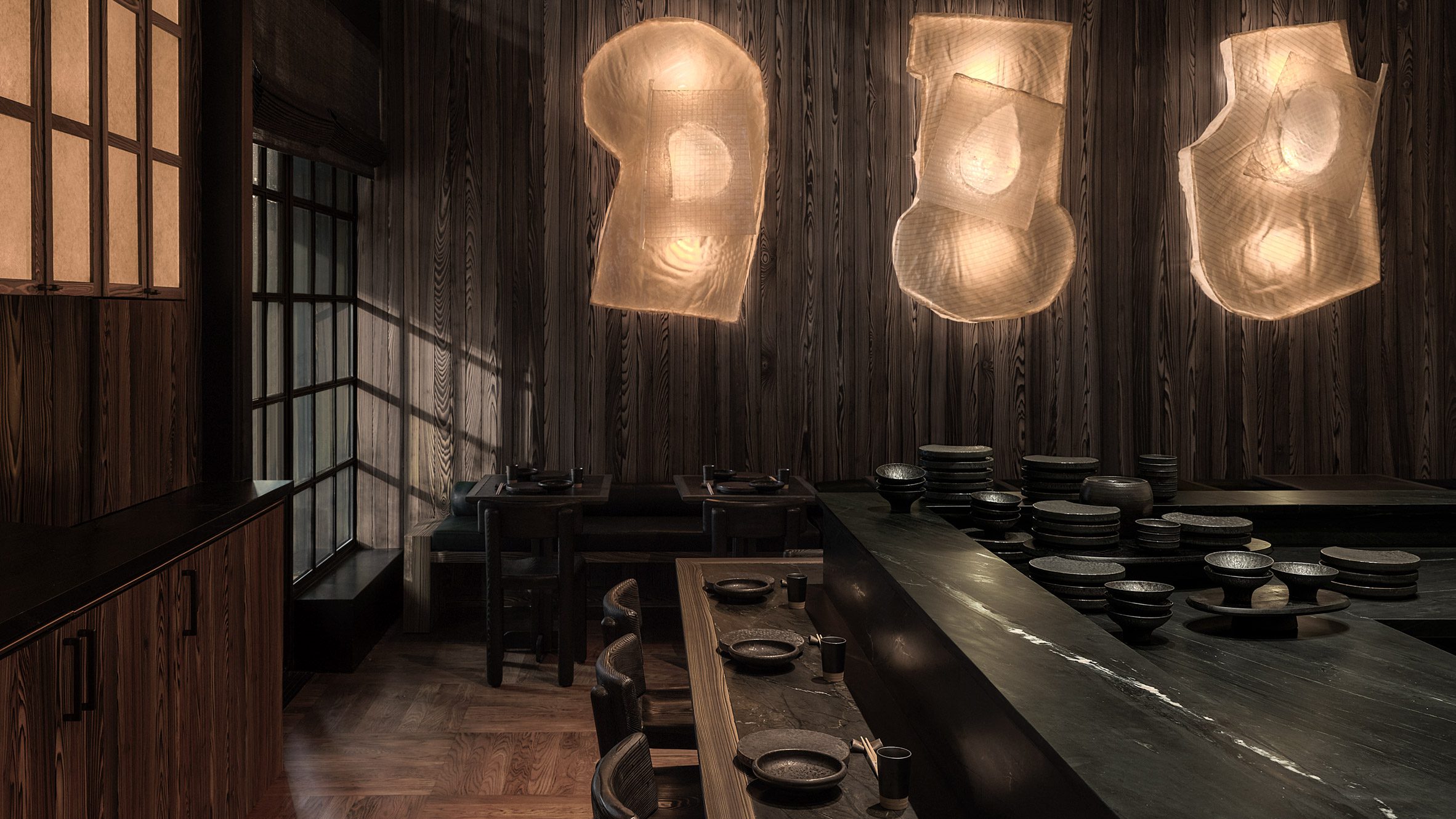
The restaurant, helmed by twin chefs Haru and Gohei Kishi, required a stage that could support their high-wire act of French-Japanese fusion. Wearstler’s response was to darken the room, shrinking the perceived volume to focus all attention on the chefs’ hands. The walls are clad in floor-to-ceiling slats of charred cypress, treated with the ancient Shou Sugi Ban technique. This carbonized timber absorbs light, eliminating glare and creating a hush that feels protective and enveloping. It is a textural nod to both the campfire traditions of Texas and the preservation techniques of Japan.

Shou Sugi Ban timber absorbs light, shaping intimate shadow
To break the heaviness of the blackened wood, Wearstler introduced a series of grid-like millwork screens. These are a modernized, muscular interpretation of delicate shoji screens. Instead of paper, they are framed in timber and back-lit with a deep, amber glow, housing the restaurant's collection of handmade ceramics and glassware. This lighting strategy is crucial; it does not flood the room but rather smolders, highlighting the edges of the furniture and the faces of the diners.

Amber-lit spirits nestle within the gridded millwork screen
The furniture itself is treated as sculpture. The standalone tables are carved from leathered stone, a finish that offers a tactile, pitted surface that feels ancient to the touch. These are paired with chairs made from ebonized, sandblasted pine, continuing the theme of raw, organic luxury. "We wanted to showcase the natural beauty of stone and balance all the wood," Wearstler explains, noting that the goal was to make the space feel "collected, not just designed."

A handcrafted paper lantern glows soft against darkened grain
The layout is centered around the chef’s counter, where 15 guests sit in close proximity to the action. Here, the barrier between the kitchen and the dining room dissolves completely. The design forces a confrontation with the process of making—the heat, the knife work, the plating—all framed by Wearstler’s moody, cinematic material palette.

Tile, timber, and darkness converge at the bar's edge
Kappo Kappo stands as a bold counterpoint to the bright, sun-soaked interiors of the surrounding hotel. It is a pocket of shadow and intensity, a place where the design does not just recede into the background but actively participates in the meal. Wearstler has created a space that matches the complexity of the Kishi brothers' menu, proving that in the right hands, darkness can be just as appetizing as light.
Raw artwork merges with the carbonized wood's textured grain

PHOTO CREDIT: Giulio Girardi
Save this story. A free account keeps your reading list and the 07:00 email in one place.
CREATE FREE ACCOUNT →SIGN IN