A Town Built on Waves and Calm
Chapadmalal sits in an unusual position along Argentina's Buenos Aires coastline. Equidistant from Mar del Plata and Miramar, the town draws wave riders and food travelers in equal measure, yet it refuses to surrender the agricultural rhythms that define much of the province's interior. This is not a beach town that pretends to be something else; it is farmland that happens to meet the Atlantic, a place where salt air mingles with the scent of turned earth.
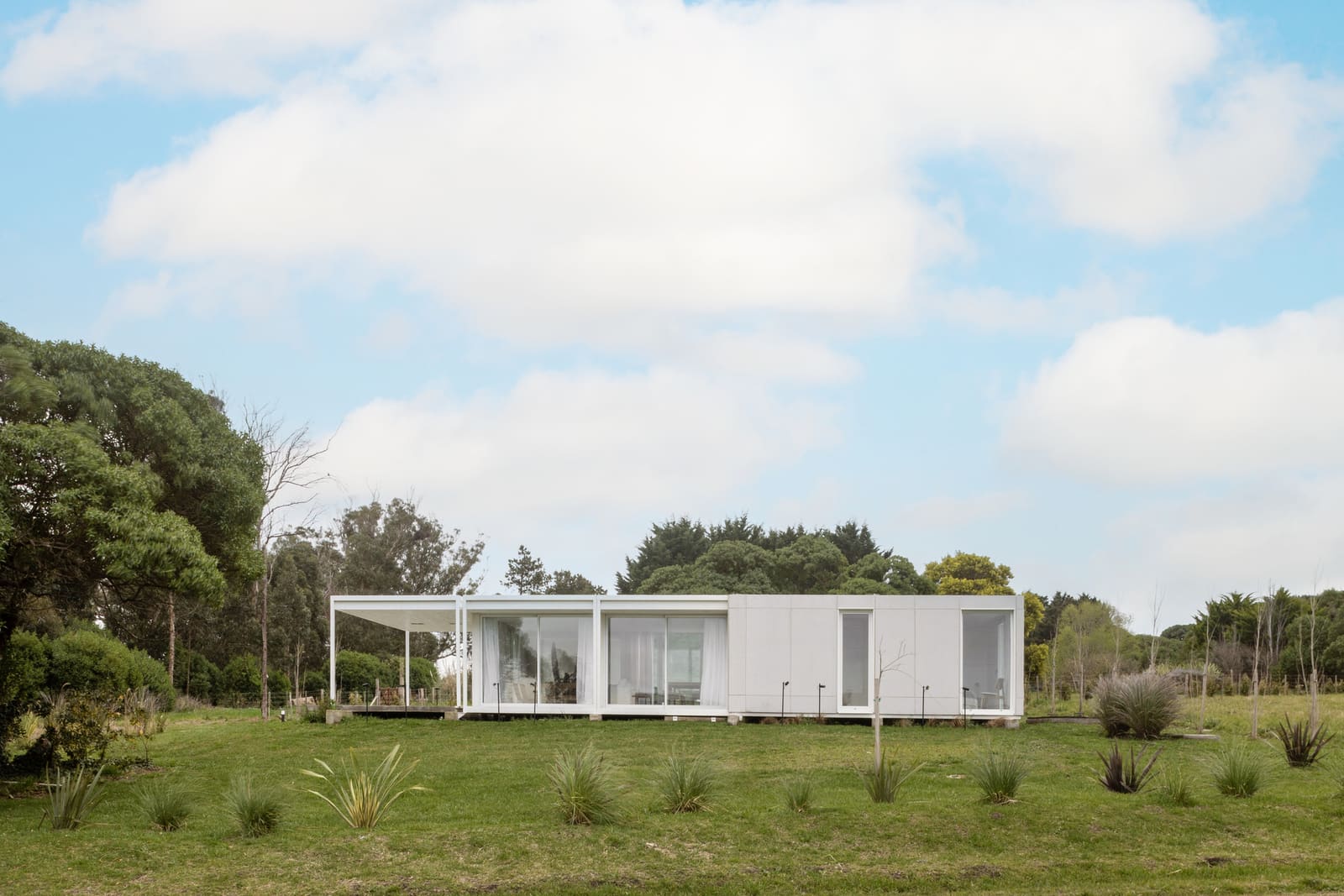
PLUG arquitectura modular designed Looking South House within this specific duality. Completed in 2023 under the direction of Juan Martín Roldán, with Mateo Nuss contributing to the design team, the 124-square-meter dwelling occupies a plot where the client's requirements centered less on square footage and more on orientation, both literal and experiential. The project's name signals its primary organizing principle: views and apertures face southward, an uncommon move in a region where northern exposure typically governs residential layouts.
Massing and the Modular Strategy
The house employs a modular construction approach, a method that PLUG has refined across multiple projects. Here, the strategy yields a compact footprint without sacrificing spatial generosity. The envelope reads as a single volume, but its internal organization reflects the efficiencies of prefabricated assembly. Walls align with structural grids, and service cores consolidate plumbing and electrical runs, reducing on-site complexity.
Roldán's plan privileges circulation as a spatial device rather than leftover space. Corridors widen at key moments to become informal gathering zones, and thresholds between rooms are treated as transitions worth designing. The modular system imposes discipline, but within that discipline, the house finds room for variation. Ceiling heights shift subtly, and window placement responds to specific views rather than a uniform fenestration pattern.
Material Choices and Regional Context
The material palette draws from manufacturers with established presences in Argentine construction: Etex for cladding systems, Aluar for aluminum profiles, Ferrum for fixtures. These are not exotic imports but locally sourced components, a pragmatic decision that also roots the house in its regional supply chain. The exterior cladding, likely a fiber-cement board system from Etex, provides weather resistance against the coastal environment's salt and wind without requiring intensive maintenance.
Inside, finishes remain restrained. Surfaces are smooth where they need to be, textured where warmth is required. The house does not announce its modular origins through exposed joints or overtly industrial detailing; instead, it uses the precision of factory-built components to achieve clean transitions and tight tolerances. This is modular construction as refinement rather than exhibition.
Orientation and the Question of Light
The decision to orient primary living spaces southward inverts conventional wisdom in the Southern Hemisphere, where north-facing rooms capture the most direct sunlight. In Chapadmalal's climate, however, southern light offers a different quality: diffuse, consistent, and less prone to the harsh glare that can overwhelm north-facing glass during summer months. The choice suggests a client who values evenness over intensity, and a design team willing to prioritize lived experience over prescriptive solar diagrams.
Large openings on the south facade frame views of the surrounding landscape, which transitions gradually from cultivated fields to coastal scrub. The fenestration strategy creates a cinematic relationship with this terrain, treating the exterior as a slow-moving composition rather than a static backdrop. Smaller apertures on other elevations provide cross-ventilation and borrowed light without diluting the house's directional emphasis.
Compact Footprint, Expanded Perception
At 124 square meters, the house operates within a scale that demands careful editing. Every room must justify its existence, and every element must perform multiple roles. PLUG's plan avoids the trap of over-subdivision, instead allowing spaces to flow into one another with minimal obstruction. The result is a house that feels larger than its actual dimensions, a perceptual expansion achieved through sightlines and spatial continuity rather than additional square footage.
This approach recalls the spatial economy of mid-century case study houses, where architects like Craig Ellwood and Pierre Koenig demonstrated that modest budgets and tight footprints could yield generous living environments. Looking South House does not mimic that aesthetic, but it shares the same underlying conviction: that careful design can outperform sheer size.
Precedents in Modular Coastal Architecture
PLUG's work in Chapadmalal exists within a broader lineage of modular beach houses that balance efficiency with site responsiveness. Glenn Murcutt's coastal projects in Australia, though bespoke rather than prefabricated, offer a relevant comparison in their attention to orientation and climate. Murcutt's houses often turn away from obvious views to capture oblique light and ventilation, a strategy that Looking South House echoes in its southward focus.
Closer to home, Argentine architects have long explored prefabrication as a tool for expanding access to quality housing. The country's modernist tradition includes experiments by Amancio Williams and Eduardo Catalano, both of whom investigated industrialized building systems. PLUG's work updates this legacy for contemporary coastal living, where clients seek efficiency without sacrificing design intelligence.
Living Between Two Landscapes
Chapadmalal's identity as both agricultural land and surf destination creates a unique spatial condition. Residents and visitors move between two distinct landscapes, each with its own rhythms and requirements. The house acknowledges this dual condition by refusing to choose one over the other. Its materials and construction logic speak to the practicality of rural building, while its orientation and fenestration respond to the coastal environment's light and views.
This synthesis matters beyond the specific project. As coastal areas worldwide face increasing pressure from tourism and development, architecture that can honor local character while accommodating new uses becomes essential. Looking South House suggests that modular construction, often associated with bland uniformity, can instead become a vehicle for regional specificity when guided by attentive design.
The Quiet Ambition of Restraint
What Looking South House ultimately demonstrates is that restraint can be its own form of ambition. The project does not announce itself through dramatic gestures or novel materials. Instead, it pursues clarity: in its plan, in its relationship to the site, in its use of available resources. This is architecture that trusts its decisions enough to let them speak quietly.
In a design culture that often rewards spectacle, such quietness can register as modesty. But there is nothing modest about the precision required to make 124 square meters feel expansive, or to turn a southward orientation into an asset rather than a compromise. PLUG arquitectura modular has delivered a house that understands its place, both geographically and within the broader conversation about how we build for coastal living in an era that demands efficiency, durability, and a lighter footprint.
Save this story. A free account keeps your reading list and the 07:00 email in one place.
CREATE FREE ACCOUNT →SIGN IN