When Architecture Meets the Recording Booth
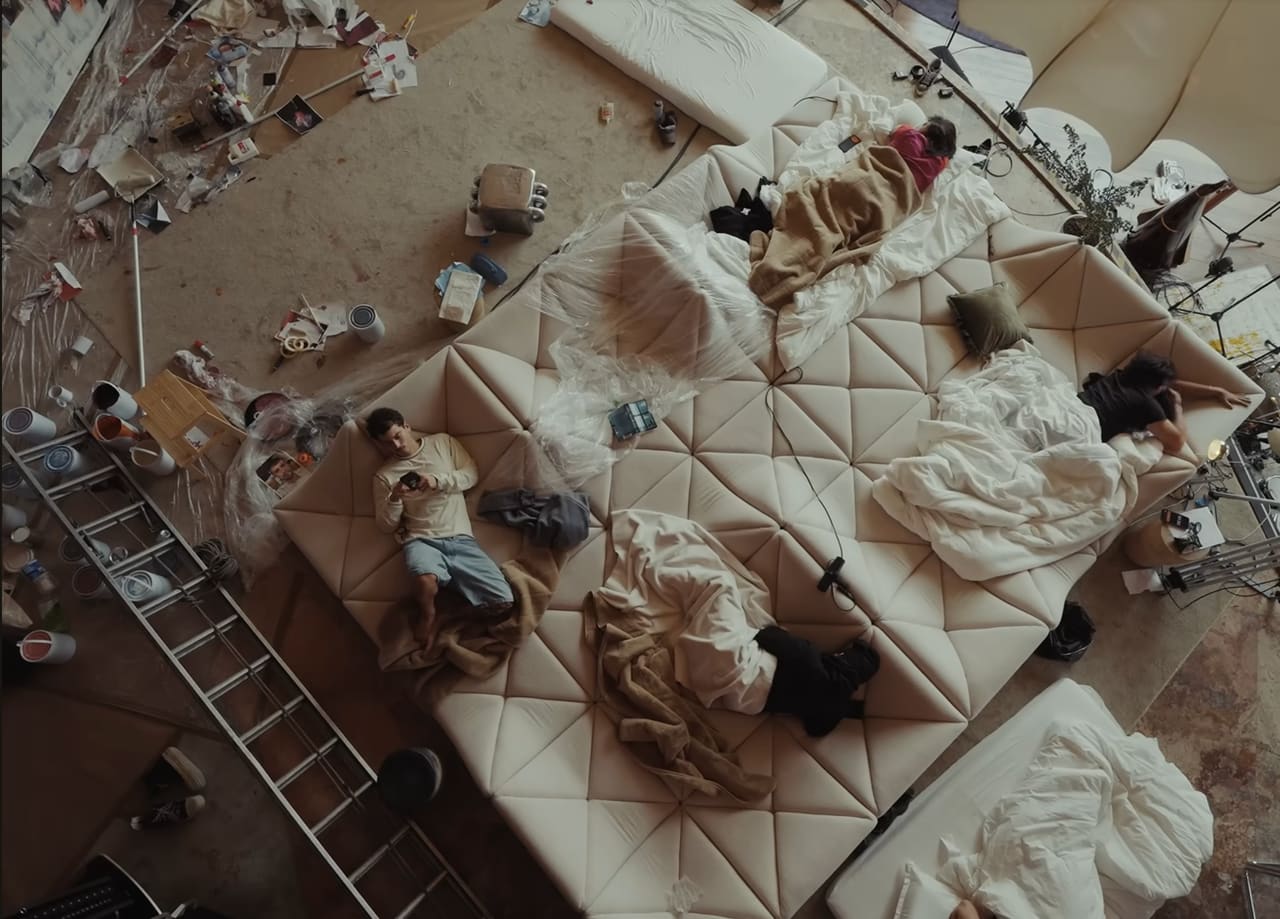
There's something profoundly fitting about watching musicians sprawl across furniture designed for conversation. At LagoAlgo, a cultural venue housed in a 1960s structure overlooking Bosque de Chapultepec's waters, British producer Fred Again.. and Mexican collective Latin Mafia spent weeks finishing their joint mixtape surrounded by Pierre Paulin's Dune sofa system. The piece, conceived decades ago but never produced during the French designer's lifetime, finally found its natural habitat: a space where creative exchange takes precedence over formality.
The pairing wasn't accidental. Benjamin Paulin, who stewards his father's design archive through the studio Paulin, Paulin, Paulin alongside his wife Alice, has made it his mission to pull these objects out of museum vitrines and into lived experience. At World Archi Design, we've been tracking how second-generation custodians handle modernist legacies, and this approach stands out for its willingness to let furniture do what it was designed for: facilitate human interaction, even when that interaction involves synthesizers and microphones.
The Landscape Principle
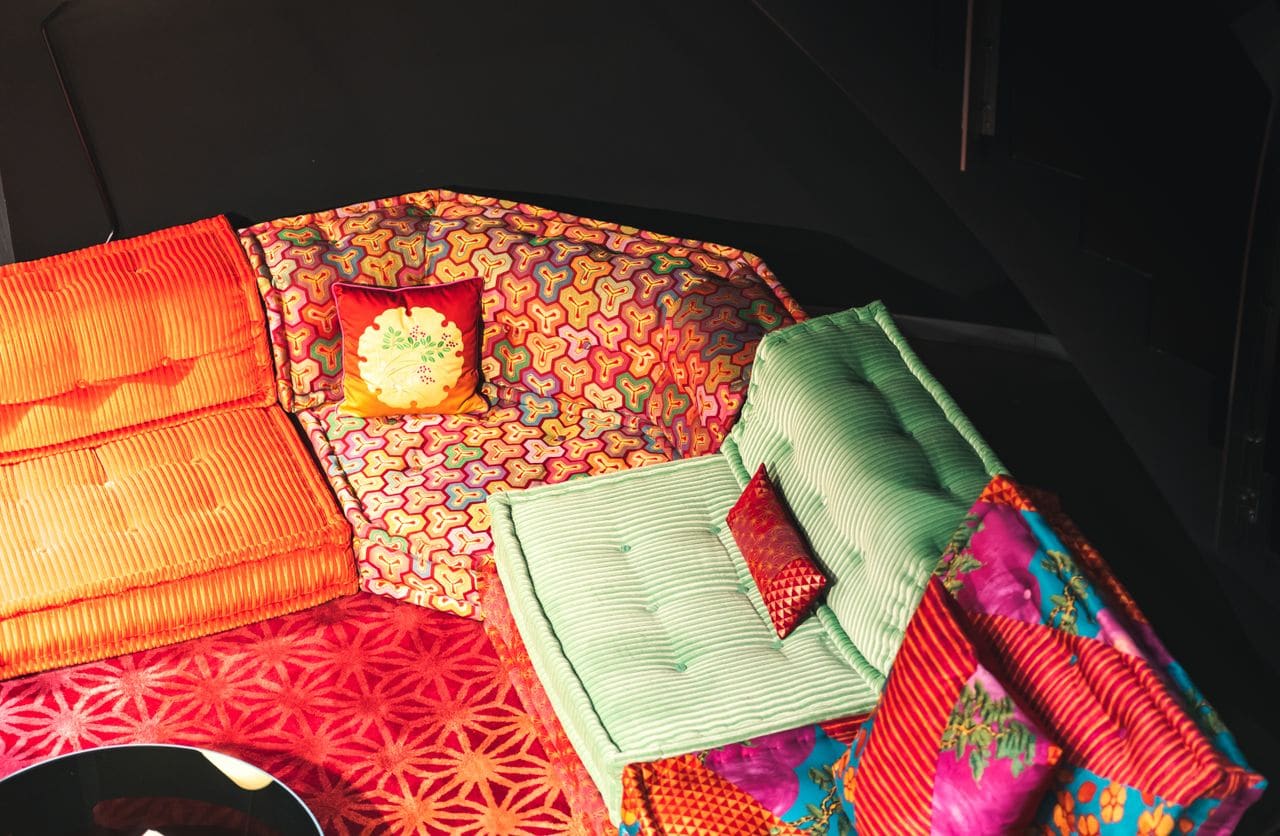
Pierre Paulin's work in the 1960s and 1970s challenged the very grammar of interior space. Rather than conceive rooms as collections of discrete objects, he imagined fluid topographies where seating, lounging, and circulation blurred into a single continuous surface. The Dune system embodies this philosophy most completely. Its modular components can be arranged and rearranged, creating valleys and peaks that respond to the body's need for support or sprawl.
In practice, this means no fixed orientation. Users approach the system from any angle, sink into its foam-filled volumes, and reposition themselves as conversation or mood shifts. For Paulin, this wasn't merely ergonomic experimentation; it was a spatial argument. If modernism had spent decades refining the chair, the table, the discrete unit, why not dissolve those boundaries entirely?
The LagoAlgo installation deployed multiple Dune modules across the studio floor, transforming the recording space into something closer to a salon than a technical facility. Musicians could recline while listening to playback, gather in clusters during collaborative sessions, or retreat into the system's recesses during solitary work. The livestream footage captures this fluidity: bodies shifting, postures changing, the furniture accommodating rather than dictating.
A Design That Never Was, Until Now
One of the more curious aspects of the Dune system is its production history, or lack thereof. Despite being widely celebrated in design circles and featured prominently in retrospectives of Paulin's career, the piece remained unrealized during his lifetime. Drawings, prototypes, and photographs circulated, but no manufacturer brought it to market at scale.
Paulin, Paulin, Paulin has since released the system in super-limited editions, positioning it as both archival artifact and functional furniture. This strategy reflects a broader tension in design preservation: how to honor a creator's vision while adapting to contemporary production realities and market conditions. By placing these rare pieces in high-visibility cultural contexts, rather than restricting them to collector living rooms, the studio argues that legacy lives through use, not sequestration.
The decision to install the Dune system at LagoAlgo extends this logic. The building itself, a modernist structure from the same era that birthed Paulin's most radical furniture ideas, provides contextual resonance. Both the architecture and the sofa emerged from a moment when designers believed spatial arrangements could reshape social behavior. Pairing them half a century later, in a context driven by collaborative music production, tests whether that optimism holds.
From Salon to Sound Lab
Benjamin Paulin has been explicit about his interest in music as a vehicle for his father's design philosophy. Earlier in 2025, Paulin, Paulin, Paulin launched Sounds Like Paulin, described as a cultural label centered on music. The initiative seeks to transform the historical concept of the salon into what Paulin calls an "immersive sound meeting place," a venue where artists from disparate backgrounds converge over shared listening and creation.
The LagoAlgo collaboration fits within this framework. Fred Again.., known for his sample-heavy, emotionally direct electronic productions, and Latin Mafia, whose work blends reggaeton structures with experimental textures, represent different sonic traditions. Their decision to co-create a mixtape over an extended residency, documented via livestream, mirrors the conversational, process-oriented ethos that Pierre Paulin embedded in his furniture.
Watching the recording sessions unfold, it becomes clear that the Dune system functions as more than backdrop. Its lack of hierarchy, its invitation to shift and reposition, supports the kind of lateral thinking that characterizes collaborative improvisation. There's no "head of the table" moment, no designated leader position. Instead, participants occupy the space as equals, negotiating ideas through proximity and movement.
Design as Dialogue
Paulin, Paulin, Paulin's involvement in the mixtape project reflects a curatorial strategy that prioritizes placement over preservation. Rather than safeguard Pierre Paulin's work behind glass, the studio positions these pieces within active cultural production. The resulting visibility serves dual purposes: it introduces the designs to audiences who might never encounter them in traditional design contexts, and it generates new associations that refresh the work's relevance.
This approach has precedents. In the 1970s, Verner Panton allowed his inflatable furniture to appear in nightclub environments, embracing the patina and wear that came with heavy use. More recently, studios like Established & Sons have revived modernist designs by placing them in unexpected retail and hospitality settings, demonstrating their adaptability beyond the domestic sphere.
What distinguishes the Paulin, Paulin, Paulin strategy is its emphasis on documentation. The LagoAlgo sessions were livestreamed, creating a public record of how musicians interact with the furniture over time. This transparency invites viewers to assess the design's functionality in real conditions, rather than accept curatorial claims about its theoretical merits. If the Dune system truly supports creative collaboration, the evidence unfolds in real time across hours of footage.
Legacy Through Circulation
The tension between preservation and activation defines much of contemporary design stewardship. Estates and archives face constant pressure to balance access with protection, to allow use without risking damage or dilution. Benjamin Paulin's response has been to embrace circulation, even when that means his father's work appears in contexts Pierre Paulin never anticipated.
A recording studio in Mexico City, populated by musicians whose genres didn't exist during Pierre Paulin's career, might seem far removed from the designer's original milieu of corporate interiors and presidential offices. Yet the underlying logic remains consistent: create spatial conditions that facilitate human connection and creative exchange. Whether that exchange involves policy discussions or mixtape production matters less than the furniture's capacity to support it.
This philosophy aligns with a broader shift in how institutions and inheritors approach modernist design. Rather than treat these objects as fixed historical documents, there's growing recognition that their meanings evolve through continued use and reinterpretation. A chair designed in 1965 accumulates new associations when placed in a 2025 context, and those associations don't diminish its original significance; they expand it.
What Endures
As the Fred Again.. and Latin Mafia mixtape circulates and the LagoAlgo sessions recede into documentation, the Dune system returns to its status as rare artifact. The super-limited production run ensures most people will never experience its particular combination of softness and structure firsthand. Yet the project's visibility, amplified through livestreaming and subsequent coverage, extends the design's reach beyond its physical scarcity.
This is perhaps the most contemporary aspect of Paulin, Paulin, Paulin's approach: using digital circulation to compensate for limited material availability. In an era when most people encounter design primarily through screens, a furniture system that appears in a widely watched creative process gains cultural presence that exceeds its production numbers. The Dune sofa becomes recognizable not because thousands own it, but because thousands have watched others use it.
Whether this model sustains Pierre Paulin's legacy long-term remains open. Design histories are written not only by curators and critics but by users, and user experience of the Dune system remains restricted to a small circle. Still, projects like the LagoAlgo collaboration suggest that legacy can circulate through channels other than ownership. Sometimes, watching furniture do what it was designed to do is enough to understand its value.
Save this story. A free account keeps your reading list and the 07:00 email in one place.
CREATE FREE ACCOUNT →SIGN IN