When Furniture Enters the Lyric Sheet
Pop culture has a way of canonizing objects we thought belonged solely to design history. When Charli XCX lists a particular modular sofa alongside handbags and hypothetical new lives in her track 'Card Declined', she signals something larger than a passing reference: the Mah Jong seating system, designed by Hans Hopfer in 1971, has crossed from the realm of modernist furniture into the vernacular of desire.
At World Archi Design, we've observed this phenomenon before. Objects that begin as solutions to spatial or domestic problems sometimes acquire a second life as cultural markers. The Mah Jong's journey from experimental seating landscape to lyrical shorthand reveals how design thinking rooted in flexibility and user agency can remain legible across five decades.
The Origins of the Seating Landscape
Hopfer, a German designer whose practice spanned painting, sculpture, and furniture, spent the 1960s interrogating what domestic seating could become. His early work for Mobiliar-Basar included the Bausystem in 1965, a sofa bed stripped to essential forms, and the Mobiliante two years later, which fused sofa, loveseat, and ottoman into a single adaptable piece. Both designs reflected a conviction that furniture should respond to the rhythms of modern life rather than dictate them.
The concept of a "seating landscape" emerged from this philosophy. Instead of discrete chairs or fixed sofas, Hopfer envisioned continuous, reconfigurable surfaces that households could shape according to shifting needs. This approach anticipated later developments in open-plan living and the blurring of traditional room hierarchies, though Hopfer's vocabulary remained resolutely low-slung and informal.
By 1971, when he partnered with Roche Bobois to develop the Mah Jong, Hopfer had just become a father. The timing mattered. He began thinking about furniture that could accommodate the unpredictable choreography of family life: play, rest, conversation, solitude. Initially called "The Forever Sofa," the design was later renamed after the Chinese tile game, whose rectangular pieces its cushioned modules visually echo.
Modularity as Principle
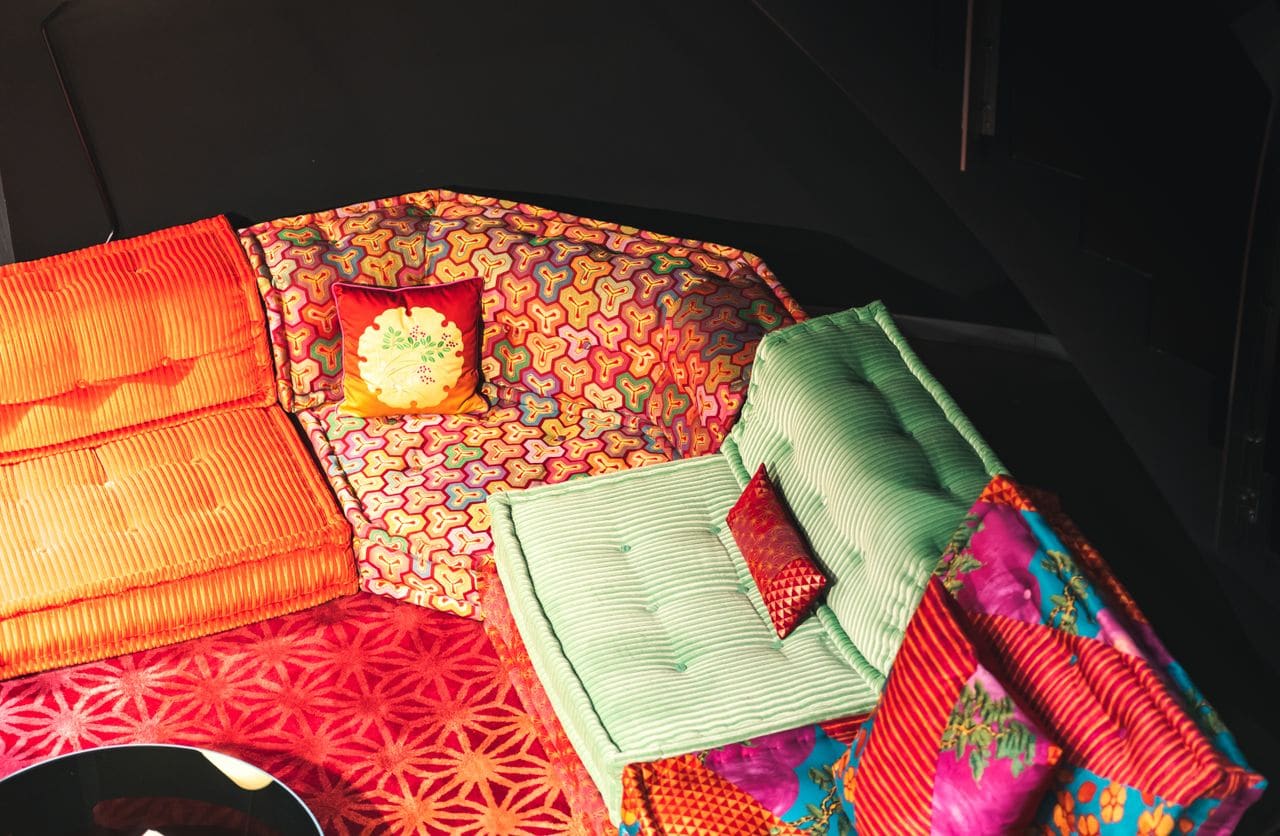
The Mah Jong's formal language is deceptively simple. Three core elements - a corner module, a back cushion, and a flat base - can be arranged into virtually limitless configurations. Users become co-designers, assembling compositions that fit their spatial constraints and social habits. In the early 1970s, this degree of agency was uncommon. Furniture was typically purchased as fixed objects; the idea that a sofa could be perpetually reimagined ran counter to established retail and domestic conventions.
Early iterations featured cleaner cushion edges and more uniform seams. Over time, the design evolved to emphasize visible stitching and irregular borders, embracing an aesthetic that reads as deliberately handmade. This shift reinforced the sofa's participatory ethos: it looks like something you might assemble yourself, even as its construction remains rigorously engineered.
Roche Bobois has since introduced platform bases, adjustable backs, and weather-resistant versions for outdoor use. These additions extend the system's reach without diluting its core principle. The Mah Jong remains a kit of parts rather than a finished statement, which is precisely why it adapts so readily to different eras and tastes.
Textile as Identity
Material choices have always been central to the Mah Jong's identity. From the outset, Hopfer and Roche Bobois treated upholstery not as a secondary decision but as a defining characteristic. Bold patterns, saturated colors, and textile collaborations with designers like Kenzo Takada, Missoni, and Sonia Rykiel have turned each configuration into a distinct visual proposition.
This approach aligns with broader 1970s design currents: the embrace of pattern, the rejection of monochrome minimalism, and the celebration of craft traditions. But it also serves a practical function. When modules can be rearranged at will, textile becomes the unifying element that holds disparate pieces together. Mix-and-match compositions work because the fabric asserts coherence across a sprawling seating field.
The sofa's aesthetic demands space. In smaller rooms, its low profile and expansive footprint can overwhelm. But in loft-like environments or open-plan interiors, the Mah Jong fulfills Hopfer's original ambition: it becomes a landscape, a topography of cushions that invites occupation from multiple angles and postures.
Precedents and Parallels
Hopfer's seating landscape concept has clear antecedents. The Italian radical design movements of the 1960s - particularly groups like Archizoom and Superstudio - explored modular, anti-hierarchical furniture systems that questioned bourgeois domesticity. Joe Colombo's Tube Chair (1969) and the inflatable seating experiments of the same period share the Mah Jong's interest in flexibility and informal use.
Yet Hopfer's design diverges in crucial ways. Where radical design often pursued provocation or utopian critique, the Mah Jong remained grounded in comfort and durability. Its modularity was not a conceptual gesture but a pragmatic response to how people actually live. This balance between avant-garde thinking and everyday usability helps explain its longevity.
Contemporary parallels include Vitra's Alcove seating system and the resurgence of pit-style sofas in residential design. Both reflect ongoing interest in furniture that accommodates multiple users and activities simultaneously. But few designs have achieved the Mah Jong's cultural penetration, where the object itself becomes a recognizable symbol beyond design circles.
From Counterculture to Pop Reference
The Mah Jong's appearance in a Charli XCX lyric is not accidental. Pop music has long cataloged consumer desire, and the objects that appear in lyrics often carry specific connotations. The sofa's bohemian coding - its association with informal living, artistic lifestyles, and a certain kind of curated domesticity - makes it legible as a status marker distinct from conventional luxury goods.
This kind of cultural visibility is rare for furniture. Eames chairs and Barcelona lounges occasionally surface in film and media, but usually as background signifiers of taste. The Mah Jong, by contrast, has been named outright, positioned alongside other aspirational items. It suggests that modularity, comfort, and bold pattern have acquired a new kind of cachet.
At the same time, the reference highlights a tension inherent in design longevity. Objects conceived as democratic and flexible can, over time, become expensive and exclusive. The Mah Jong's modular ethos was meant to empower users, yet its current market position places it firmly within the luxury segment. Whether this contradiction undermines or enriches its legacy depends on how one values accessibility versus craft.
What Endures
Design objects that survive multiple decades typically do so because they solve a problem elegantly or because they capture something essential about their moment. The Mah Jong achieves both. Its modular logic addresses real spatial and social needs, while its aesthetic - low, plush, pattern-forward - embodies a particular vision of domestic freedom that still resonates.
Hopfer's original ambition was to create furniture that could evolve alongside its users. Fifty years later, the Mah Jong continues to do exactly that, adapting not only to individual households but to shifting cultural contexts. Its journey from experimental seating landscape to pop culture touchstone suggests that the most enduring designs are those that invite participation, refusing to impose a single, fixed identity.
In an era increasingly defined by customization and user-driven experiences, the Mah Jong's modularity feels less like a relic of 1970s counterculture and more like a prescient model for how we want to inhabit space. Whether that space is a loft, a showroom, or a lyric sheet, the sofa's adaptability remains its most radical feature.
Credit: Getty Images
Save this story. A free account keeps your reading list and the 07:00 email in one place.
CREATE FREE ACCOUNT →SIGN IN