The Collision of Protective Technology and Fashion Provocation
There's a particular kind of design practice that thrives at the intersection of material science and narrative excess. It's a space where technical specification becomes storytelling device, where the language of catastrophe preparedness bleeds into lifestyle product. Vollebak, the London design studio founded by twin brothers Nick and Steve Tidball, has carved out this territory with remarkable consistency. Their latest project, a strictly limited run of ten trench coats fabricated from the same polychloroprene rubber used in airtight chemical protection suits, pushes that fusion further still.
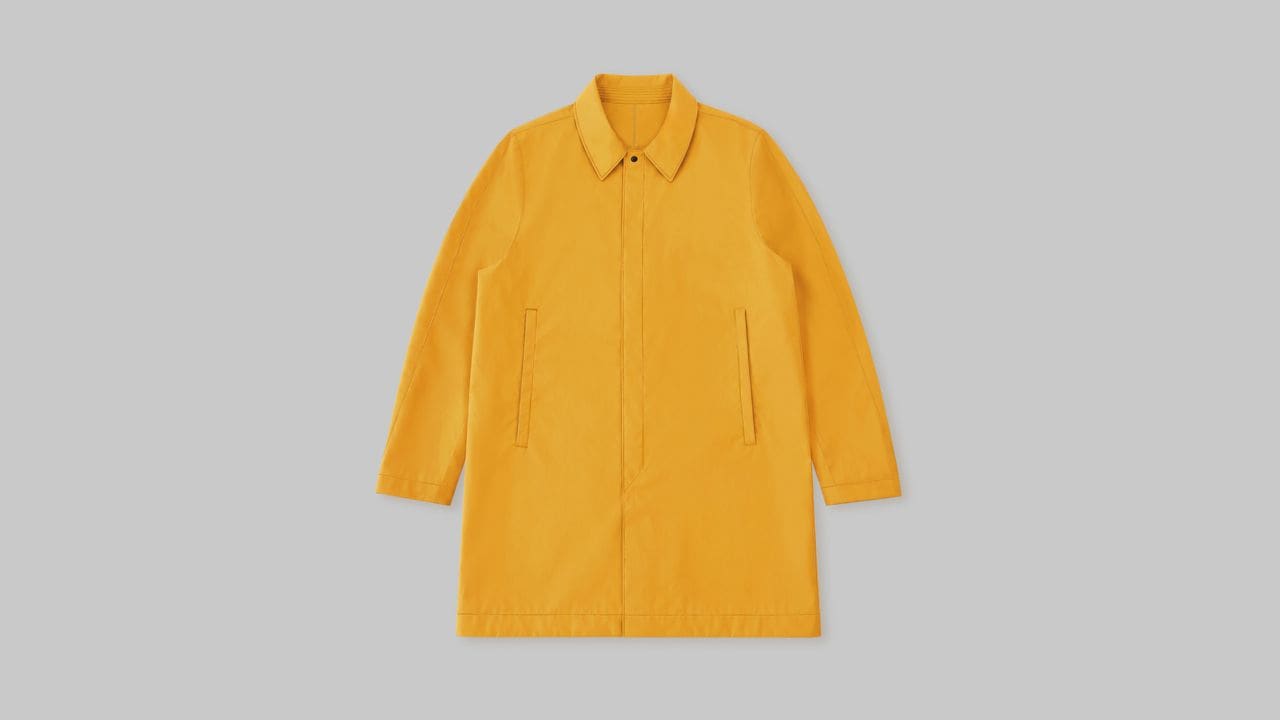
The garment itself arrives as FWAHBL, an acronym that expands to "For When All Hell Breaks Loose." It's a name that announces its own absurdity while simultaneously grounding the project in a very real material history. The vivid yellow fabric at the core of this piece isn't speculative; it's deployed daily in industrial accident response, chemical spill containment, and military hazmat operations. What Vollebak has done is extract that material from its utilitarian context and recontextualize it through fashion's grammar of cut, silhouette, and cultural signaling.
A Textile With Industrial Lineage
The fabric specification tells its own story. Double-faced polychloroprene rubber, bonded to both sides of a woven polyester core, delivers resistance to oils, ozone, and flame. Vollebak developed this particular iteration in collaboration with the Fothergill Group, a British textile manufacturer with roots stretching back 179 years to cotton weaving and khaki uniform production for military deployment. Fothergill continues to supply the British Army with advanced protective textiles, situating this project within a lineage of performance-driven material innovation rather than purely aesthetic experimentation.
Polychloroprene itself, a synthetic rubber first commercialized in the 1930s, has long been valued for its chemical stability and mechanical resilience. In protective equipment contexts, the material's impermeability makes it essential for environments where exposure to hazardous substances poses immediate risk. Translating that impermeability into a garment meant for everyday wear requires negotiating between the material's inherent stiffness and the drape required for a trench coat silhouette. The result is a garment that reads as both familiar and estranging, a recognizable form rendered in an unmistakably industrial substrate.
Narrative Architecture as Product Strategy
What distinguishes this release from straightforward technical outerwear is the elaborate world-building apparatus Vollebak has constructed around it. The jacket arrives embedded in a package of AI-generated comic book imagery, film trailer, retro video game aesthetics, and promised interactive digital content. It's a marketing strategy that treats the garment as narrative artifact rather than standalone product, a prop from a fictional universe that happens to be wearable in ours.
The visual language draws heavily from 8-bit arcade culture, pixel art, and the iconography of boss battles and digital apocalypse. Vollebak frames this as "a love letter to 40 years of gaming," moving through the aesthetic evolution from early arcade cabinets through contemporary photorealistic rendering. The AI-generated imagery that saturates the campaign carries the telltale smoothness and uncanny compositional logic that marks machine learning output, a choice that feels both deliberately provocative and oddly fitting for a garment positioned at the edge of utility and fantasy.
Yet beneath the promotional theatrics sits a genuine design question: what happens when materials engineered for worst-case scenarios migrate into everyday contexts? The studio is careful to note that the jacket is not certified safety equipment, that it's "built for bad weather and existential dread, not actual chemical spills." That disclaimer is crucial. It acknowledges the garment's conceptual relationship to disaster preparedness while declining to make functional claims it can't support. The piece occupies a space between costume and equipment, between preparedness and performance.
Material Culture and the Language of Preparedness
Vollebak's broader catalog reveals a consistent interest in material experimentation as design driver. Previous projects have incorporated graphene for thermal regulation, copper for antimicrobial properties, and electromagnetic shielding fabrics. The Sonic Jacket, embedded with 180 speakers to deliver frequencies from 4 Hz to 20,000 Hz across the wearer's body, pushed wearable technology into sensory manipulation territory. A collaboration with Bang & Olufsen yielded a futuristic retail unit exploring the spatial language of high-tech commerce. There was even discussion of a Bjarke Ingels-designed island retreat in Nova Scotia, though that project's status remains speculative.
What unites these efforts is a willingness to treat garment design as a vehicle for material narrative. Each project begins with a technical substrate, graphene or copper or polychloroprene, and constructs a speculative use case around it. The approach inverts conventional fashion development, where aesthetic direction typically precedes material selection. Here, the material's properties generate the conceptual framework, and the garment becomes a demonstration of what that material might enable or symbolize.
The FWAHBL jacket's bright yellow surface carries its own semiotic weight. High-visibility yellow has long served as visual shorthand for caution, hazard, and institutional authority. It's the color of emergency response, of construction zones, of spaces where risk is managed through visibility. Deploying that color in a trench coat silhouette creates immediate cognitive dissonance, the language of safety equipment colliding with the codes of urban fashion. It's a garment that announces itself from across a street, that refuses to disappear into the visual field of everyday dress.
The Economics of Scarcity and Spectacle
At £2,995 and limited to ten units, the jacket operates firmly within luxury object territory. That pricing and scarcity model positions it less as functional outerwear and more as collectible artifact, a piece for those who view wardrobe as material culture archive. The edition size ensures the garment will remain rare, while the price point signals that this is an object for serious collectors rather than casual enthusiasts.
This approach mirrors strategies deployed by contemporary art practice, where limited editions and high price points create aura and exclusivity. It's a model that works when the object in question carries sufficient conceptual or material interest to justify its positioning. Whether a trench coat made from chemical protection fabric, however well-executed, meets that threshold will depend largely on how one values the convergence of technical material and speculative narrative.
Precedents in Performance Garment Design
The project invites comparison to other studios working at the boundary of technical performance and fashion provocation. Acronym, the German-based design house founded by Errolson Hugh and Michaela Sachenbacher, has long explored military and technical garment construction within fashion contexts. Stone Island's decades-long investment in textile research and garment dyeing technology demonstrates sustained engagement with material innovation as brand identity. More recently, A-COLD-WALL*'s Samuel Ross has incorporated industrial materials and construction techniques into garments that bridge streetwear and conceptual fashion.
What distinguishes Vollebak's approach is the degree to which narrative construction and world-building drive the project. Where Acronym emphasizes functional utility and modular design, and Stone Island foregrounds textile research, Vollebak wraps its material experiments in layers of speculative fiction and gaming culture reference. It's a strategy that risks overshadowing the garment itself, turning the actual object into a footnote to its own promotional apparatus.
The Gap Between Claim and Function
The studio's disclaimer that the jacket is not certified safety equipment opens up interesting territory around design responsibility and consumer expectation. By explicitly stating the garment won't protect against actual chemical spills, Vollebak acknowledges the gap between the material's industrial application and its fashion deployment. The fabric may be chemically resistant, but cut, construction, and finishing determine whether a garment actually provides protection. Seam sealing, closure systems, and fit all matter enormously in protective equipment contexts. A trench coat, however well-made, cannot deliver the hermetic seal required for hazmat environments.
This gap between material capability and garment function is worth examining. It reveals how design can appropriate the visual and tactile language of protective equipment without assuming the responsibility that comes with actual protective function. The result is a garment that signals preparedness without delivering it, that borrows the aesthetic authority of industrial safety gear while operating purely within fashion's symbolic register. It's costume in the sense that theater uses the term: clothing that communicates character and context rather than providing utilitarian service.
Curation as Compensatory Strategy
The elaborate packaging, the AI-generated comic, the promised video game, all function as curatorial apparatus designed to elevate a relatively simple garment into something resembling transmedia narrative. It's a strategy that acknowledges the limitations of the object itself, recognizing that a yellow trench coat, however unusual its material, requires additional layers of meaning-making to justify its positioning and price.
Whether that curation succeeds depends largely on how much one values design as storytelling practice. For some, the layered narrative will enrich the garment, transforming it from jacket into artifact within a larger fictional universe. For others, it will read as compensatory excess, an attempt to obscure the relative simplicity of the core object through surrounding noise. Both readings are defensible. What's clear is that Vollebak has committed fully to the latter approach, building out a world dense enough to make the garment feel like one element within a larger system rather than a standalone piece.
The Studio's Trajectory and Future Experiments
Vollebak's trajectory suggests a studio more interested in spectacle and material provocation than in building a sustainable garment business. The limited editions, the high price points, the collaborations with figures like Bjarke Ingels, all point toward a model that values cultural visibility and design discourse over volume production. It's an approach that works when each release generates sufficient attention to maintain momentum until the next project arrives.
The question is whether that model can sustain over time, and whether the studio's embrace of AI-generated imagery and gaming culture aesthetics will age well or quickly feel dated. AI's visual language is evolving rapidly; what reads as cutting-edge in 2025 may look quaint by 2027. Similarly, the retro gaming nostalgia that saturates this project trades heavily on millennial and Gen X cultural memory, a reference pool that may not resonate as strongly with younger audiences.
What remains compelling is the core impulse: to take materials engineered for extreme scenarios and explore what they might mean when relocated into everyday contexts. That's a legitimate design investigation, one that asks how we understand preparedness, risk, and resilience through the objects we choose to wear. The FWAHBL jacket, beneath its layers of promotional excess, engages that question. Whether it answers it convincingly is another matter entirely.
Save this story. A free account keeps your reading list and the 07:00 email in one place.
CREATE FREE ACCOUNT →SIGN IN