The Observation Deck Reimagined
Observation platforms have long occupied an awkward position in the architectural canon. They exist primarily as vantage points - spaces to look from rather than at. Yet at the Edge platform atop 30 Hudson Yards, a collaboration between Softlab and Moment Factory attempts to redefine this passive relationship. Positioned on the 100th floor of the Kohn Pedersen Fox-designed tower, the Western Hemisphere's highest indoor-outdoor sky deck now hosts seven immersive installations that transform the act of observation into something closer to spatial participation.
The interventions draw from a vocabulary we've seen mature over the past decade - kinetic surfaces, responsive lighting, prismatic geometries - but apply them to a context where the architecture itself is already performing. The question becomes: how do you design for a space where the city below is the primary spectacle?
Capturing Urban Energy Through Repetition
Softlab's Pulse installation operates through multiplication. Four hundred and fifty suspended spheres fill a sequence of interconnected rooms, each orb programmed to shift through gradients derived from Edge's brand palette - blues of midday sky transitioning to amber sunset tones. The choreography responds to visitor movement, creating what the studio frames as a microcosm of urban energy.
The choice of spheres is deliberate. Unlike the angular geometries that dominate Hudson Yards' architectural language, the globes introduce softness and repetition. They recall Olafur Eliasson's serial installations, though here the interactivity is more subtle - a gentle pulse rather than dramatic transformation. The system employs generative algorithms to ensure variation across visits, a technical approach that mirrors how TeamLab has used computational design to create perpetually evolving environments.
What makes Pulse effective is its restraint. The color shifts are gradual, the pulsing rhythmic but not overwhelming. In a context where visitors are already processing one of the most expansive urban panoramas in North America, the installation provides a moment of transition - a decompression chamber between elevator and open air.
Prismatic Space as Urban Metaphor
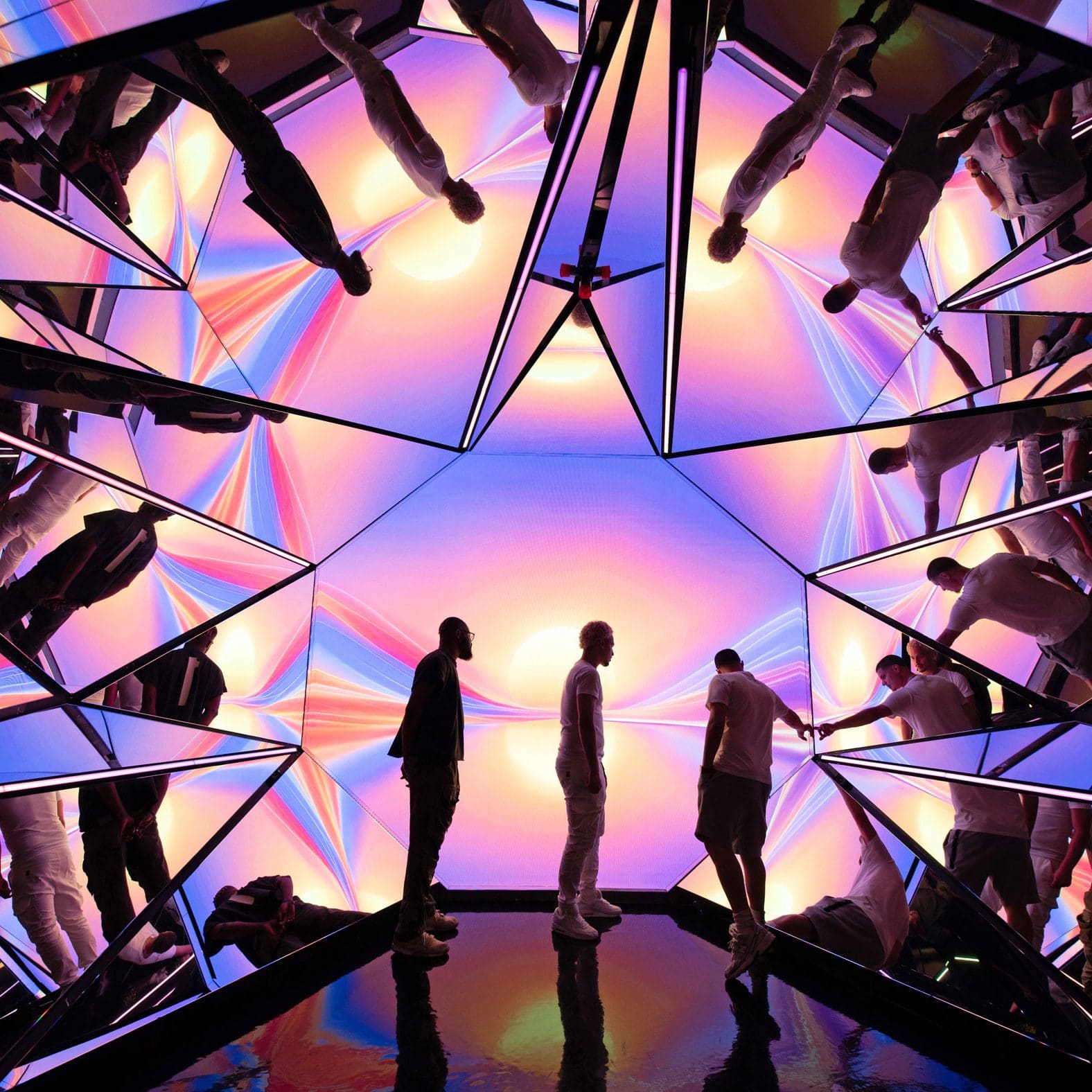
Moment Factory's Kaleidoscope suite takes a more assertive stance. The centerpiece - a walk-in kaleidoscope that the venue bills as New York's largest - surrounds visitors with multiplying reflections and shifting digital patterns. The technical execution combines highly reflective architectural surfaces with synchronized media content, creating what amounts to an infinite regression of geometry and light.
The installation functions as both mirror and prism. Visitors become part of the content as their movements are captured and refracted across multiple surfaces. It's a spatial strategy that has precedents in Dan Graham's pavilions and Yayoi Kusama's infinity rooms, but here the mirrored environment is explicitly tied to the urban context outside. The prismatic metaphor - New York as a refracting lens - provides conceptual grounding for what could otherwise read as purely decorative spectacle.
Moment Factory also created smaller kaleidoscopic interventions throughout the space, including one that incorporates street photography of the city. This gesture toward documentary imagery grounds the more abstract installations, creating a dialogue between representational and experiential modes of engaging with New York's urban fabric.
Material Vocabulary and Architectural Integration
The remaining installations extend the prismatic theme across different scales and materials. Reflections employs 200 mirrored surfaces in a kinetic configuration, while Crystal Cave suspends oversized crystalline forms across a 25-foot span. These pieces function less as standalone artworks and more as atmospheric modulation - ways of fragmenting and refracting light that echo the glass-and-steel materiality of Hudson Yards itself.
This approach reveals both the strength and limitation of the overall strategy. By deriving formal language directly from Edge's angular architecture and transparent surfaces, the installations achieve visual coherence. They feel integrated rather than imposed. Yet this same unity risks making the interventions feel like extensions of the building's branding rather than independent artistic voices.
The elevator sequence - dubbed Skyrise - and the entry experience Prism further embed the immersive strategy into the visitor journey. Rather than treating the installations as discrete moments, the design creates a continuous experiential gradient from ground level to sky deck. It's a totalizing approach that reflects current thinking in experience design, where every touchpoint is choreographed.
Context and Precedent
Hudson Yards has consistently pursued spectacle as an urban strategy. Heatherwick Studio's Vessel - now closed following safety concerns - attempted to create a vertical public space through pure form. The Shed's telescoping roof by Diller Scofidio + Renfro demonstrates architectural kinetics at building scale. Edge's immersive installations operate at a different register, using digital media and responsive systems to create atmosphere rather than relying solely on structural expression.
This positions the project within a broader trend we've tracked across major observation decks. From the Lotte World Tower in Seoul to the Burj Khalifa's At the Top experience, developers are layering digital experiences onto architectural observation. The strategy reflects both economic pressure - extending dwell time and differentiating from competitors - and evolving visitor expectations shaped by immersive art institutions like Meow Wolf and teamLab Borderless.
The View as Artifact
What remains compelling about Edge's approach is how it frames the act of viewing itself. By creating spatial experiences before visitors reach the outdoor deck, the installations position the Manhattan skyline as a kind of culmination - the final reveal in a sequence of optical and spatial manipulations. The city becomes artifact rather than backdrop.
This inversion raises questions about the future of observation architecture. As digital augmentation becomes standard, will the unmediated view retain its power? Or will we increasingly expect our urban vistas to be enhanced, filtered, and choreographed?
At World Archi Design, we've seen how immersive installations can either complement or compete with architectural experience. The Edge interventions largely succeed because they understand their supporting role. They prepare visitors for the scale and complexity of the view without attempting to replace it. The installations are pre-show rather than main event.
Materiality and Maintenance
One aspect worth considering is longevity. Digital installations require ongoing technical maintenance and content updates in ways that static architecture does not. The generative behaviors that keep Pulse fresh across multiple visits also demand backend systems and periodic recalibration. As these technologies mature and visitor expectations evolve, will the current installations feel dated? The prismatic vocabulary, while conceptually sound, already circulates widely in commercial and cultural spaces.
The project's reliance on reflective and transparent materials also ties it closely to Edge's existing architectural language - the glass floor panels, the angled barriers, the emphasis on vertigo-inducing transparency. This coherence is a design strength but also a constraint. Future interventions might benefit from introducing material contrast - opacity, weight, earthiness - to provide relief from the relentless lightness and reflection.
Design as Urban Interface
Ultimately, the Edge installations represent an emerging typology: the observation deck as experiential interface rather than passive platform. Journey, the experience agency that guided the strategic vision, explicitly framed the project around Edge's "visual language of triangles and prismatic energy," treating the architecture itself as content generator.
This approach aligns with how we increasingly encounter cities - mediated, curated, and designed for social sharing. The installations create moments optimized for documentation, spaces that photograph distinctively. Whether this enhances or diminishes the direct experience of urban scale remains an open question.
What the project demonstrates clearly is that observation deck design has moved beyond railings and telescopes. The view is no longer enough. Developers and designers are now tasked with creating spatial narratives that transform looking into a choreographed sequence of sensory and social experiences. At 350 meters above Hudson Yards, prisms and mirrors have become the new infrastructure of urban viewing.
Credit: Edge NYC
Save this story. A free account keeps your reading list and the 07:00 email in one place.
CREATE FREE ACCOUNT →SIGN IN