In today’s design economy, two powerful forces appear to be pulling in opposite directions. On one side is tech-driven design - parametric modeling, AI-assisted workflows, digital fabrication, and data-led optimization promising speed, precision, and scalability. On the other is craft - material intelligence, handwork, tacit knowledge, and cultural specificity rooted in time, place, and human touch. The tension between the two has become a defining question for architecture, interiors, and product design alike: as markets accelerate and standardize, is there still room for craft, or will technology absorb it entirely?
The reality is more complex and more promising than a simple either-or.
The Rise of Tech as Market Logic
Technology has reshaped design not only as a toolset but as a market logic. Computational design allows teams to test thousands of iterations in hours. BIM and digital twins align stakeholders, reduce risk, and compress timelines. AI-driven visualization and generative tools lower entry barriers, enabling smaller studios to compete visually with global firms. For developers and clients, these tools translate into predictability, efficiency, and return on investment.
In a market defined by speed and scale - mixed-use towers, logistics architecture, hospitality rollouts - tech-driven design is not optional. It is the operating system. Standardization, modular construction, and prefabrication are increasingly seen as responsible responses to cost pressures, labor shortages, and sustainability targets. Here, craft can appear slow, expensive, and difficult to quantify.
Yet this perception reveals only half the story.

Morpheus Hotel (Macau) - Parametric exoskeleton and algorithm-driven geometry translating digital complexity into structural efficiency
Photo Credit: Virgile Simon Bertrand

Apple Park (USA) - Precision-engineered glass and modular systems reflecting technology’s influence on architectural execution at scale
Photo Credit: Foster + Partners
Craft as Value, Not Nostalgia
Craft is often mischaracterized as nostalgia - an aesthetic preference rather than an economic proposition. In practice, craft is a form of embedded intelligence. It encompasses material performance learned over generations, local construction logic, and an ability to adapt to context without overengineering. In many regions, craft is not an alternative to technology but a parallel system of knowledge.
Markets have not abandoned craft; they have repositioned it. Craft now operates as a value amplifier rather than a baseline. In hospitality, retail, and high-end residential projects, hand-finished surfaces, bespoke joinery, and artisanal detailing signal authenticity and differentiation in an otherwise globalized design language. These qualities are not incidental, they are strategic, used to build brand identity and emotional connection.
What has changed is that craft must now justify itself within market frameworks shaped by technology. Emotional value, cultural resonance, and longevity are increasingly articulated alongside metrics like lifecycle cost and carbon footprint.

Kengo Kuma’s GC Prostho Museum Research Center (Japan) - Traditional wooden joinery reinterpreted without metal fasteners
Photo Credit: Daici Ano

Thread Artists Residency & Cultural Center (Senegal) - Earth construction techniques rooted in local craftsmanship and climatic intelligence
Photo Credit: Iwan Baan
Where the Two Converge
The most compelling work today does not pit technology against craft but orchestrates their convergence. Digital tools are being used to preserve, extend, and reinterpret craft rather than replace it.
Parametric modeling enables designers to translate traditional patterns into responsive façades optimized for climate performance. CNC milling and robotic fabrication allow complex geometries inspired by handcraft to be produced with consistency and reduced waste. AI-assisted analysis can refine material use while leaving final assembly to skilled hands.
In this hybrid model, technology handles repetition, precision, and simulation; craft governs judgment, tactility, and meaning. The result is neither purely digital nor purely handmade, but something more resilient: design that is efficient without being anonymous.

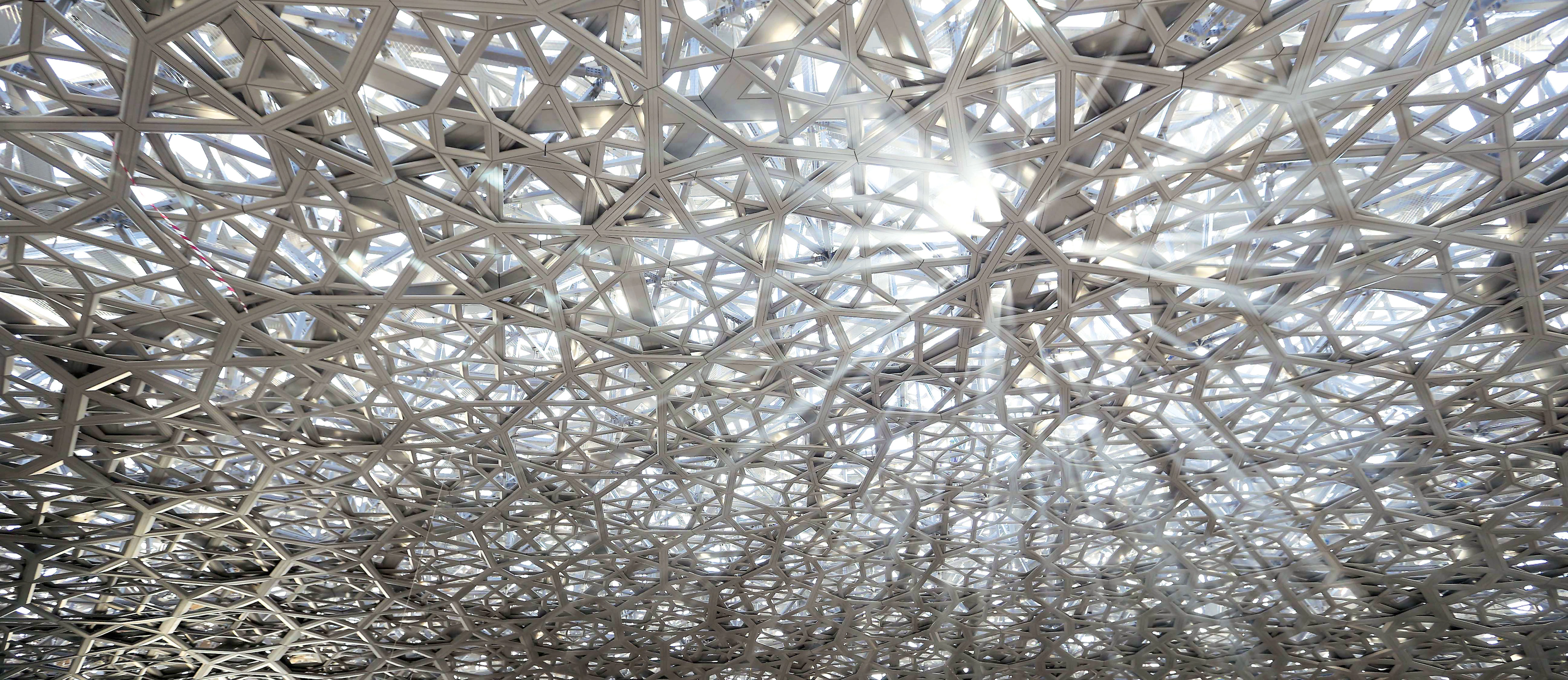
Louvre Abu Dhabi (UAE) - Computationally designed dome filtering light through a pattern inspired by traditional mashrabiya craft
Photo Credit: Ateliers Jean Nouvel

King Abdullah Financial District Metro Stations (Saudi Arabia) - Digitally generated forms executed with refined material detailing and human-scale interiors
Photo Credit: Hufton&Crow
Market Segmentation, Not Elimination
Rather than asking whether the market can sustain both, it may be more accurate to ask how markets are segmenting. Large-scale, infrastructure-led developments will continue to favor tech-driven processes. Speed, compliance, and coordination are non-negotiable at that scale.
At the same time, a parallel demand is growing for projects that resist homogeneity - adaptive reuse, cultural institutions, boutique hotels, and community-driven spaces. These sectors increasingly value craft as a differentiator and as a marker of social and environmental responsibility.
Importantly, craft is also finding renewed relevance in sustainability discourse. Low-tech solutions - passive cooling strategies, locally sourced materials, repairable assemblies - often outperform complex systems over time. As clients become more literate about long-term value, craft is reframed not as indulgence but as risk mitigation.
The Economic Question
Can the market sustain both financially? Evidence suggests it already does, but unevenly. Craft struggles when it is treated as an add-on rather than an integrated design strategy. It thrives when embedded early, aligned with narrative, brand, and performance goals.
For designers, the challenge is not choosing sides but articulating value. Tech-driven design speaks fluently in the language of efficiency and data. Craft must be translated into equally legible terms: durability, cultural capital, user experience, and long-term relevance. When craft is positioned as an investment rather than a cost, its market viability strengthens.
Toward a Post-opposition Mindset
Framing technology and craft as adversaries is increasingly outdated. The future belongs to practices that understand how to calibrate both, using advanced tools to free time and resources for deeper material exploration, and using craft to humanize and ground digital ambition.
Markets do not reward purity; they reward relevance. As design navigates economic uncertainty, climate pressure, and cultural homogenization, the ability to combine technological intelligence with crafted meaning may be the most sustainable model of all.
The question, then, is no longer whether the market can sustain both, but whether designers can lead the conversation beyond the false choice between them.
Save this story. A free account keeps your reading list and the 07:00 email in one place.
CREATE FREE ACCOUNT →SIGN IN