The Paradox of the Archive
What does a building for memory look like when memory itself has become distributed, digitized, and dematerialized? Tengbom's recently completed National Archives of Sweden in Härnösand wrestles with this question across 35,000 square meters of floor area, a project that asks architecture to reconcile the material weight of paper records with the weightlessness of civic ideals. The building, delivered in 2025 under the direction of Pontus Eriksson, occupies a peculiar position in the typology of government architecture: it must be fortress and forum at once, protecting fragile documents while embodying the transparency demanded of democratic institutions.
The National Archives represents one of Sweden's oldest state agencies, charged with preserving administrative records that stretch back centuries. That dual mandate of safeguarding and accessibility has always posed a spatial challenge. Too much security reads as opacity; too much openness compromises conservation. Tengbom's response does not resolve the tension so much as make it legible.
Massing and the Vocabulary of Containment
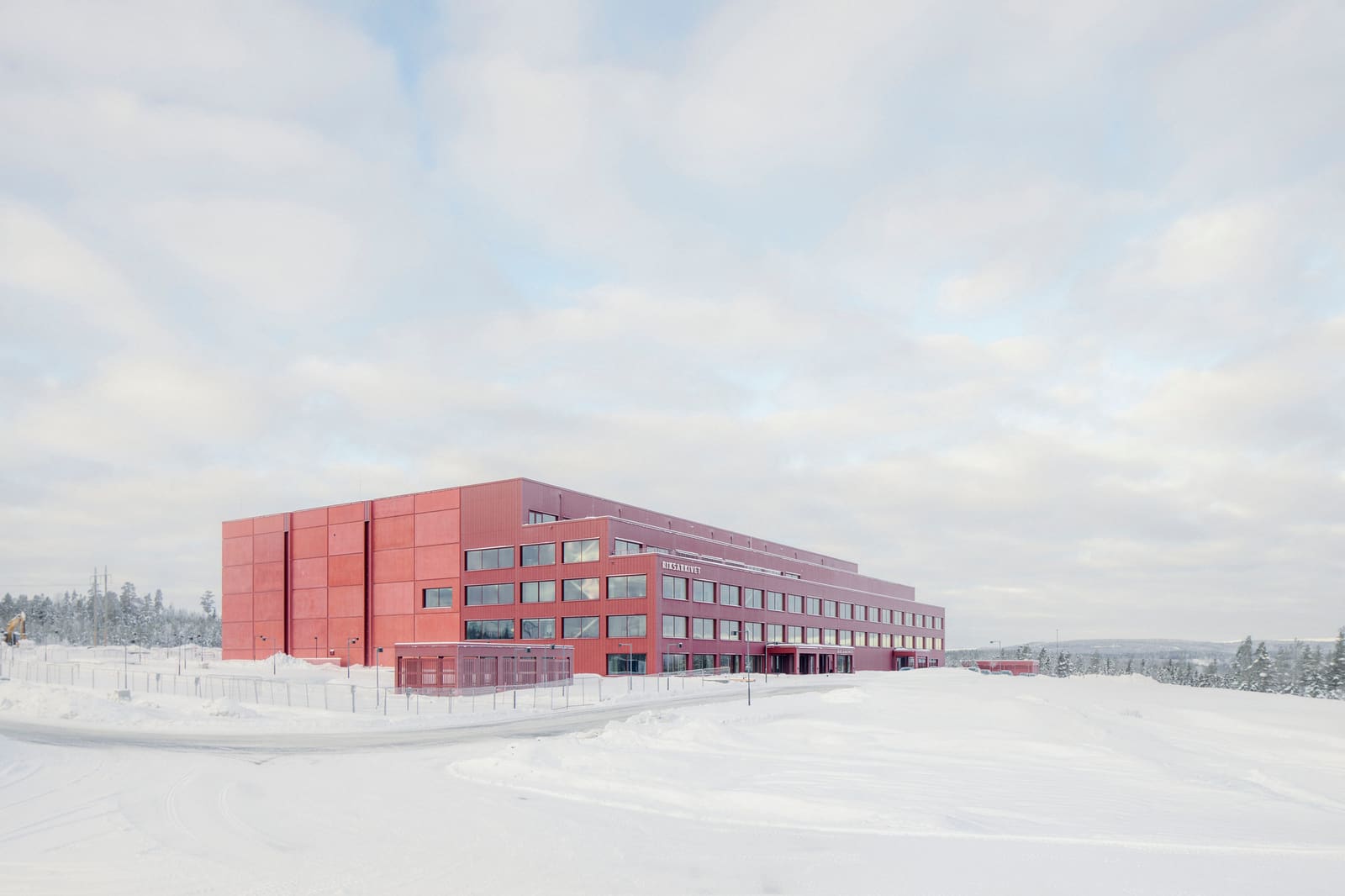
The building's exterior vocabulary draws from industrial typologies rather than the neoclassical language typically associated with state archives. This is not accidental. Lead architect Eriksson and his team developed a parti that treats the archive less as a temple to the past and more as a working infrastructure of collective memory. The massing strategy breaks the program into discrete volumes, a move that recalls the modular logic of container ports and distribution centers. Salad Hilowle's installation "The Containers" reinforces this reading, embedding an artistic commentary on standardization and storage directly into the architectural narrative.
The fenestration pattern is restrained, almost austere. Large expanses of wall surface dominate, punctuated by carefully calibrated openings that admit daylight to office zones while shielding sensitive archival storage from ultraviolet exposure. This is fenestration as filter, a tectonic expression of the building's core function: to mediate between the public and the protected.
Material Choices and the Question of Durability
Tengbom specified materials with longevity and minimal maintenance in mind. The cladding system employs precast concrete panels with a textured finish, a choice that nods to Scandinavian brutalism without resorting to pastiche. The surface treatment avoids the polished sheen of contemporary curtain walls, opting instead for a matte, almost tactile quality that weathers rather than deteriorates. This is architecture that accepts the passage of time as part of its design thesis.
Inside, the material palette shifts. Exposed concrete ceilings in circulation zones contrast with warmer wood finishes in reading rooms and public-facing spaces. The juxtaposition is deliberate: hard surfaces for the apparatus of the state, softer materials where citizens engage with the archive's contents. It is a modest gesture toward biophilic design, though one constrained by the building's stringent environmental controls.
The project team included Eyvind Bergström, Charles Davis, Stefan Samuelsson, and Lottie Hedlund, among a larger roster of designers who navigated the technical complexities of climate control, fire suppression, and structural load-bearing for high-density storage. These are not glamorous concerns, but they shape every cubic meter of the building. An archive is, at its essence, a climate machine.
Spatial Organization and the Choreography of Access
The plan organizes circulation to separate public and staff flows, a typological move borrowed from museum design. Visitors enter through a double-height lobby that provides visual access to deeper zones without physical penetration. This is transparency as spectacle, a carefully staged sightline that suggests openness while maintaining security protocols.
Reading rooms occupy intermediate zones, spaces where researchers interact with physical documents under controlled conditions. The design of these rooms reflects a tension we have observed across archival projects in recent years: how to accommodate both analog and digital research practices within a single spatial framework. Tengbom's solution is pragmatic rather than radical. Workstations are flexible, power and data infrastructure is robust, and natural light is modulated through automated shading systems.
Storage vaults occupy the building's core, insulated from exterior walls and organized on a dense shelving grid. These are spaces designed for machines and archivists, not visitors. The environmental systems here operate independently, maintaining precise temperature and humidity levels that fluctuate minimally throughout the year. It is a reminder that much of the building's square footage is not habitable in any conventional sense; it is engineered for the preservation of cellulose and ink.
Regional Context and the Politics of Location
Härnösand is not an obvious choice for a national archive. Situated on Sweden's northeastern coast, the city is far removed from Stockholm's administrative core. The decision to locate the facility here reflects a broader policy of decentralizing government functions, a move intended to distribute economic activity and counteract urban concentration. Architecturally, this creates an interesting condition: a building of national significance embedded in a regional context, where its symbolic weight must negotiate with local scale and character.
The site itself is relatively flat, offering few topographic cues. Tengbom's response is to treat the building as a landscape element, a horizontal datum that organizes the surrounding terrain rather than punctuating it. This is not iconic architecture in the conventional sense. There is no signature gesture, no singular facade designed to be photographed from a specific angle. Instead, the building presents multiple readings depending on approach and season, a strategy that prioritizes experiential sequence over static image.
Precedents and Typological Lineage
The National Archives invites comparison with other recent institutional storage projects. One thinks of Herzog & de Meuron's Schaulager in Basel, which similarly grapples with the tension between containment and display, or David Chipperfield's Neues Museum restoration in Berlin, where the act of preservation becomes architecturally explicit. Tengbom's approach is less sculptural than either precedent, more aligned with the pragmatic tradition of Scandinavian functionalism.
There are also echoes of earlier Swedish modernism, particularly the work of Sigurd Lewerentz, whose attention to material detail and spatial sequence informs the project's quieter moments. The reading rooms, with their carefully proportioned windows and restrained material palette, recall Lewerentz's libraries, spaces where architecture recedes to support concentration and contemplation.
Performance and the Limits of Sustainability
The building targets stringent energy performance standards, integrating ground-source heat pumps, high-efficiency ventilation with heat recovery, and photovoltaic arrays on the roof. These systems are necessary, but they also reveal the inherent contradictions of sustainable archive design. Preserving paper requires constant environmental control, an energy-intensive proposition that conflicts with low-carbon ambitions. Tengbom's solution is to optimize rather than eliminate, designing systems that meet conservation requirements with the least possible energy input.
Water management follows a similar logic. Stormwater is collected, filtered, and used for landscape irrigation, reducing potable water demand. The site's planting strategy favors native species adapted to regional climate conditions, minimizing the need for supplemental watering once established. These are incremental improvements, not transformative ones, but they reflect a design ethos attentive to resource flows.
The Archive as Civic Infrastructure
At World Archi Design, we have been tracking a shift in how institutional buildings articulate their public mission. The trend away from grand, monumental forms toward more restrained, infrastructural expressions is evident across Europe and North America. Tengbom's National Archives participates in this shift, treating civic architecture as a service rather than a symbol.
Whether this approach succeeds depends on how one defines success. The building will undoubtedly perform its technical functions: preserving documents, accommodating researchers, housing administrative staff. But does it communicate the importance of its mission to a public increasingly disconnected from physical archives? This is a question the building poses but does not answer definitively.
The project, constructed by PEAB for the government property agency Specialfastigheter, represents a substantial public investment in analog infrastructure at a moment when digital archives dominate policy discussions. There is something almost counter-cyclical about the commitment, a wager that physical records will continue to matter even as their use declines. Tengbom's architecture neither celebrates nor laments this condition; it simply accommodates it with precision and restraint.
Looking Forward
The National Archives in Härnösand will likely serve as a reference point for future archival projects, particularly in how it navigates the dual demands of security and transparency. Its material choices, spatial organization, and environmental systems offer a template that other architects can adapt or critique. The building does not break new ground typologically, but it executes familiar strategies with clarity and rigor.
What remains to be seen is how the building performs over decades, not years. Archives are long-duration projects, and their architecture must accommodate not only current needs but also future expansions, technological shifts, and changing conservation practices. Tengbom's design leaves room for adaptation, a pragmatic acknowledgment that permanence in architecture is always provisional.
Save this story. A free account keeps your reading list and the 07:00 email in one place.
CREATE FREE ACCOUNT →SIGN IN