The Convergence of Water, Waste, and Recreation
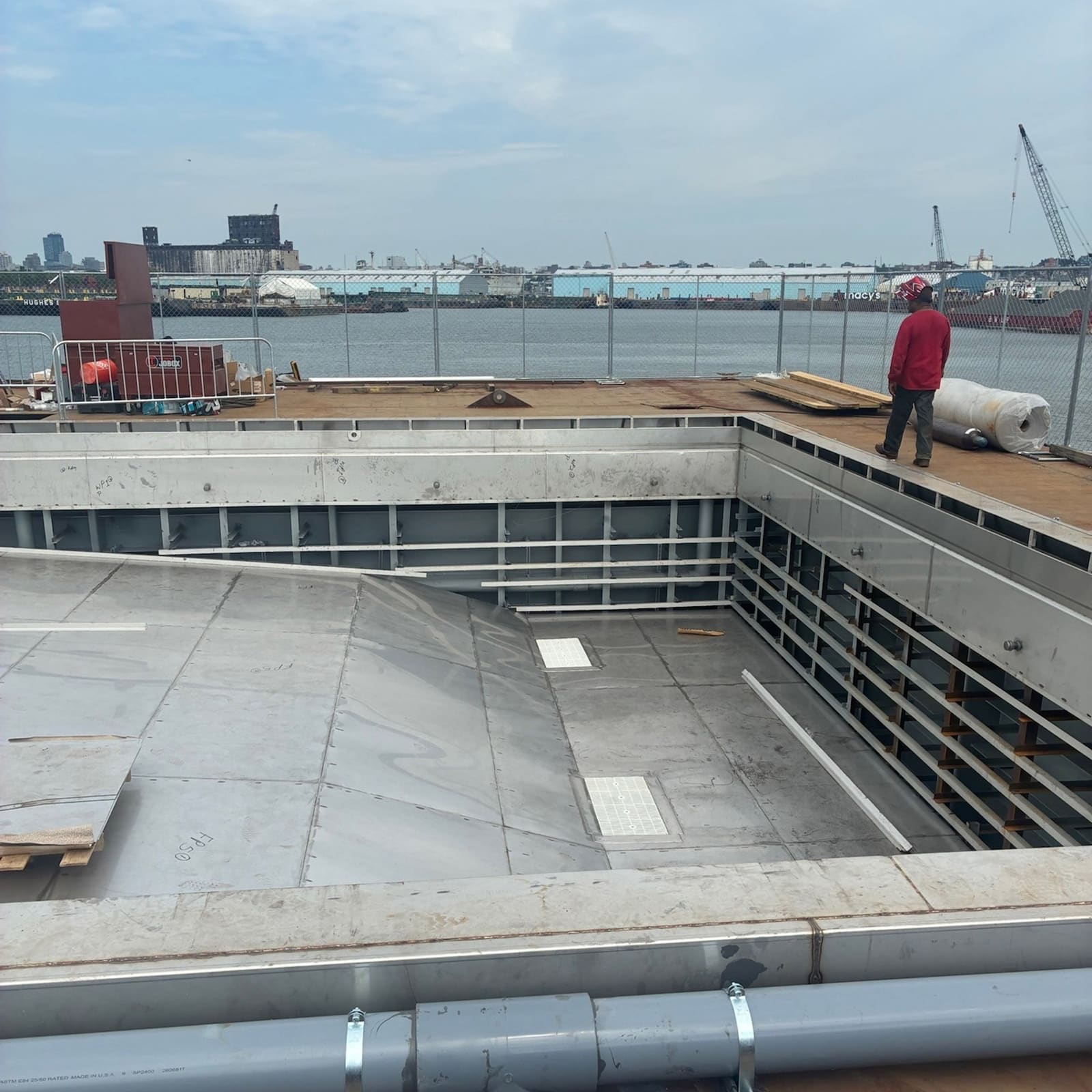
There is a particular kind of urban optimism that believes a river can be both infrastructure and amenity, conduit and destination. Pool 1, a rectangular barge currently under construction at Erie Basin Bargeport in Red Hook, Brooklyn, embodies that belief. Designed as a pilot for a larger cross-shaped facility, the structure is fitted with a filtration system engineered to draw water directly from the East River, clean it without chlorine, and create a swimmable enclosure in one of the city's most contested bodies of water.
The project has moved through more than a decade of approvals, testing, and recalibration. What began as a speculative proposal by a group of young designers in 2011 has matured into a state-backed initiative under New York governor Kathy Hochul's NY Swims program, launched in 2024. The prototype barge, now nearly complete, represents both the technical viability of river-fed recreation and the entanglement of such projects with broader infrastructure imperatives, from flood resilience to utility access.
A Stainless Steel Basin and a Mississippi Frame
The construction sequence for Pool 1 has been methodical. An initial metal frame was fabricated in Mississippi and towed to New York City in the summer of 2025. The basin itself is lined with stainless steel, chosen for its durability in brackish conditions and its compatibility with the filtration apparatus installed below deck. Piping for the system, developed in collaboration with Arup, threads through the barge's lower structure, designed to pull river water through a series of filters before it enters the swimming volume.
The filtration technology is central to the project's identity. Unlike conventional pool systems that rely on chemical disinfection, this approach treats the East River as a dynamic source, one that can be made swimmable through mechanical and biological filtration. The system is patented, a detail that underscores both the novelty of the engineering and the proprietary nature of the solution. At World Archi Design, we have seen a growing interest in closed-loop and adaptive water systems, from rainwater harvesting in arid climates to greywater reuse in residential towers. Pool 1 extends that logic into public recreation, proposing that urban waterways need not be barriers but resources.
Site Preparation and the Resilience Imperative
The intended location for Pool 1 is off Pier 35, between the Two Bridges and Lower East Side neighborhoods in Manhattan. Site preparation has involved installing utility lines for power, water, and sewer discharge, infrastructure that was previously absent from the pier. Friends of + POOL, the nonprofit managing the project, has coordinated with city, state, and federal agencies to secure the necessary approvals. The organization states that 17 distinct permits have been obtained.
Yet the timeline has shifted. A public demonstration originally planned for 2026 has been postponed until 2027, a delay attributed to coordination with the Brooklyn Bridge-Montgomery Coastal Resilience project, a flood-prevention initiative that shares the Pier 35 site. Pool 1 cannot connect to permitted sewer lines for waste discharge until the resiliency work is complete. Kara Meyer, managing director of Friends of + POOL, acknowledged the cost of the delay but framed it within a broader urban agenda, one in which storm-surge protection and recreational access are not competing priorities but interdependent goals.
This is a telling moment for urban design. The convergence of resiliency planning and public amenity reflects a shift in how cities conceptualize waterfront space. Where previous generations built seawalls and bulkheads to keep water out, contemporary approaches seek to integrate flood management with social infrastructure. Pool 1, in this context, is both a recreational facility and a signal of the city's evolving relationship with its edges.
From Speculative Proposal to Statewide Initiative
The larger concept, known as +Pool, was first developed by a group of designers including Archie Lee Coates IV and Jeff Franklin of Playlab Inc, Dong-Ping Wong of Food Architects, and architect Oana Stănescu. The proposal called for a 9,000-square-foot cross-shaped structure, with each arm designated for different activities: lap swimming, wading, sports, and lounging. The geometry was both functional and symbolic, a plus sign floating in the river as a gesture of addition, of opening up access to a resource long considered off-limits.
The project has since grown beyond its initial team. Coates IV, Franklin, and Stănescu remain involved, though Wong has publicly stated that he was excluded from decision-making after raising concerns about board diversity. The governance structure has evolved as well, transitioning from a grassroots initiative to a formalized nonprofit with state-level backing. Under the NY Swims framework, the model could be replicated across water bodies throughout Upstate New York, extending the prototype's influence well beyond the East River.
This scaling strategy is reminiscent of other modular public infrastructure projects, from prefabricated pavilions to mobile libraries. The advantage lies in replicability: once the filtration system is proven, the barge typology can be adapted to different hydrological and social contexts. The risk, however, is that standardization erodes site specificity. The East River is not the Hudson, nor is it Lake Ontario. Each body of water carries different sediment loads, pollutant profiles, and tidal regimes. The challenge for Friends of + POOL will be demonstrating that the technology is adaptable without being generic.
Precedents and the Politics of Public Water
Pool 1 enters a lineage of floating structures that negotiate the boundary between architecture and marine engineering. Precedents include the floating saunas of Scandinavia, the Thames Baths proposal in London, and the Seine swimming zones in Paris, all of which reimagine urban rivers as sites of leisure rather than mere transit corridors. Each project confronts similar obstacles: water quality, regulatory complexity, and the politics of access.
The filtration system distinguishes Pool 1 from these precedents. Where the Thames Baths proposal relied on natural filtration through reed beds, and the Seine zones depend on upstream treatment infrastructure, Pool 1 integrates filtration directly into the barge, making it a self-contained unit. This autonomy is both a technical achievement and a pragmatic necessity. The East River, despite decades of environmental regulation, remains a working waterway, subject to runoff, tidal mixing, and periodic pollution events. A pool that depends on ambient water quality would be vulnerable to closure. A pool that treats its own supply can operate with greater consistency.
Yet autonomy has limits. The delay caused by the Brooklyn Bridge-Montgomery Coastal Resilience project reveals the extent to which even a self-contained structure is embedded in larger systems. Power, sewer, flood walls, and pier access are all negotiated assets, subject to municipal timelines and competing priorities. Pool 1 may filter its own water, but it cannot filter out the complexities of urban governance.
What Comes Next
The completion of the barge marks a threshold, but not a conclusion. Testing will need to verify that the filtration system performs as modeled, that the stainless steel basin withstands tidal forces, and that the public embrace the idea of swimming in treated river water. Perception is as much a design challenge as engineering. For decades, New Yorkers have been conditioned to view the East River as polluted, dangerous, a boundary rather than a destination. Changing that perception will require not just clean water but visible proof, sustained access, and a narrative of reclamation.
If Pool 1 succeeds, it will offer a model for other cities grappling with similar questions: how to open up waterfronts, how to integrate recreation with resilience, how to build public amenities that are both site-specific and scalable. The project is a test case for infrastructure as architecture, for the idea that engineering can be not just functional but generative, producing new forms of urban life rather than merely supporting existing ones.
At World Archi Design, we have been tracking the rise of adaptive water infrastructure, from tidal parks to amphibious housing. Pool 1 fits within that trajectory, but it also complicates it. This is not a passive adaptation to rising water but an active appropriation, a claim that the river itself can be architecture. Whether that claim holds will depend on the performance of a stainless steel barge, a network of filtration piping, and the willingness of a city to reconsider what its edges can become.
Credit: Friends of + POOL
Save this story. A free account keeps your reading list and the 07:00 email in one place.
CREATE FREE ACCOUNT →SIGN IN