The Unexpected First Move
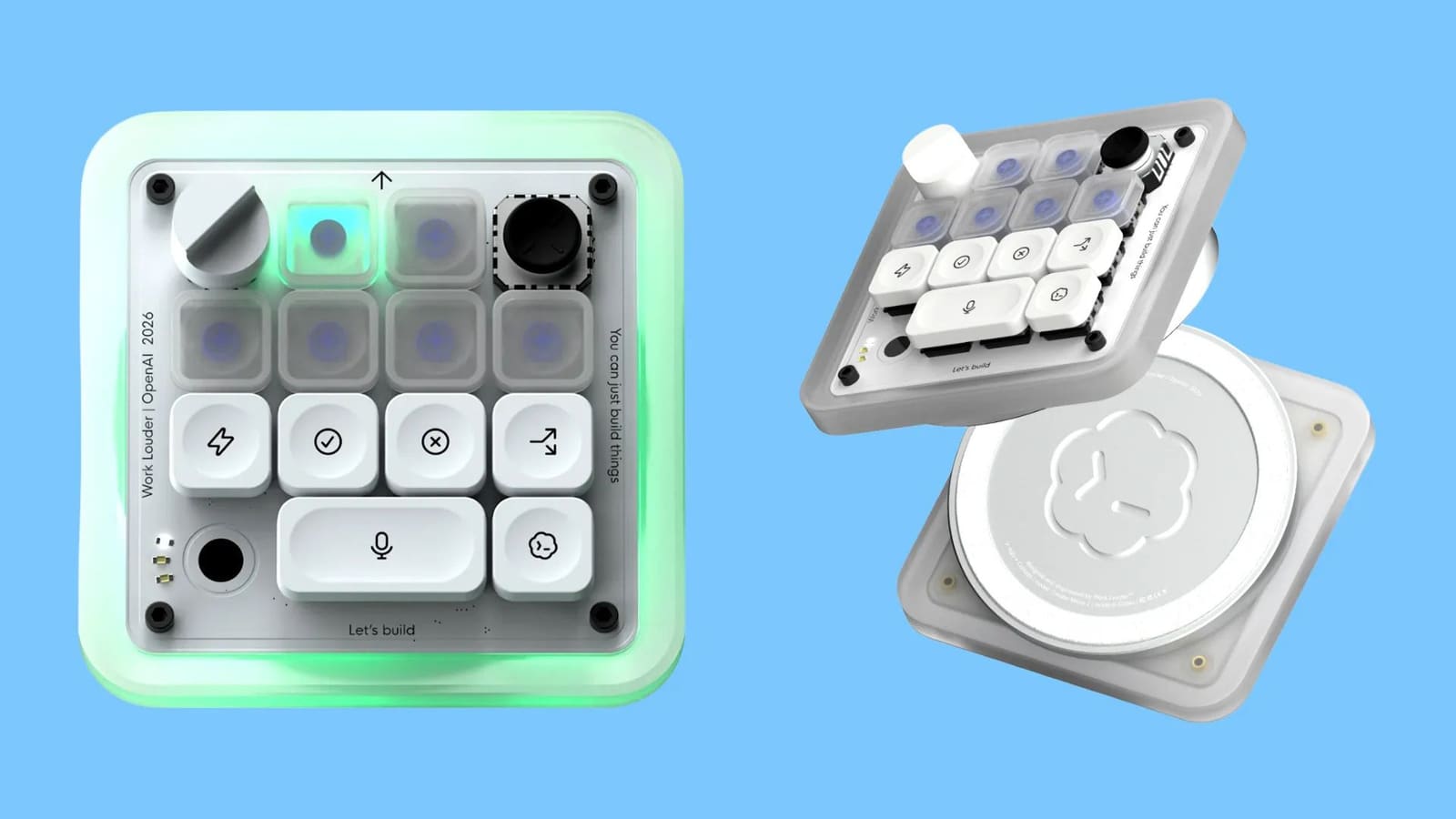
When a company known exclusively for language models decides to enter the world of physical objects, you might expect something transformative. OpenAI introduced its first piece of branded hardware in mid-July 2026, and it was decidedly not the screenless AI companion device rumored to be under development with Jonathan Ive. Instead, the company unveiled the Codex Micro, a compact macro keypad developed alongside specialty keyboard manufacturer Work Louder.
The device targets developers working with OpenAI's Codex agents, offering a tactile interface for task delegation and workflow management. What makes this release interesting is not the object itself but what it represents: a low-stakes rehearsal for a company that has never had to think about supply chains, warranty policies, or customer service for something you can hold in your hand.
A Different Kind of Interface
Traditional keyboards translate human intention into machine action. You type, the computer executes. The Codex Micro flips that dynamic. Here, the machine produces the work while the human supervises, a shift that reflects the broader transformation happening across knowledge work as AI agents take on generative tasks.
The device features thirteen mechanical switches, a joystick, a rotary dial, and a touch sensor. Constructed from CNC-machined polycarbonate and aluminum with a sandblasted anodized base, it connects via Bluetooth or USB-C and supports both Mac and Windows environments. The industrial language is utilitarian, closer to professional audio equipment than consumer electronics.
Work Louder, the partner behind the hardware, specializes in programmable macro pads for streamers, editors, and creative professionals who rely on physical shortcuts. The Codex Micro borrows its chassis directly from the company's existing Creator Micro line, a product refined over years of iteration. OpenAI did not engineer this keypad from the ground up. It adapted an established design platform, similar to how Figma previously collaborated with the same manufacturer for its own custom input device.
Three Layers of Control
The functionality breaks into three distinct zones. Agent Keys form the first layer, displaying live RGB status indicators that communicate whether a Codex agent is idle, processing, executing, or awaiting input. This visual feedback loop eliminates the need to switch contexts or open the application to check progress.
Command Keys occupy the second layer, programmable shortcuts mapped to the most frequent actions developers perform when interacting with agents. Accept, reject, modify, these binary or tertiary decisions happen dozens of times during a single session, and reducing them to single keystrokes compresses cognitive overhead.
The third layer introduces analog control through the joystick and rotary dial. The joystick launches common Codex workflows, while the dial adjusts what OpenAI calls "reasoning level," a variable that scales the computational intensity an agent applies to a given task. Simple queries get fast, lightweight processing; complex problems trigger deeper inference. This tactile modulation of AI behavior is an interface design choice worth noting, it externalizes a parameter that typically lives buried in settings menus and makes it continuously adjustable during active work.
The Borrowed Chassis Strategy
OpenAI's decision to partner rather than build in-house reveals a pragmatic approach to industrial design. Work Louder had already solved the ergonomic, mechanical, and manufacturing challenges of a programmable macro pad. The RGB lighting, mechanical switches, joystick integration, and firmware architecture were proven. By licensing or adapting this platform, OpenAI avoided the multi-year development cycle that original hardware demands.
This strategy is not novel. Figma took the same route, recognizing that domain expertise in keyboard design does not spontaneously emerge from software engineering talent. What OpenAI gained was speed and a crash course in the realities of physical goods: component sourcing, quality control, packaging, shipping logistics, and post-sale support. These operational layers are invisible in software but unavoidable in hardware.
The Codex Micro is priced at $230, positioning it as a premium accessory rather than a mass-market tool. That price point suggests limited production volume and a target audience of power users willing to invest in workflow optimization. It also keeps financial risk contained, if the product underperforms, the company has not committed to manufacturing tens of thousands of units.
The Jony Ive Question
The design community has been tracking OpenAI's collaboration with Ive, the former Apple design executive whose work defined consumer electronics aesthetics for two decades. That project, described as a screenless AI companion device, carries enormous expectations and equally enormous stakes. So why release a niche keypad now?
One explanation is timing. Hardware development is slow, and the Ive collaboration is likely still deep in the prototyping phase. But another explanation is strategic. The Codex Micro functions as a learning exercise, a way for OpenAI to understand what it means to ship a physical product before the company has to do so under intense scrutiny.
Reports emerged shortly before the keypad's release that OpenAI's leadership had instructed staff to avoid distractions and focus on core priorities. A limited-run novelty keyboard might seem like exactly the kind of side project that directive would discourage. Yet if the Codex Micro is understood as infrastructure building, as a deliberate exercise in operational readiness, the release makes more sense. It is not a distraction; it is preparation.
The Logistics of Physicality
Software companies entering hardware often underestimate the complexity. A digital product can be patched, updated, and distributed globally at near-zero marginal cost. A physical product cannot. It must be manufactured at scale, tested for durability, packaged, warehoused, shipped, and supported through return policies and repair channels. Each of these steps introduces friction, cost, and potential failure modes.
By releasing the Codex Micro, OpenAI activates all of those systems in a controlled environment. The production run is small. The target market is forgiving, developers are accustomed to beta-quality tools and iterative improvement. If something goes wrong, the reputational damage is minimal. When the Ive device eventually ships, those same systems will need to operate flawlessly at a much larger scale and under far greater public attention.
This is not a product launch. It is a dress rehearsal.
What It Signals About AI Interaction Design
The Codex Micro also offers insight into how OpenAI is thinking about human-AI interaction beyond chat interfaces. The shift from text-based prompts to physical controls suggests an interest in multimodal input, in creating interfaces that feel more embodied and less purely linguistic.
The rotary dial for reasoning level is particularly telling. It treats AI capability as a continuous variable rather than a fixed attribute, acknowledging that not every task requires maximum computational effort. This mirrors the way photographers adjust aperture or audio engineers adjust gain, a manual control that balances output quality against resource consumption.
As AI agents become more capable, the bottleneck shifts from what the machine can do to how effectively the human can direct it. Physical interfaces like the Codex Micro attempt to reduce that friction, making supervision faster, more intuitive, and less cognitively taxing. Whether this particular device succeeds is less important than the design philosophy it represents.
The Quiet Experiment
The Codex Micro will not define OpenAI's hardware ambitions. It is too niche, too borrowed, too modest. But it serves a purpose. It teaches the company how to think about materials, manufacturing, and the messy realities of objects that exist in the physical world. It builds institutional knowledge that will matter when the stakes are higher.
And it offers an early signal about the kind of interaction paradigms OpenAI believes will matter as AI agents move from experimental tools to production infrastructure. The keyboard has always been the interface between intention and execution. Now, as machines take on execution, the interface is evolving. The Codex Micro is one small step in that evolution, a rehearsal for the larger shifts ahead.
Credit: OpenAI
Save this story. A free account keeps your reading list and the 07:00 email in one place.
CREATE FREE ACCOUNT →SIGN IN