A Death Without a Certificate
Charles Jencks knew how to announce an ending. When he declared modern architecture dead at precisely 3:32 pm on July 15, 1972, the moment Pruitt-Igoe's towers fell in St. Louis, he gave the discipline a punctuation mark it could debate for decades. Paulo Martins Barata, founding partner of Promontório, suggests another death occurred around 2008, but this one passed without ceremony, without a memorable explosion, and largely without notice.
His recently published essay, The Language of Metamodern Architecture, arrives from Porto-based Circo de Ideias with a yellow-edged cover and a deliberately provocative title. The reference to Jencks' 1977 polemic is intentional, ironic, and perhaps more than a little serious. Barata's central proposition is simple but destabilizing: the architecture produced across Europe since the Great Recession belongs to neither the modernist nor the postmodernist traditions that structured the twentieth century's most heated disciplinary arguments.
At World Archi Design, we've been tracking a curious pattern in the projects emerging from European studios over the past fifteen years. There's a quality that resists easy classification, a kind of emotional register that oscillates between earnestness and self-awareness, between material honesty and playful contradiction. Barata gives this sensibility a name borrowed from cultural theory: metamodernism.
Beyond the Binary
The modernist-postmodernist debate organized architectural discourse for half a century. On one side stood the ethical clarity of functionalism, the belief that form should follow need, that ornament was crime, that architecture could reshape society through rational design. On the other stood the ironic détournement of historical reference, the embrace of complexity and contradiction, the assertion that meaning is constructed rather than inherent.
Metamodernism, as Barata frames it, refuses this binary. It acknowledges the exhaustion of both positions without declaring victory for either camp. Where postmodernism trafficked in irony and distance, metamodernism permits sincerity, even vulnerability. Where modernism insisted on purity and consistency, metamodernism allows for ambiguity and oscillation.
This is not synthesis. It's not a dialectical resolution that produces a stable third position. Instead, it describes a kind of perpetual movement between poles, a willingness to be earnest and ironic in turn, sometimes within the same project, occasionally within the same gesture.
Material Honesty, Contextual Play
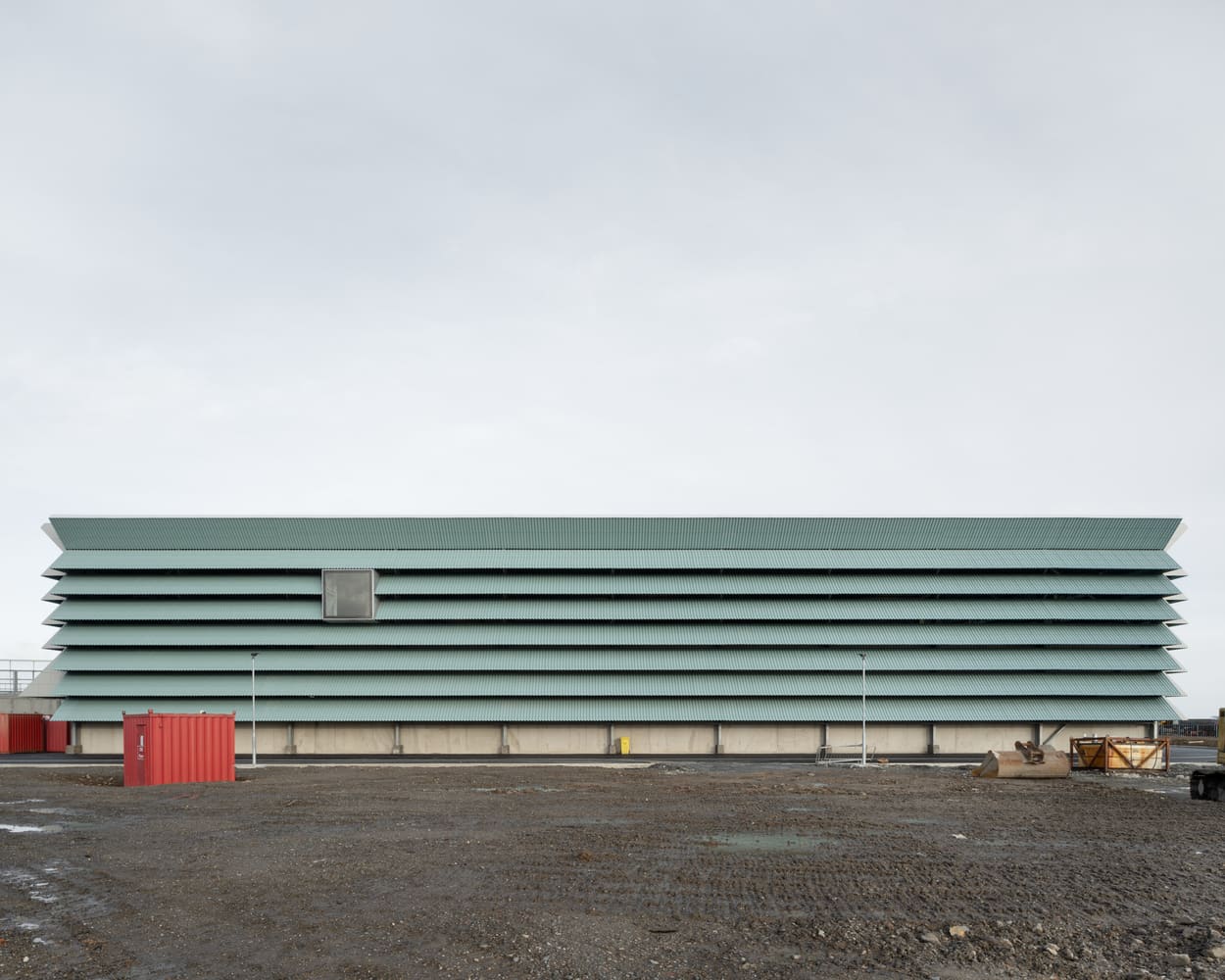
Consider the tectonic strategies visible in recent European work. Clancy Moore Architects' Arklow Waste Water Treatment Plant, for instance, presents industrial infrastructure with an almost ceremonial dignity. The massing is straightforward, the program legible, the materials, concrete and metal, deployed without disguise. Yet the fenestration pattern and the building's relationship to its coastal landscape introduce a lyrical quality that transcends pure functionalism.
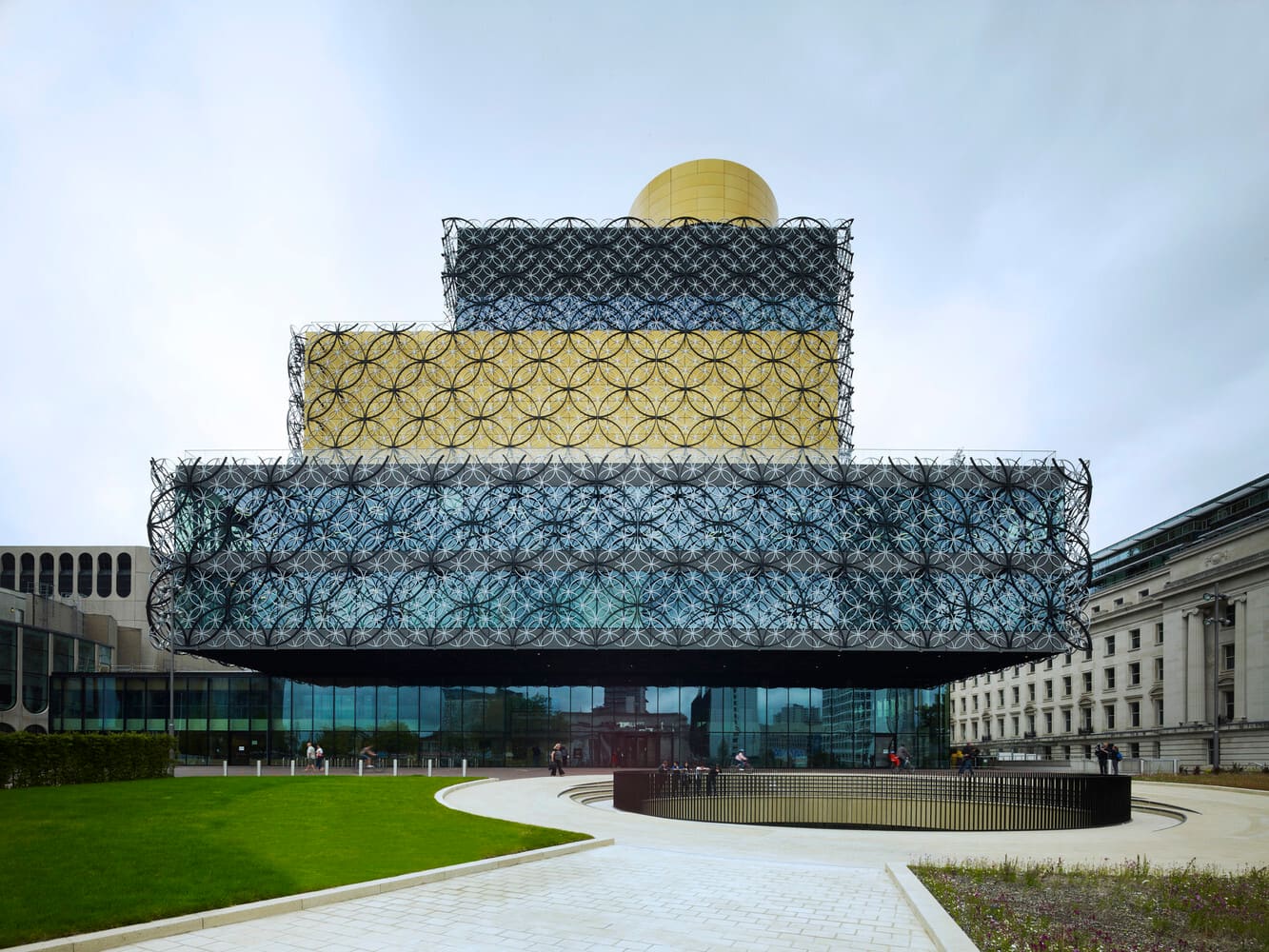
This duality appears across scales and typologies. We see it in Herzog & de Meuron's continued exploration of surface and structure, where tectonic clarity coexists with almost baroque elaboration. We see it in the work of younger Portuguese practices like Fala Atelier, where orthogonal rigor meets saturated color and spatial surprise. We see it in adaptive reuse projects across Berlin, Barcelona, and Brussels, where historic fabric is preserved not out of nostalgia but as active material in contemporary spatial narratives.
The metamodern sensibility, if we accept Barata's taxonomy, allows these projects to be both things at once: materially honest and formally playful, contextually responsive and conceptually autonomous, emotionally open and intellectually rigorous.
The Great Recession as Rupture
Why 2008? Barata locates the shift in the economic and cultural disruption of the financial crisis, a moment when certainties dissolved across multiple registers. The building boom that characterized the early 2000s, with its starchitect spectacles and globalized formal languages, came to an abrupt halt. Practices were forced to reckon with constrained budgets, skeptical clients, and a public increasingly wary of architecture's grand promises.
In that context, neither modernist optimism nor postmodernist cynicism felt adequate. The former seemed naïve in the face of systemic failure; the latter, exhausted by its own knowingness. What emerged instead was a more provisional stance, one that could hold contradictions without resolving them, that could be hopeful without being utopian, critical without being dismissive.
This is not to say that every European project since 2008 is metamodern, or that the term captures the full range of contemporary practice. Barata's argument is more subtle: he's identifying a cultural structure of feeling, a shift in the emotional and intellectual assumptions that inform design decisions, even when those decisions aren't explicitly theorized.
Precedent and Difference
Metamodernism has roots in cultural criticism, particularly in the work of Timotheus Vermeulen and Robin van den Akker, who coined the term in 2010 to describe shifts in art, literature, and film. Their observation was that a generation of artists and writers born in the 1970s and 1980s had begun to move beyond the postmodern strategies that dominated late-twentieth-century culture.
Architecture, characteristically, arrives late to these conversations. The discipline's material constraints, its entanglement with capital and construction, its long project timelines, all delay its responsiveness to cultural currents. But delay is not absence. By the mid-2010s, the patterns Vermeulen and van den Akker identified in other media were becoming visible in built work.
What distinguishes metamodern architecture from earlier attempts to move beyond postmodernism, say the neo-rationalism of the 1980s or the digital formalism of the 1990s, is its comfort with instability. It doesn't propose a new manifesto or a unified aesthetic program. It doesn't claim to solve the problems that stalled its predecessors. Instead, it accepts multiplicity, contradiction, and oscillation as permanent conditions rather than problems to be overcome.
The Limits of Labels
Barata's slim volume is more provocation than manifesto. He doesn't offer a comprehensive survey of metamodern buildings, doesn't propose design guidelines or formal strategies. His intervention is taxonomic: he's naming something he sees happening, offering a conceptual frame that might make certain patterns more legible.
This raises the inevitable question of whether the label matters. Architecture has always been suspicious of theory that arrives from outside the discipline, and cultural criticism's tendency toward abstraction can feel remote from the concrete problems of site, program, and construction. Yet theory's value often lies precisely in its capacity to make visible what was previously intuited but not articulated.
If Barata is right, and European architecture has indeed shifted into a new cultural register, then having a name for that shift allows for more precise conversation. It permits practitioners to recognize affinities across geographic and formal boundaries, to understand their own work as part of a larger pattern rather than as isolated responses to local conditions.
It also opens space for critique. If metamodernism describes a genuine shift, then we can begin to ask what it enables and what it forecloses, what kinds of projects it makes possible and what kinds it renders unthinkable. We can ask whether its oscillation between sincerity and irony is a productive instability or a failure to commit. We can ask whether it represents a genuine rupture with postmodernism or merely its latest iteration.
What Comes Next
The architectural culture of the early twenty-first century lacks the polemical clarity that characterized earlier moments. There are no manifestos circulating, no schools declaring allegiance to a single formal language, no critics pronouncing deaths with Jencks' theatrical precision. This might be metamodernism's most defining feature: its refusal of definitive statements, its acceptance of ambiguity as a permanent condition.
Whether this represents maturity or paralysis remains an open question. Barata doesn't answer it, and perhaps that's the point. The Language of Metamodern Architecture is less interested in declaring what architecture should be than in describing what it has become, almost without realizing it. The volume's yellow-edged cover and its winking reference to Jencks signal a self-awareness about its own position within the discourse, a recognition that even the act of naming a new paradigm participates in the oscillation it describes.
At World Archi Design, we remain skeptical of grand taxonomies, but attentive to the patterns they illuminate. If Barata's framework helps us see connections between disparate projects, helps us articulate what felt intuitive but unspoken, then the label has done its work. Whether metamodernism becomes a useful category or fades into the archive of architectural neologisms will depend not on the elegance of the theory but on whether it continues to describe the lived reality of contemporary practice.
For now, it offers a lens. And sometimes, in a discipline as materially grounded and theoretically diffuse as architecture, a lens is enough.
Credit: Johan Dehlin
Save this story. A free account keeps your reading list and the 07:00 email in one place.
CREATE FREE ACCOUNT →SIGN IN