From Label to Lens
Stand before any canonical work of architecture and the act of identification feels almost trivial. Point your phone at Gaudí's Sagrada Família and a dozen image-search platforms will return its name, location, and construction timeline within seconds. The same holds true for Fallingwater, the Pantheon, or the Seagram Building. But naming a structure has never been the challenge. Understanding it, reading its spatial intentions and formal language, has always required a different mode of engagement.
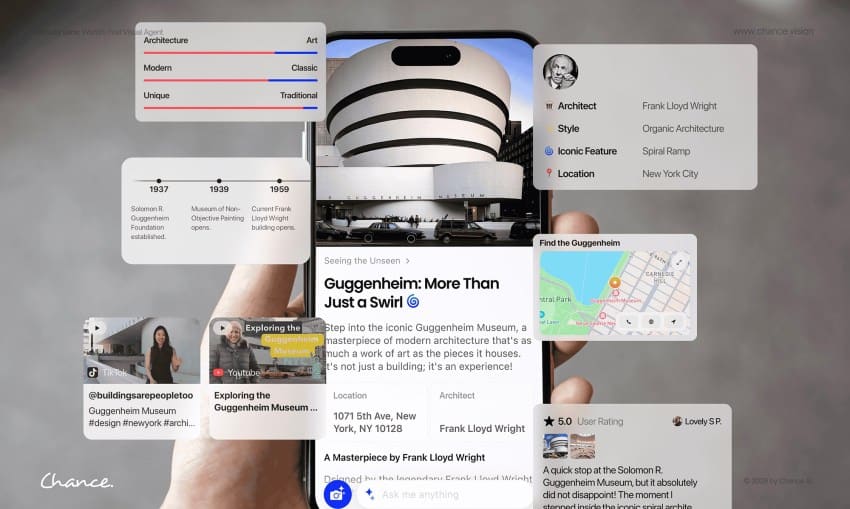
At World Archi Design, we've been tracking a quiet but fundamental shift in how computational vision intersects with architectural literacy. The tools emerging now are not simply cataloging what they see. They are beginning to parse why a facade is articulated in a particular rhythm, how a massing strategy responds to site constraints, or what historical precedents inform a building's formal vocabulary. This is not image recognition. It is interpretive analysis delivered through a camera interface.
The Limits of Visual Search
The dominance of image-based search engines over the past decade has conditioned us to expect instant identification. Snap a photo of a building, and machine learning models trained on millions of labeled images will retrieve its metadata: architect, year, style classification. These systems excel at matching visual patterns to known datasets. They are encyclopedic in scope but shallow in depth.
What they cannot do is explain the design decisions embedded in a building's form. They do not differentiate between load-bearing structure and applied ornament. They cannot articulate how fenestration patterns modulate interior light or how a building's parti organizes circulation and program. They retrieve information but do not generate understanding.
This limitation becomes especially pronounced when confronting vernacular or anonymous architecture, adaptive reuse projects, or contemporary works that resist easy stylistic categorization. A rural barn, a Brutalist housing block, or a parametrically designed pavilion may not exist in the image database at all. In those cases, search engines return nothing, or worse, incorrect analogies drawn from superficial formal resemblance.
Interpretive AI as Design Companion
The next generation of visual tools is being built on large language models trained not only on images but on architectural discourse, technical literature, and design theory. These systems can analyze a photograph and generate commentary on spatial organization, material tectonics, structural logic, and contextual relationships. They are, in effect, reading architecture rather than merely recognizing it.
Consider the difference in output. A traditional image search might return: "Sagrada Família, Antoni Gaudí, Barcelona, 1882-present." An interpretive model might note the hyperbolic paraboloid geometry of the vaulting, the influence of Catalan Gothic precedent, the integration of natural light through polychromatic glazing, and the tension between organic form and structural rationalism. The former is a label. The latter is a reading.
This shift has implications for how architects, students, and enthusiasts engage with the built environment. Instead of needing to recall the name of a building to access its history, users can now ask: "Why does this facade use setbacks?" or "How does this building address the street?" The camera becomes a pedagogical tool, not just a search bar.
Parsing Materiality and Tectonic Expression
One of the more promising applications lies in material analysis. Traditional image recognition struggles to differentiate between materials that share similar color or texture profiles: polished concrete and terrazzo, zinc cladding and weathered steel, cast glass and acrylic. An interpretive model, however, can contextualize material choices within broader design strategies.
A photograph of a building facade might prompt analysis of whether the material is load-bearing or applied, whether it exhibits signs of weathering consistent with local climate, or whether its jointing detail suggests prefabrication or in-situ assembly. These are the kinds of observations that require not just visual pattern matching but an understanding of construction logic and material behavior.
This capability is particularly valuable in the context of adaptive reuse and preservation. A historic industrial building clad in brick may have been altered over decades with additions in concrete, steel, and glass. An interpretive tool can help distinguish original fabric from later interventions, identifying construction techniques and material assemblies that correspond to different periods. This is not forensic analysis, but it is a form of rapid, accessible building archaeology.
Precedent and Typological Lineage
Another dimension of this interpretive turn involves situating a building within its typological and historical context. Rather than simply identifying a structure as Modernist or Postmodern, these tools can articulate specific formal strategies and trace them to earlier precedents.
A photograph of a contemporary museum with a cantilevered upper volume might generate commentary linking it to the formal language of the Whitney Museum by Marcel Breuer, or to the inverted ziggurat massing of the Hirshhorn by Gordon Bunshaft. A residential courtyard scheme might be contextualized within Mediterranean or Islamic architectural traditions. These connections are not arbitrary stylistic labels but analyses of spatial typology and organizational logic.
For students and practitioners, this offers a mode of learning that is embedded in direct observation. Rather than needing to know in advance that a building belongs to a particular lineage, they can discover those relationships through real-time analysis. The camera becomes a way of building visual literacy and expanding one's mental library of precedents.
The Question of Bias and Training Data
Of course, any AI system is only as robust as the data on which it is trained, and architectural discourse has its own biases. Western canonical works are overrepresented in both image datasets and textual archives. Vernacular traditions, non-Western modernisms, and marginalized design practices are often under-documented or misclassified.
An interpretive model trained predominantly on European and North American examples may struggle to accurately read a rammed-earth mosque in Mali, a timber machiya in Kyoto, or a contemporary housing project in Lagos. It may default to analogy rather than specificity, or impose inappropriate formal categories. This is a problem of training scope, not inherent to the technology, but it is one that developers and institutions must address if these tools are to have genuine global utility.
The risk is that interpretive AI, like earlier image-search systems, will reinforce existing hierarchies of architectural value. The buildings that are most thoroughly documented and discussed will be the ones the system reads most fluently. Everything else becomes peripheral, described in relation to the canon rather than on its own terms.
Toward a New Mode of Architectural Engagement
Despite these challenges, the shift from recognition to interpretation represents a meaningful evolution in how we mediate architectural experience. It suggests a future in which the built environment becomes more legible, not just to specialists but to anyone with a camera and curiosity.
This does not replace the slow, embodied practice of walking through a building, noting light and shadow, feeling material texture, understanding scale through movement. But it does offer a supplement, a way of surfacing design logic that might otherwise remain opaque. It is a tool for asking better questions, for moving from "What is this?" to "How does this work?"
We are still in the early stages of this transition. The tools are imperfect, the datasets incomplete, the interpretations sometimes reductive. But the trajectory is clear. The camera is no longer just a device for capturing images. It is becoming an interface for reading the world, and architecture, with all its complexity, is one of the most compelling subjects it can address.
Credit: Chance
Save this story. A free account keeps your reading list and the 07:00 email in one place.
CREATE FREE ACCOUNT →SIGN IN