The Anxiety Object
There exists a peculiar category of domestic artifacts that telegraph nervousness. The runner laid over pristine carpet. The lampshade still wearing its cellophane. And perhaps most memorably, the sofa wrapped in plastic - a piece of furniture that announces its own untouchability.
For decades, vinyl-clad seating occupied this uncomfortable territory. It was protection masquerading as hospitality, a transparent membrane between guest and belonging. The message was unambiguous: this house contains things too valuable to trust you with. Even children understood the subtext, that crinkle beneath their legs a constant reminder to be careful, to ask for less, to take up minimal space.
Yet material meanings shift. What once signified preservation anxiety is now circulating through design conversations as something altogether different - a gesture of confidence, even irreverence.
From Preservation to Performance
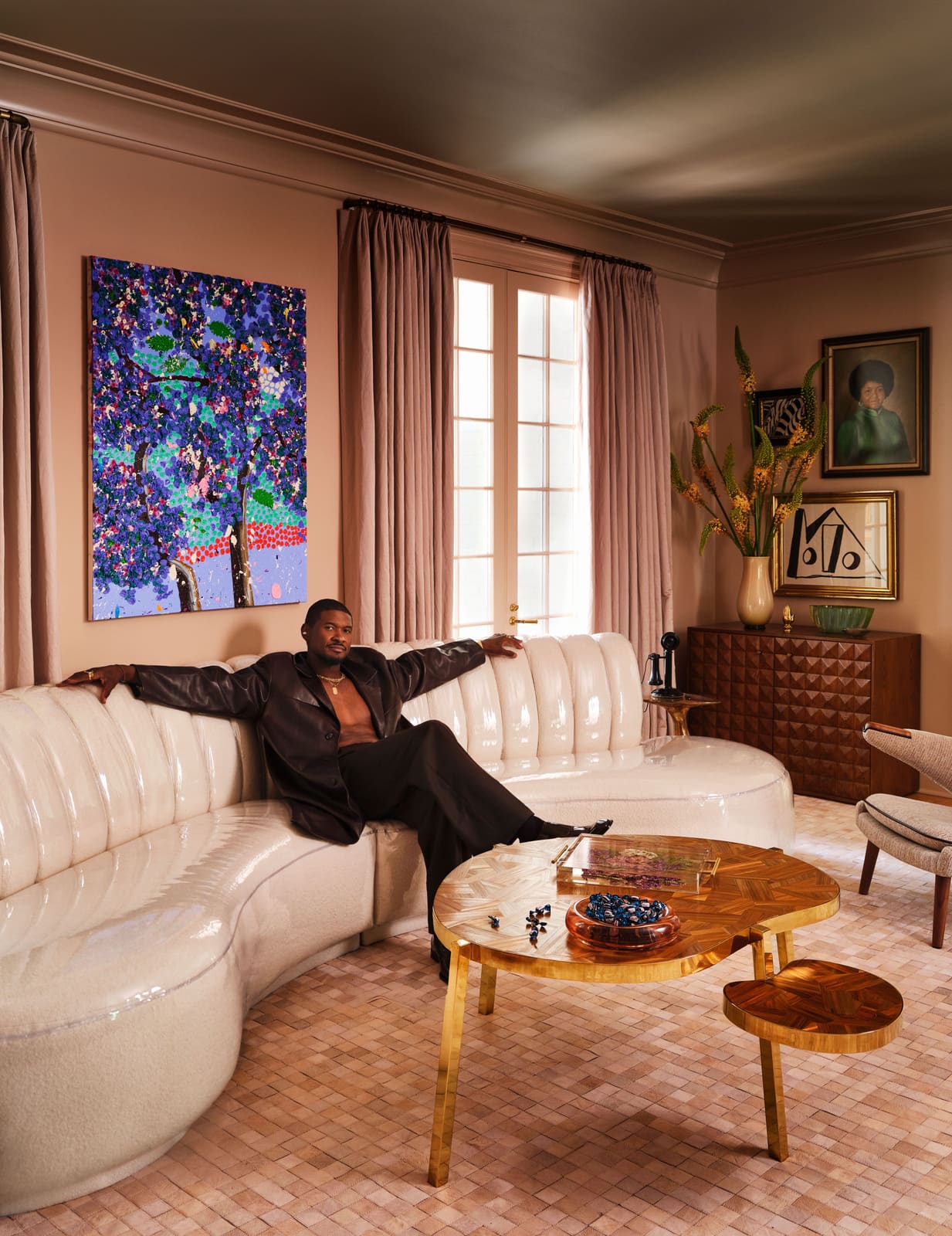
The seven-seat curved sofa in Usher's Atlanta residence doesn't apologize for its vinyl skin. Designed in collaboration with Nicole Fuller and Bjork Studio, the ivory piece commands its room with vertical channel backing that nods to diner booths while its sculptural form pulls from 1970s silhouettes. It shares space with work by Damien Hirst and a Campana Brothers coffee table, yet holds its own as the room's gravitational center.
The choice is deliberate. Where previous generations used vinyl to protect what they'd worked hard to acquire, this application flips the logic entirely. The material becomes the spectacle itself, not the shield. As Usher frames it, the sofa is art - which means it's meant to be seen, sat on, experienced without hesitation.
This recontextualization required cultural distance. The Tenement Museum's "Under One Roof" exhibit preserves a recreation of the plastic-covered living room, common in Puerto Rican, Jewish, and African American households through the 1960s and 70s. Visitors routinely identify the setup from their own childhoods, responses split between affection and remembered discomfort. The plastic represented economic reality: you preserved what you could afford because replacement wasn't guaranteed.
Artist Alima Lee has written about the particular longing that vinyl covering produced - the desire to touch something specifically because access was restricted. That tension between visibility and prohibition created a strange intimacy, the object becoming more precious precisely because it remained slightly out of reach.
High Design Reclamation
The material's migration into contemporary design vocabulary accelerated with Harry Nuriev's powder-coated steel sofa for Crosby Studios. Upholstered in glossy cobalt vinyl sourced from New York's garden district, the piece created productive friction between futurism and nostalgia - particularly striking beneath the Orthodox iconography of Nuriev's Brooklyn apartment.
Nuriev pushed the concept further for Balenciaga at Design Miami, constructing a sectional from deadstock fabric wrapped in salvaged vinyl. The installation made excess itself the subject, turning material surplus into formal vocabulary. Where the original domestic application spoke to scarcity and protection, Nuriev's version addressed abundance and waste.
The Crosby Studios approach leans conceptual, designed to provoke as much as accommodate. Usher's sofa operates differently - it's less concerned with making an argument about materiality than with creating livable space. The rest of the Georgian-style compound reflects similar priorities: his son's paintings occupy wall space throughout; a troweled concrete surface preserves handprints from each family member, including the dog. These aren't gestures toward design theory. They're evidence of daily life.
The Sound of Confidence
One detail matters more than aesthetics: yes, the vinyl makes that characteristic crunching sound. It's the acoustic signature that most people remember from childhood visits to relatives' living rooms, the soundtrack of careful sitting. Rather than engineer the noise away or select a quieter material, the design preserves it.
That choice reveals the contemporary logic at work. The crinkle no longer signals anxiety - it becomes textural evidence of use. You're supposed to sit here. Set your glass down. Live without hesitation. The sound that once meant "be careful" now means "relax."
This represents a particular definition of luxury, one that prioritizes ease over preservation. Real affluence, by this measure, means owning things you're not afraid to use. The vinyl coating that once protected the sofa from life now invites it.
Material Futures
Vinyl's rehabilitation in design circles suggests broader shifts in how we read domestic materials. What registers as aspirational changes across generations. The impulse to protect and preserve - entirely rational under certain economic conditions - reads differently when applied to contemporary contexts where replacement is accessible.
Yet the material carries memory. Even divorced from its preservation function, vinyl seating evokes specific cultural reference points: diner booths, mid-century optimism, the aesthetic vocabulary of a particular American moment. Designers working with the material today are negotiating that history, deciding which associations to amplify and which to subvert.
The Muller Van Severen collaboration with Kassl, for instance, uses vinyl to emphasize modularity and cleanability - practical concerns reframed through high-design formal language. Vintage Italian pieces from the 1950s showcase the material's range, from wood-framed elegance to sculptural experiments that anticipated later developments.
These varied applications share one quality: they treat vinyl as a choice, not a compromise. The material isn't standing in for leather or fabric - it's selected for its specific visual and tactile properties, including that telltale crinkle.
Living Without Apology
At World Archi Design, we've been tracking the ways materials shed old meanings and acquire new ones. Vinyl's trajectory is particularly revealing because the shift isn't purely aesthetic. It required cultural permission to value ease over preservation, to prioritize living in your space over protecting it.
The plastic-covered sofa of previous generations made perfect sense within its context. Economic precarity makes preservation rational. But material choices also reflect aspiration, and contemporary luxury increasingly defines itself through confidence rather than caution.
Usher's seven-seater doesn't ask you to be careful. It invites you to sit back, pour that glass of red wine, and set it down directly on the cushion if you want. The vinyl isn't there to protect the sofa - it's there to protect you from worrying about the sofa.
That's the real luxury: living in your home as though you trust yourself in it. The material that once symbolized anxiety now signals its opposite. And that crunch when you sit down? It's not a warning anymore. It's just the sound of being comfortable.
Save this story. A free account keeps your reading list and the 07:00 email in one place.
CREATE FREE ACCOUNT →SIGN IN