The Case for Borrowed Vocabulary
Interior design has always borrowed metaphors from other disciplines, but the jewelry-box analogy offers something more practical than poetic. At World Archi Design, we've noticed a recurring pattern in the projects that feel most resolved: they share a compositional logic with well-assembled jewelry collections. Both rely on foundational elements, deliberate layering, and strategic moments of visual emphasis. The comparison surfaces frequently among practitioners because it maps cleanly onto how successful interiors actually function.
Paris-based designer Laura Gonzalez frames her work this way explicitly. She considers interiors as assemblies of treasured objects, each carrying its own history and material presence. The analogy extends beyond decorative objects to encompass furniture, architectural elements, and spatial planning. Summer Thornton, whose Chicago studio works across residential and hospitality typologies, notes that memorable schemes possess qualities she associates with precious materials: controlled luminosity, saturated color, and a balance between new fabrication and inherited pieces that reads as collected rather than purchased wholesale.
The framework proves useful not because rooms should literally resemble jewelry boxes, but because both disciplines grapple with similar questions of hierarchy, scale, and personal narrative.
Establishing the Foundation Layer
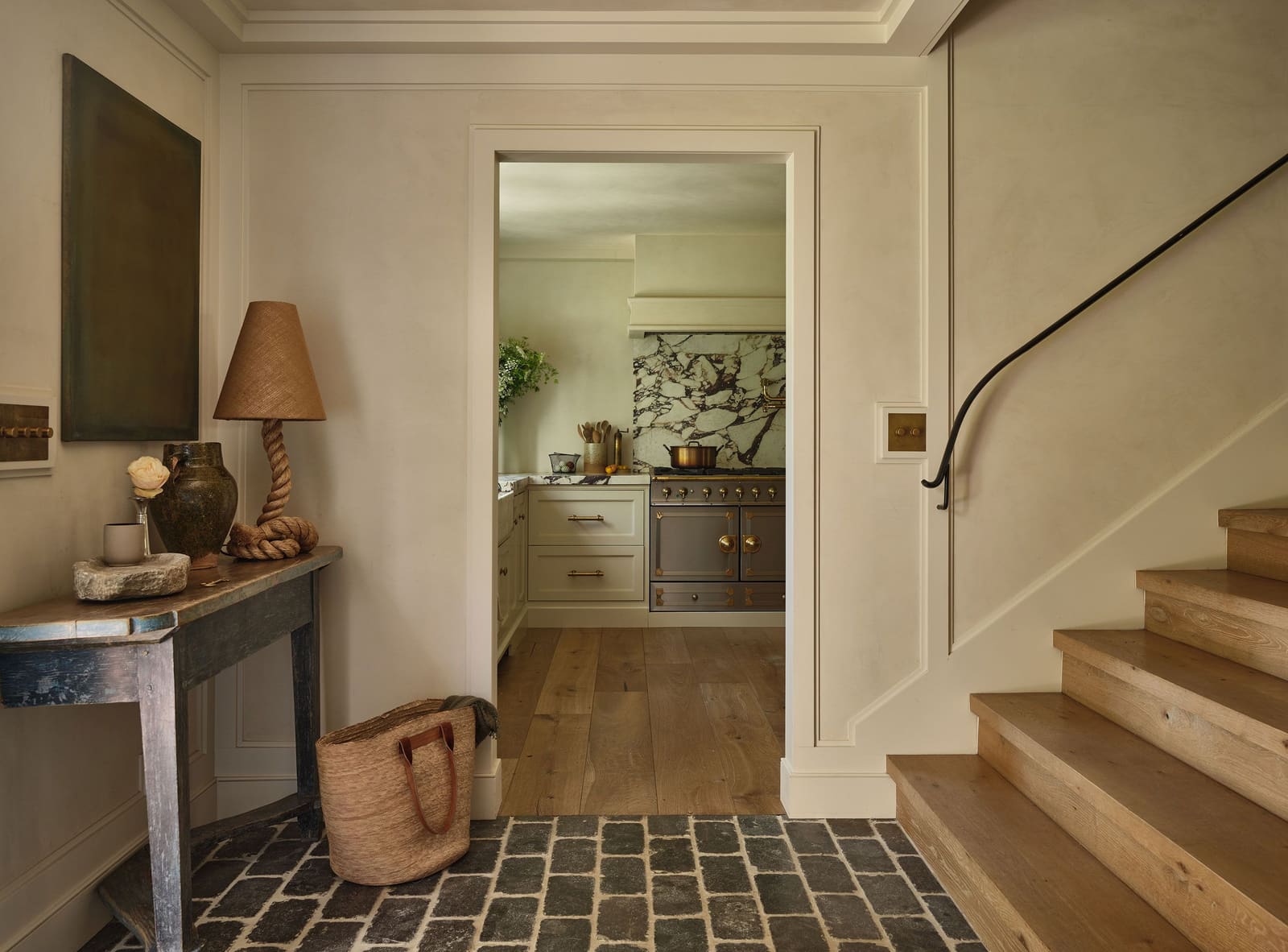
Every jewelry collection includes pieces worn daily without conscious thought - simple chains, understated studs, items that recede into background utility. Interiors require the same anchoring elements. These are not the components guests comment on immediately, but they establish coherence that allows other choices to register clearly.
Maxime Bousquet, working primarily in Paris, often begins spatial compositions with floor coverings. A well-chosen rug defines a conversational field, setting boundaries within which more expressive elements can interact. The foundation might be an object, but it can also manifest as a repeated color temperature, a consistent material palette, or a textural motif that surfaces in multiple locations. The goal is to create enough continuity that eccentric choices read as intentional rather than arbitrary.
New York designer Mieke ten Have interprets foundational elements through the lens of physical comfort. Regardless of how compelling the art, window treatments, or surface finishes might be, a room fails if the seating proves uncomfortable or the spatial proportions induce unease. The basics - ergonomics, circulation paths, acoustic performance - must be resolved before layering begins. This is the equivalent of ensuring a necklace clasp functions reliably before considering gemstone selection.
The Discipline of Layering
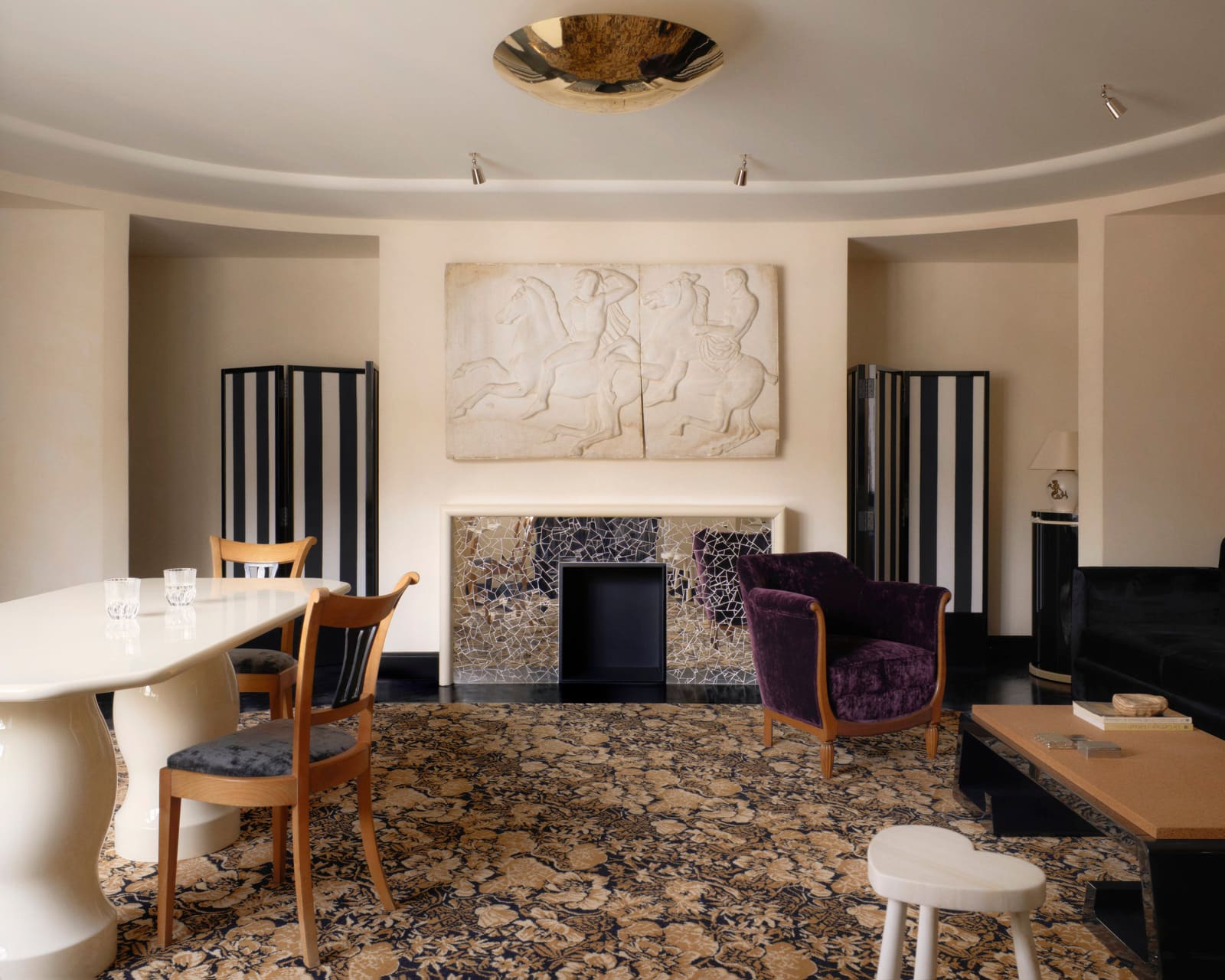
Coordinated room sets, like matched jewelry suites, tend to feel static. Layering introduces temporal depth and material contrast. Gonzalez argues that rooms become memorable when they juxtapose rather than coordinate: fine craftsmanship against unexpected finds, contemporary art within historical architecture, luxury adjacent to humor. That productive tension sustains interest over time.
The practice requires mixing across multiple axes simultaneously. Eras should collide - a mid-century credenza beneath an 18th-century oil painting, for instance. Materials need variety: polished metals near raw timber, reflective glass beside matte plaster. Provenance matters too; inherited pieces carry narrative weight that newly commissioned work cannot replicate, no matter how skillfully executed.
Lucy Mayers, a designer at the London firm Sibyl Colefax & John Fowler, works regularly with inherited objects her clients may not have selected themselves but nonetheless cherish. These items - a relative's desk, a friend's gifted artwork - anchor schemes precisely because they arrive with established emotional significance. The designer's task becomes building around these fixed points rather than imposing a totalizing vision. The resulting interiors feel inhabited from the outset, bypassing the sterile perfection that plagues many professionally decorated spaces.
Layering also operates at the scale of individual objects. A tabletop vignette might combine a Murano glass vessel, a bronze Dogon figure, and a contemporary ceramic bowl. None shares material, origin, or era with the others, yet careful attention to scale relationships and negative space allows them to coexist productively. The same logic applies at room scale: disparate elements unified through deliberate compositional choices.
The Strategic Showpiece
If foundations provide continuity and layered elements supply depth, showpieces deliver visual punctuation. In jewelry terms, this is the cocktail ring or statement necklace - the piece that reorganizes perception of everything worn alongside it. Gonzalez describes these as items with confidence and character, often bordering on theatrical.
In spatial terms, the showpiece might be a saturated paint color applied to a single wall, an outsize chandelier, or an artwork that commands attention from multiple vantage points. Thornton frequently deploys decorative lighting this way, treating chandeliers as three-dimensional sculptures that define a room's emotional register. The key is singularity: one bold gesture per space, not three competing for dominance.
The showpiece need not be expensive or historically significant. It simply needs presence - enough visual or conceptual weight to anchor attention. A monumental photograph, an eccentric vintage find, or even an unexpected material application can fulfill this role. What matters is that the choice feels deliberate rather than accidental, and that it reflects the inhabitant's sensibility rather than generic notions of luxury.
Restraint as a Maximalist Tool
Maximalism, often misunderstood as uncontrolled accumulation, actually depends on rigorous editing. Mayers observes that without restraint, visual abundance collapses into chaos. Nothing registers within its own spatial envelope; the eye finds no place to rest. Practitioners who work successfully in layered, object-rich modes also exercise discipline about what to exclude.
This is where the jewelry-box analogy proves most instructive. A collection becomes coherent not by including every possible piece, but by curating toward a recognizable point of view. Some items remain in storage, brought out for specific occasions or contexts. Others get retired as taste evolves. The same should be true of interiors: not every cherished object belongs on display simultaneously.
Restraint also governs color saturation, pattern density, and textural complexity. A room can sustain a bold Oushak rug or vivid lacquered millwork, but rarely both at full intensity. Designers working in this mode develop an intuition for how much visual information a given volume can accommodate before crossing into sensory overload. That threshold varies by ceiling height, natural light levels, and architectural articulation, which is why formulaic approaches to maximalism so often misfire.
The Personal Equation
AD100 designer Brigette Romanek frames the entire exercise in terms of personal narrative. The jewelry box is the room itself; what makes it meaningful is the specific collection of objects, finishes, and spatial gestures the inhabitant chooses to include. Heirloom furniture, lighting selected for a particular quality of illumination, souvenirs from travel - these elements accumulate over time, building a legible record of priorities and experiences.
This is the dimension coordinated room sets can never replicate. A space furnished entirely from a single showroom in a single transaction may achieve visual harmony, but it lacks the temporal layering that signals genuine habitation. The most compelling interiors we encounter feel assembled gradually, with each addition responding to what already exists rather than imposing a predetermined scheme.
The jewelry-box framework ultimately matters because it privileges curation over consumption. It suggests that the value of a space lies not in the individual cost of its components but in the intelligence and specificity with which those components are combined. An empty jewelry box, no matter how beautifully crafted, holds no interest. Its contents - and the relationships among them - are what transform a container into a collection, a room into a home.
Credit: Ludovic Balay
Save this story. A free account keeps your reading list and the 07:00 email in one place.
CREATE FREE ACCOUNT →SIGN IN