A Brief for Light
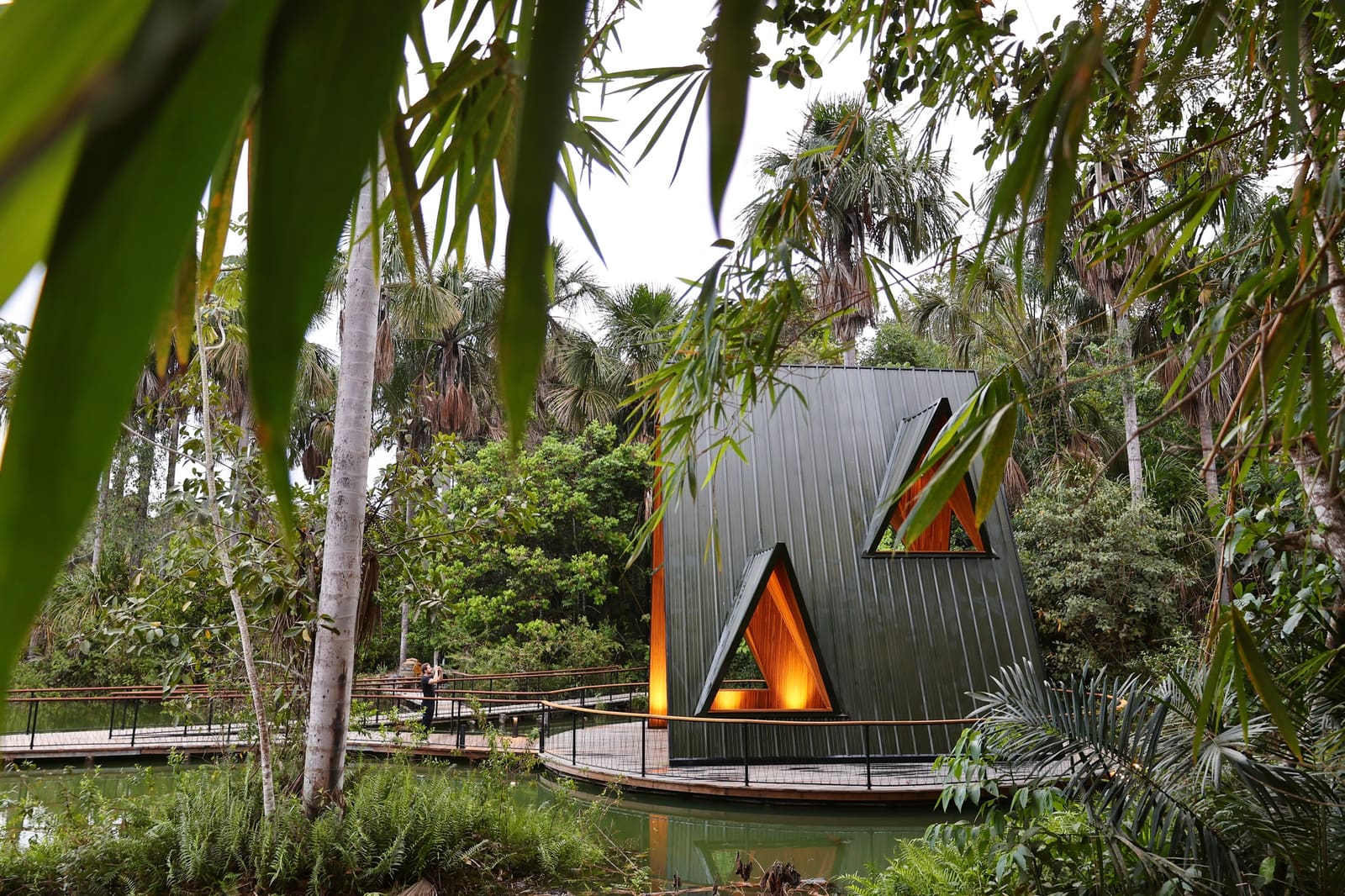
There's something quietly radical about asking for a building that serves as "a point of light in the Amazon." Not a monument, not a proclamation of faith written in stone and glass, but light itself, something that guides rather than commands. That brief, presented to Rogoski Arquitetura by a client in Cacoal, Rondônia, set the parameters for what would become the Light of Amazonia Chapel, a 61-square-meter structure completed in 2026 that sits on the shores of a lake, nestled within what remains of the region's native forest.
At World Archi Design, we've been tracking the evolution of contemporary chapel design, particularly projects that resist the urge to shout. The best examples, from Peter Zumthor's Bruder Klaus Field Chapel to Tadao Ando's Church of the Light, understand that sacred architecture is often most powerful when it withdraws, when it creates a threshold rather than a spectacle. Rogoski Arquitetura's approach in Rondônia aligns with this lineage, though its context, a fragile ecological remnant in Brazil's western Amazon, demands a different kind of humility.
Siting as Dialogue
The chapel's placement matters as much as its form. Positioned at the water's edge, the structure enters into what the architects describe as "a relationship of contemplation and profound respect with the landscape." This is not rhetorical flourish. In a region where deforestation rates have historically been among Brazil's highest, any new construction carries weight. The decision to work within the forest's logic rather than clear a dramatic site speaks to a broader shift in how architects are approaching projects in ecologically sensitive zones.
The building doesn't announce itself from a distance. Instead, it reveals itself gradually, emerging from the trees as visitors approach along the lakeshore. This choreography of arrival, a slow unfolding rather than an immediate reveal, is a deliberate tactic. It privileges the forest first, the architecture second. The chapel becomes part of a sequence: water, trees, threshold, enclosure.
Minimal Footprint, Maximum Restraint
Sixty-one square meters is not much. For comparison, that's roughly the size of a small urban apartment, a footprint that forces discipline. Giordano and Bibiana Rogoski, leading the design with a team that included Bruna Stumm, Bruna Magalhães, and João Paulo Caiado, among others, had to distill the program to its essence: space for gathering, space for reflection, and the infrastructure to support both without overwhelming either.
The chapel's compact dimensions also minimize its physical impact on the site. Less excavation, less clearing, less disruption to root systems and hydrology. In regions like Cacoal, where every square meter of native forest represents decades of ecological succession, this restraint is not just aesthetic, it's ethical. The architecture acknowledges that it is a guest, not a conqueror.
Materiality and the Question of Light
The brief's central metaphor, a point of light, suggests both illumination and beacon. How that translates materially is the project's defining challenge. Light in architecture can be manipulated through aperture, through surface, through the interplay of transparency and opacity. We don't have full material specifications here, but the logic of the brief implies a design where natural light is both medium and message.
Consider the precedent of Ando's concrete churches, where light enters through precise cuts, transforming the mundane act of sitting into something charged with attention. Or the more recent work of studios like Estudio ALA, whose chapels in rural Mexico use local materials to create interiors that glow softly, almost from within. Rogoski Arquitetura's challenge in Rondônia was to achieve something similar while responding to the Amazon's specific luminosity, diffuse, humid, filtered through canopy.
The relationship between the chapel and the lake also plays a role. Water reflects and refracts, doubling the available light and creating a dynamic environment where interior conditions shift with weather, time of day, and season. A chapel sited at water's edge is never static. It breathes with its surroundings.
Regional Practice and the Amazon Context
Rogoski Arquitetura, a firm based in the southern Amazon region, brings local knowledge to this project that an imported practice might lack. Understanding Rondônia's climate, its construction traditions, its social fabric, these are not peripheral concerns. They shape everything from material selection to thermal performance to how the community will ultimately use the space.
The Amazon is not a monolith. Rondônia's landscape, heavily altered by agricultural expansion, differs significantly from the dense rainforest further north. Native forest remnants like the one surrounding this chapel are fragments, islands of biodiversity in a sea of pasture and soy. Building here means acknowledging that fragility, designing not just for today but for a future where these fragments may need to serve as seed banks for regeneration.
The Politics of Sacred Space
Chapels, by definition, are tied to belief systems, and in Brazil, that often means Catholicism. But the architects' language, "contemplation," "respect," "point of light," suggests something less doctrinaire. This is sacred space in the broader sense: a place set apart, a threshold between the everyday and the transcendent, however one defines that.
In recent years, we've seen a growing interest in non-denominational or multi-faith spaces that prioritize atmosphere over iconography. The Light of Amazonia Chapel, with its emphasis on landscape and light, seems to lean in that direction. It's a place for reflection that doesn't prescribe the content of that reflection. The forest, the water, the light do the work.
What Remains to Be Seen
The chapel was completed in 2026, which means we're still in the early phase of its life. How it weathers, both literally and culturally, will determine its success. Will the community adopt it? Will it serve as the beacon its brief imagined, drawing visitors not just for worship but for a particular kind of encounter with place?
Photography by Marcus Camargo captures the structure in what appears to be soft, even light, the kind of conditions that make any building look its best. The real test comes in the extremes: in the heavy rains of the wet season, in the heat of midday, in the years of use that reveal whether the architecture's gestures of humility are structural or merely aesthetic.
At 61 square meters, the Light of Amazonia Chapel is a small building. But its ambition, to be a point of light, to honor rather than dominate its context, to create sacred space through restraint, is anything but. In a region where architecture often means extraction and erasure, a chapel that seeks to illuminate rather than impose offers a different model. Whether that model scales, whether it influences other projects in the Amazon and beyond, is the question we'll be watching.
Credit: Marcus Camargo
Save this story. A free account keeps your reading list and the 07:00 email in one place.
CREATE FREE ACCOUNT →SIGN IN