The Façade as Garment
Stand across the street from 171 NE 39th Street in Miami's Design District and you might mistake the building for a monochrome canvas dipped in blush. Step closer, though, and the illusion fractures into thousands of tiny ceramic tiles, each one catching light differently, each contributing to a surface that breathes with texture. It's an apt metaphor for the fashion house it contains: what appears simple from a distance reveals itself, upon inspection, to be the product of meticulous craft.
At World Archi Design, we've observed a growing trend among luxury retail environments toward what we might call "tectonic translation," the practice of encoding brand identity not through logo or signage but through material language and spatial sequence. The new Alaïa store, designed by Stockholm-based Halleroed, exemplifies this approach. Rather than draping the brand's history over an anonymous shell, the architecture itself performs the brand's core tension: the interplay between sensuality and structure, between the organic and the geometric.
The mosaic cladding does double duty. It nods to Miami's Art Deco legacy, a vocabulary already steeped in decorative relief and pastel palettes, while simultaneously evoking the painstaking construction methods Azzedine Alaïa employed in his atelier. His garments often concealed internal boning, intricate seaming, and sculptural underpinnings beneath deceptively fluid silhouettes. Here, the building's skin operates similarly: thousands of individual elements coalesce into a unified, almost soft-focus impression.
Morphology of Restraint
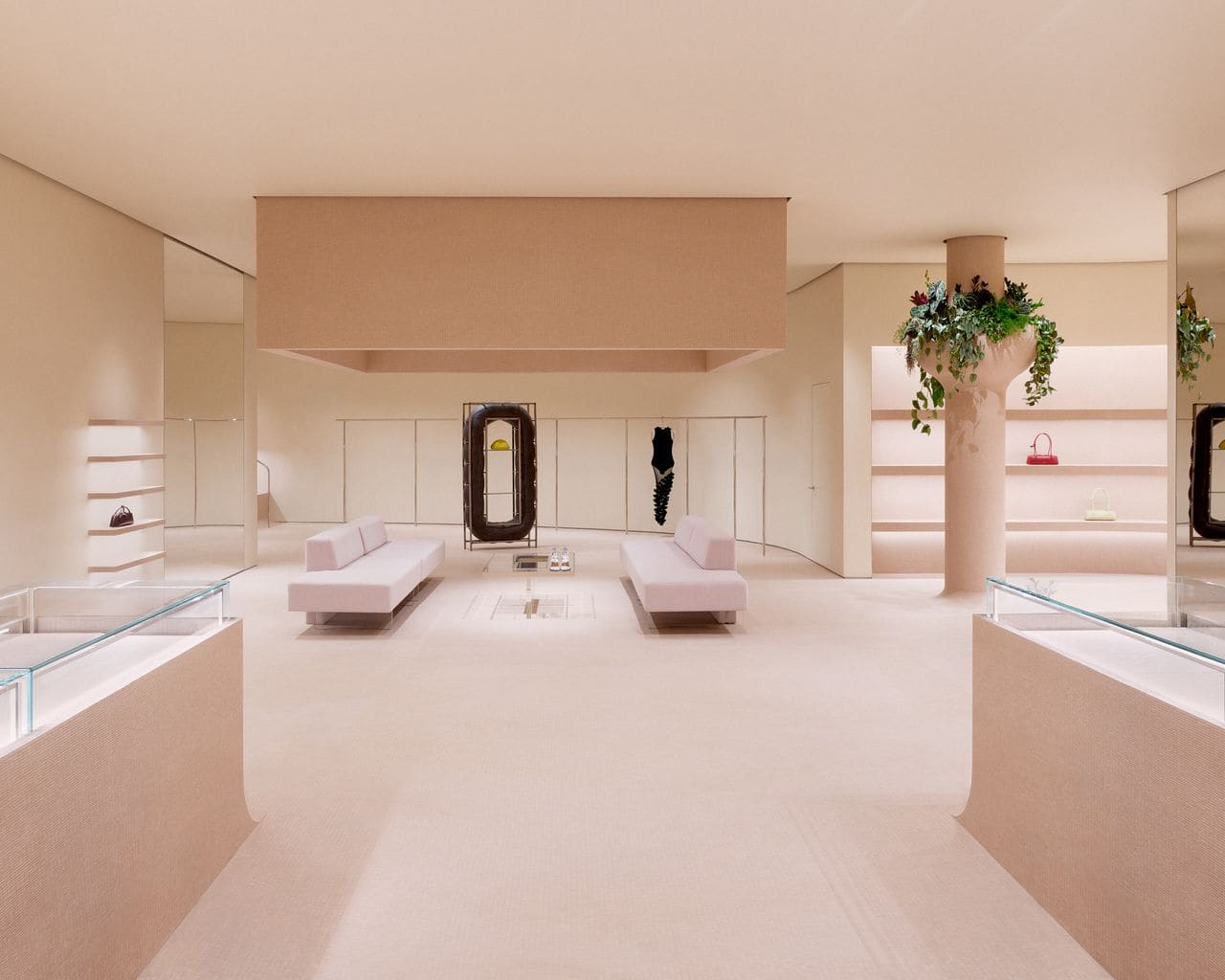
This marks the fifth collaboration between Halleroed and the maison, a partnership that has yielded a recognizable spatial dialect. Ruxandra Halleröd, the studio's principal, has spoken about developing an architectural language rooted in the late designer's approach to the female form: curves that suggest movement, hard edges that anchor and define. In previous Alaïa boutiques, this has manifested as laser-cut circular motifs and cylindrical display plinths. In Miami, the vocabulary expands to encompass entire walls that seem to swell outward, columns that morph into seating, and planters that read as volume rather than accessory.
The choice of a singular, pervasive pink is deliberate. While some might read it as merely feminine, it functions more precisely as a chromatic signature, one of Alaïa's recurring shades that appeared season after season in his collections. Within this monochrome field, Halleroed introduces punctuation: metallic accents, leather-wrapped surfaces, reflective expanses of mirror. The effect is less about contrast for its own sake and more about modulating rhythm, the way a composer might use silence to frame sound.
The store unfolds across multiple levels, each dedicated to a category, footwear, accessories, ready-to-wear, but the transitions feel gradual rather than abrupt. In the ready-to-wear zone, mirrors multiply the space while diffused lighting softens edges, creating an environment that feels both expansive and intimate. It's a spatial paradox that recalls the work of Carlo Scarpa, whose Olivetti showroom in Venice similarly used reflection and light to destabilize the visitor's sense of enclosure.
Biophilic Infrastructure
One of the more compelling gestures in the Miami store is the integration of live planting, not as decoration but as architectural element. Botanist Patrick Blanc, whose vertical garden installations have graced museums and hotels worldwide, contributed bespoke planters that inhabit both interior and exterior thresholds. Blanc has worked with Alaïa before; his cascading green wall dominates the courtyard of the maison's Paris flagship on rue de Marignan. In Miami, the collaboration takes on additional resonance given the city's subtropical context.
Halleröd describes the planting as "abundant" and "integrated into the architecture itself," a phrase that suggests the greenery is load-bearing in a conceptual sense. Rather than potted palms positioned for effect, the planters are volumetric forms that shape circulation and sightlines. This approach aligns with contemporary biophilic design theory, which argues that vegetation should be embedded within the structural logic of a building, not applied as afterthought.
The presence of living material also introduces temporal variability. Unlike static finishes, plants grow, shift with seasons, require maintenance. In a retail environment typically engineered for consistency and control, this embrace of organic unpredictability is notable. It suggests a confidence in the brand's identity, a willingness to let the space evolve rather than remain frozen at the moment of opening.
The Curatorial Object
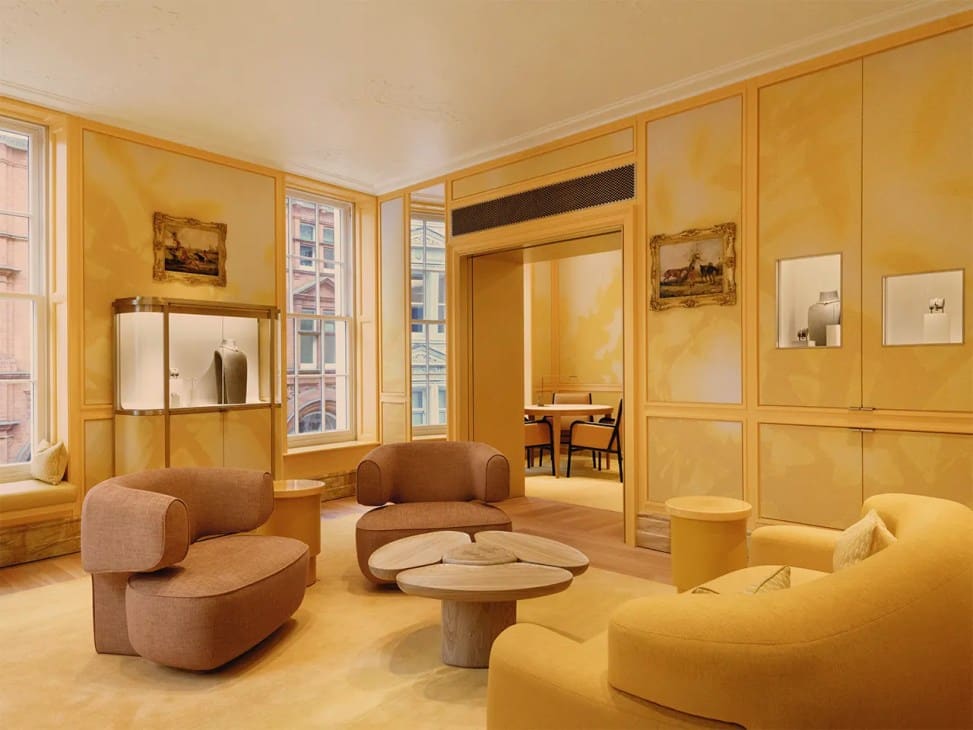
Furniture selection in luxury retail often defaults to either bespoke commissioned pieces or anonymous minimalism. Alaïa's approach, consistent across its boutiques, takes a third path: curated design objects, both vintage and contemporary, selected by interior designer Martin Brûlé. The Miami store features work by Reinhard Müller, Philippe Starck, and Ron Arad, names that span decades and design philosophies but share a commitment to sculptural form.
This curatorial strategy does several things at once. It positions the brand within a broader design lineage, suggesting that Alaïa's work exists in dialogue with furniture, lighting, and industrial design, not just fashion. It also introduces heterogeneity into what could otherwise become monotonous, a single-note pink environment relieved by the varied materiality and silhouettes of exceptional seating and tables. And it reflects Azzedine Alaïa's own collector instincts; the designer was known for his deep engagement with design history and his friendships with figures across disciplines.
The furniture pieces function as informal display platforms, blurring the line between showroom and living space. A Ron Arad chair might hold a handbag; a Starck side table could support a stack of shoe boxes. This deliberate ambiguity recalls the domestic scale of Alaïa's original rue de Bellechasse atelier in Paris, where clients would visit what felt like a private apartment rather than a commercial showroom.
Precedent and Place
Retail architecture for fashion houses has, over the past two decades, increasingly embraced site-specificity. Where once a brand might impose a uniform global template, contemporary practice tends toward what we might call "calibrated localism," a design approach that acknowledges context without resorting to literal pastiche. Herzog & de Meuron's Prada Tokyo (2003) embedded the store within a crystalline exoskeleton that responded to the neighborhood's scale and density. Rem Koolhaas's Prada New York (2001) turned the retail program inside-out, making circulation and display mechanisms the primary architectural event.
The Alaïa Miami store operates in this lineage but with a softer touch. The mosaic exterior gestures toward local architectural history without mimicking it. The abundant planting engages Miami's climate and vegetation without literalizing tropical motifs. The pink palette asserts brand identity while remaining tonally sympathetic to the pastel traditions of South Florida's built environment. It's a calibrated response, one that recognizes the specificity of place without surrendering the coherence of the brand's larger architectural program.
Spatial Continuity as Concept
Halleröd describes the result as "one continuous sculptural composition," and this may be the most useful lens through which to understand the project. Rather than discrete architectural elements, walls, floors, ceilings, furniture, planting, the design proposes a field condition in which forms emerge, transform, and recede. A wall curves upward to become a display niche. A planter swells to suggest seating. A column thickens to accommodate storage.
This formal fluidity has roots in both modernist and contemporary practice. Alvar Aalto's Villa Mairea (1939) famously employed undulating wood surfaces that refused orthogonal logic. More recently, Zaha Hadid Architects' projects have pursued seamless transitions between building elements, erasing the joints that typically articulate structure. The Alaïa store's approach is less dramatic than Hadid's but shares the underlying ambition: to create an environment in which architecture, furniture, and landscape read as a unified, immersive construct.
This continuity also serves a commercial function. By eliminating clear thresholds between zones, the design encourages exploration and dwell time. Visitors move through the space less as shoppers navigating a store and more as guests inhabiting a carefully composed interior. The distinction may seem subtle, but it aligns with the broader luxury retail strategy of creating experiential environments that transcend transaction.
The Architecture of Desire
Fashion retail has always traded in aspiration, but the mechanisms by which that aspiration is architecturally encoded have evolved. Early luxury boutiques often mimicked aristocratic interiors, heavy drapery, ornate moldings, chandeliers, signaling exclusivity through historical reference. The minimalist turn of the 1990s and 2000s inverted this logic, using stark white volumes and industrial materials to suggest cutting-edge sophistication.
The current moment, represented by projects like the Alaïa Miami store, seems to pursue something more complex: environments that feel simultaneously restrained and sensory, contemporary and timeless, specific and universal. The all-pink palette could read as kitsch in less disciplined hands, but here it functions as a coherent atmospheric device, a way of unifying disparate elements under a single chromatic field. The curves and organic forms could veer into biomorphic excess, but they're held in check by the underlying geometric discipline and the precision of the mosaic work.
What emerges is an architecture that doesn't simply house fashion but translates its principles into built form. The garments Azzedine Alaïa created were never passive; they shaped the body, directed movement, demanded a particular posture and confidence. The Miami store operates similarly, guiding visitors through a choreographed sequence of spaces, each calibrated for a specific mode of engagement. It's retail design as spatial couture, where the architecture itself wears the dress.
Alaïa
Save this story. A free account keeps your reading list and the 07:00 email in one place.
CREATE FREE ACCOUNT →SIGN IN