The Question That Started Everything
What does it take to make someone walk away from a stable career in automotive and furniture design? For Adrián López Velarde and Marte Cázarez, it was watching materials destroy ecosystems from the inside. After years embedded in production chains that moved fast and left wreckage behind, the two Mexican designers made a choice: they would spend two years trying to answer one question. Could you build materials that didn't harm the planet?
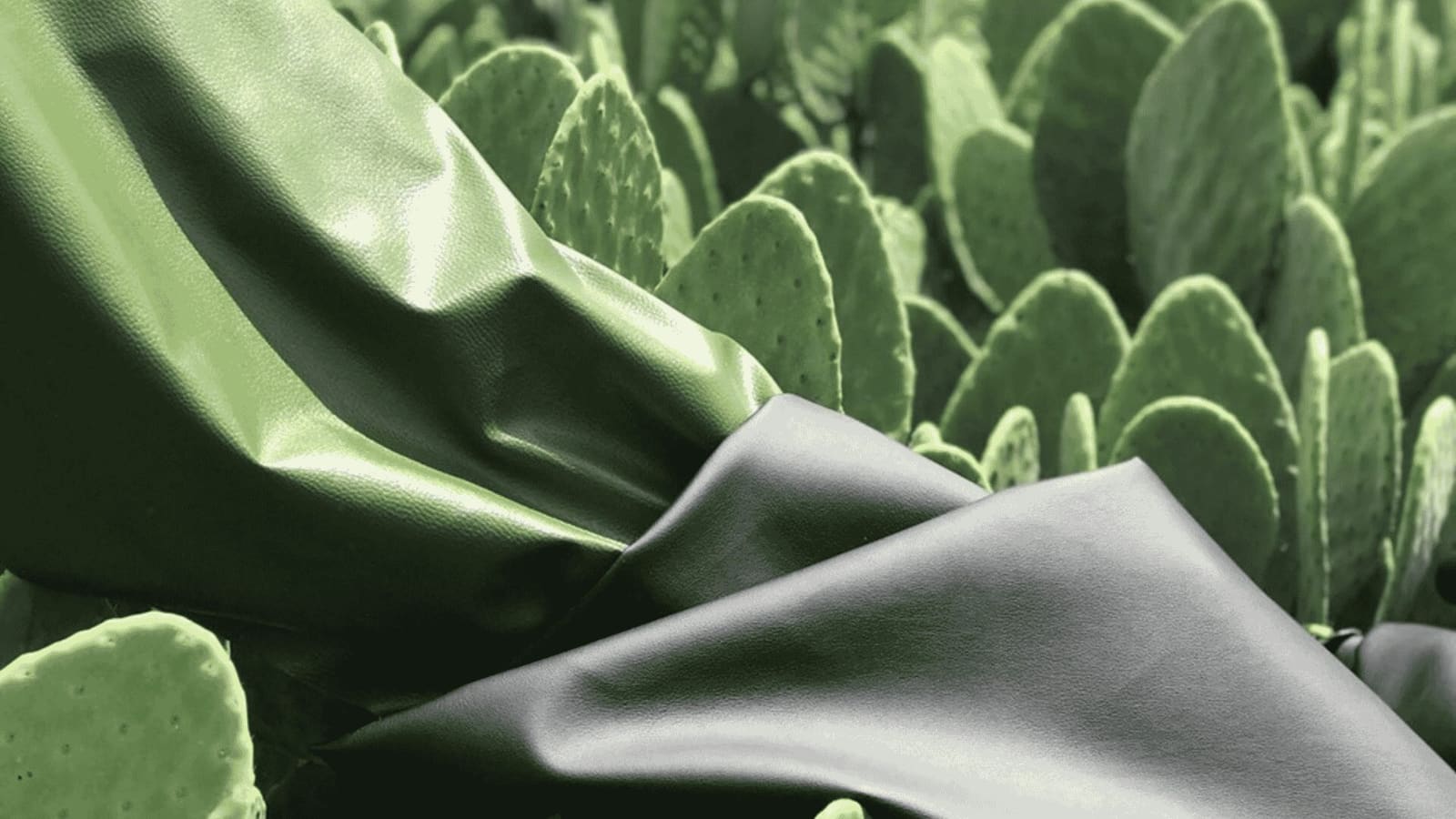
Their answer arrived in Milan in October 2019, in the form of Desserto - a biomaterial derived from nopal cactus that doesn't just replace leather or synthetic textiles. It replaces the logic that says high performance and environmental responsibility can't coexist at industrial scale.
Why Nopal, Why Now
The nopal cactus (Opuntia ficus-indica, commonly called prickly pear) is not a boutique crop. Mexico is the world's largest producer and consumer, and the plant has evolved to survive in conditions that would kill most agricultural species. It's a CAM (Crassulacean Acid Metabolism) plant, which means it opens its stomata at night to absorb CO₂ and closes them during the day to conserve water. This gives it a metabolic efficiency that makes conventional crops look profligate.
Consider the water footprint: wheat, rice, soy, and cotton typically require around 1,000 liters of water to produce one kilogram of dry matter. Nopal needs only 200 liters, and it collects most of that autonomously through its hygroscopic structure. In a desert climate increasingly stressed by drought and temperature extremes, this isn't just efficiency. It's resilience.
Desserto's cultivation strategy leans into that resilience. The crops are perennial, lasting approximately eight years, unlike annual staples such as corn. Mature leaves are harvested every six to eight months, and the plant regenerates without replanting. No herbicides, no pesticides, no irrigation infrastructure. The system is designed to work with the land, not against it.
From Harvest to Material
After cutting, the leaves spend three days in solar drying chambers. No furnaces, no fossil fuels - just passive solar energy and airflow. Once dried, the organic matter is processed according to a patented formula developed by Adriano Di Marti S.A. de C.V., the production entity behind Desserto. Leftover cactus parts that don't make it into the material are sold to Mexico's national food industry, closing the loop on waste.
The result is a flexible, durable sheet material available in multiple colors, thicknesses, and textures. It can be tooled, stitched, embossed, and finished like conventional leather or synthetic textiles, which means it slots into existing manufacturing workflows without requiring factories to retool their entire operation. That compatibility is what separates Desserto from laboratory curiosities that never leave the prototype phase.
Carbon Math and Land Use
Desserto manages 14 acres of nopal cultivation. Over that area, the crop absorbs approximately 8,100 tonnes of CO₂ annually. The agricultural operation itself emits 15.30 tonnes per year. The net sequestration is significant, and it raises a larger question: what happens if nopal cultivation expands into degraded or desertifying land?
Desertification is accelerating across arid and semi-arid regions worldwide, driven by overgrazing, deforestation, and climate stress. Nopal doesn't just tolerate these conditions; it can help reverse them. The plant's root system stabilizes soil, its organic matter supports microbial life, and its canopy provides habitat for native fauna. Desserto's organic farming practices - free of synthetic inputs - encourage biodiversity rather than flattening it.
This isn't romantic agro-ecology. It's a working model for how material production can double as ecosystem restoration. The more nopal you grow, the more carbon you pull down and the more degraded land you bring back online. Scale becomes an environmental asset, not a liability.
Industrial Adoption and the Hublot Test
Desserto has moved quickly from concept to application. In recent years, the material has appeared in boxing gloves for Adidas, a limited-edition watch strap for Hublot, a collection of bags and accessories for Karl Lagerfeld, and the interior surfaces of Mercedes-Benz's VISION EQXX electric concept car.
The Hublot collaboration is particularly revealing. Watchmaking demands material consistency, durability under friction, and aesthetic precision. A strap has to hold up to sweat, UV exposure, and daily wear without delaminating or losing color. If Desserto can meet those standards in a luxury context, it can meet them almost anywhere.
Mercedes-Benz's use of the material in a concept vehicle signals something broader: the automotive industry is hunting for bio-based alternatives that don't compromise on haptics or longevity. Desserto's ability to deliver industrial quantities with controlled quality makes it a viable candidate for series production, not just concept showcases.
Transparency as Strategy
One of Desserto's distinguishing features is vertical integration. The brand controls the entire value chain, from land management and harvest through processing and final material production. This isn't just about margin capture. It's about traceability.
In an era when "sustainable" has become a marketing term detached from measurable outcomes, Desserto's model allows for line-by-line accountability. Every bale of dried cactus, every batch of processed material, every shipment to a partner can be traced back to a specific plot of land with documented practices. That transparency is rare in materials supply chains, where opacity is often the default.
Desserto frames this as a form of social practice: by making the entire system visible, the brand invites scrutiny and encourages replication. The goal isn't to hoard a trade secret. It's to prove that regenerative agriculture and industrial material production can merge without contradiction.
What Comes After Proof of Concept
Desserto has now been in the market for several years, long enough to move past the hype cycle and into the operational grind. The material works. It scales. It integrates. The question now is whether the industries it serves will adopt it at a pace that matches the urgency of the climate crisis.
Material innovation alone doesn't change systems. It has to be paired with demand, with policy, with shifts in consumer expectation and corporate procurement. Desserto's partnerships with Adidas, Karl Lagerfeld, and Mercedes-Benz suggest that major players are willing to experiment. But experimentation is not the same as commitment.
The founders are clear about their position: sustainability isn't an option or a differentiator. It's a baseline. Every design decision carries consequences, and those consequences can either degrade the world or improve it. Desserto's wager is that if you design for the latter from the beginning, you don't have to retrofit responsibility into a broken system. You build a new one.
The Cactus as Precedent
Biomaterials have a long history in architecture and design, from mycelium composites to algae-based plastics. But many remain niche, constrained by cost, inconsistency, or limited supply. Desserto's nopal-based approach stands out because it addresses those constraints head-on. The crop is abundant, the process is low-energy, and the output is industrially compatible.
There's a broader lesson here for material research: the most viable alternatives often come from plants that have already solved the problem of survival in hostile environments. Nopal didn't need genetic modification or intensive agronomic intervention. It needed recognition and intelligent cultivation.
In that sense, Desserto isn't inventing a new material so much as it's recognizing an old one. The cactus has been there all along, absorbing carbon and conserving water in landscapes written off as unproductive. The innovation lies in seeing it not as a desert plant, but as infrastructure.
Credit: Adrián López Velarde and Marte Cázarez / Desserto
Save this story. A free account keeps your reading list and the 07:00 email in one place.
CREATE FREE ACCOUNT →SIGN IN