The Problem With Static Support
We have long designed furniture as if the human body were a static object. Chairs anchor us, hold us rigid, and demand that we conform to their geometry. Yet the physiology tells a different story: circulation, proprioception, and neural function all benefit from continuous micro-adjustments. The tension between what ergonomics prescribes and what our bodies actually need has persisted for decades.
Designer Aaron DeJule confronted this gap after a car accident left him unable to tolerate extended sitting. Conventional task seating offered lumbar dials and tilt mechanisms, but none addressed the underlying mismatch between enforced stillness and the body's preference for fluid recalibration. His response was to invent a system that treats motion as a design input rather than a problem to be solved.
Cognetic Technology and Multi-Axial Response
At the core of the Kiaura line sits a patented mechanism DeJule developed through iterative prototyping. Cognetic Technology employs a multi-axial movement platform that shifts in response to gravitational load and postural change. Unlike pneumatic tilt mechanisms that lock at discrete angles, this system permits continuous, incremental motion across multiple planes. The chair recalibrates in real time as the sitter leans, shifts weight, or adjusts posture, requiring no manual levers or conscious intervention.
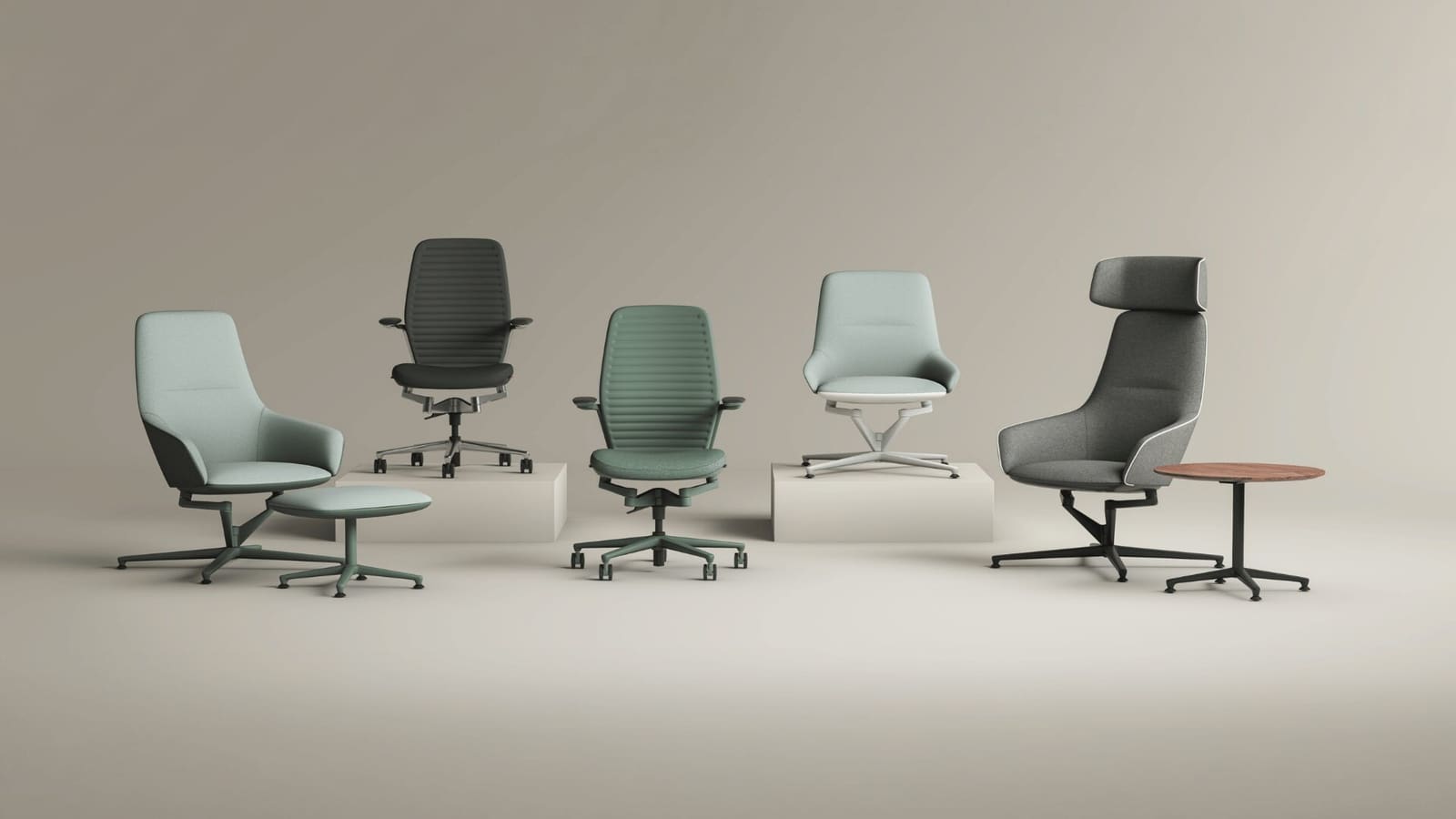
KI premiered the collection at its Inspiration Center during Chicago Design Days, presenting coordinated task, conference, and lounge typologies alongside matching tables and ottomans. The Wisconsin-based manufacturer positions the series not as an extension of its existing ergonomic portfolio but as the inaugural expression of what it terms Human Performance Seating.
From Ergonomics to Performance
The nomenclature matters. Ergonomics has traditionally centered on injury prevention and static comfort metrics. Human Performance Seating, as KI defines it, shifts the frame toward cognitive and physiological optimization during extended work sessions. The company commissioned research drawing on neuroscience, physical therapy, and sports performance studies to validate the hypothesis that varied micro-movement improves concentration, reduces anxiety, and mitigates discomfort.
In a four-hour protocol, participants using Kiaura seating reported measurable improvements in visual and auditory cognitive processing alongside reductions in lower-back and pelvic discomfort. Anxiety markers declined relative to control groups seated in conventional task chairs. The data supports what DeJule observed anecdotally: when the chair disappears from conscious awareness, the cognitive load of managing posture drops, freeing attention for primary tasks.
Tony Besasie, Chief Sales and Marketing Officer at KI, frames the collection as a platform rather than a product. The expectation is that seating can actively contribute to workplace performance rather than merely accommodate it. This positioning aligns with broader shifts in workplace design, where furniture is increasingly evaluated for its impact on output and well-being rather than square-footage efficiency alone.
Material and Aesthetic Strategy
Kiaura's visual language skews architectural. Clean lines, minimal detailing, and a restrained palette allow the technology to recede. The collection offers extensive material flexibility, including advanced technical knits engineered for breathability and durability in commercial environments. Configurations span high-density task applications, collaborative settings, and hospitality lounges, each adapted to the specific postural demands of its context.
This versatility reflects a broader trend in contract furniture: the collapse of rigid typological boundaries. A lounge chair equipped with Cognetic Technology can serve focused work as effectively as a traditional task chair, provided the user's posture remains supported through motion. The distinction between "work" and "lounge" seating becomes less about form factor and more about the underlying kinetic behavior of the structure.
The Cognetograph and Experiential Translation
During Chicago Design Days, KI installed The Art of Flow, an experiential exhibit that translated sitting into generative art. Participants occupied a Kiaura lounge chair while sensors captured pressure distribution, balance shifts, and postural micro-adjustments. The data fed into a visualization system that rendered each session as a unique Cognetograph, a graphic representation of the body's continuous recalibration.
The installation serves a dual purpose. It makes the invisible mechanics of dynamic sitting legible to observers, and it reframes a utilitarian object as a medium for interaction. The Cognetograph becomes a kind of biometric signature, evidence that no two people occupy space identically. For a technology predicated on responsiveness, the exhibit offers proof of concept in visual form.
Industry Recognition and Category Validation
The collection received seven accolades at the Best of NeoCon Awards 2026, including Best of Competition in Integrated Technology for Cognetic Technology itself. Additional Gold Awards recognized the task, lounge, and conference iterations across multiple categories, from Ergonomic Seating to Collections for Collaboration. The breadth of recognition suggests that jurors viewed Kiaura not as a niche innovation but as a systemic rethinking of how seating interfaces with the body.
Awards in the contract-furniture sector often privilege incremental refinement over categorical disruption. The fact that a motion-based platform secured top honors across disparate typologies indicates a shift in industry priorities. Manufacturers and specifiers alike are grappling with post-pandemic workplace expectations, where flexibility, wellness, and cognitive performance have moved from peripheral concerns to core requirements.
Precedent and Parallel
Dynamic seating is not unprecedented. Herman Miller's Aeron introduced synchronized tilt and elastomeric suspension in the 1990s, and HAG's Capisco has long championed active sitting through saddle geometry. What distinguishes Kiaura is the degree of motion autonomy. Earlier systems required user adjustment or relied on single-axis tilt; Cognetic Technology operates across multiple planes without conscious input, governed by gravitational feedback rather than mechanical presets.
This approach shares conceptual DNA with biophilic design principles that prioritize alignment with natural human behavior. Just as daylighting and natural ventilation reduce the cognitive friction of artificial environments, motion-responsive seating reduces the metabolic cost of maintaining static posture. The chair becomes less an object to be managed and more an ambient support system.
Implications for Commercial Interiors
Adoption in commercial settings will hinge on durability, serviceability, and cost relative to incumbent solutions. High-performance seating already commands premium pricing; Kiaura's value proposition rests on demonstrable gains in user satisfaction and productivity. If cognitive performance data holds across diverse populations and tasks, the calculus shifts from capital expense to operational return.
Specifiers will also weigh aesthetic coherence. The collection's architectural restraint positions it well for contemporary workplace interiors, but its kinetic behavior may require client education. Motion-responsive furniture challenges the visual stability that many corporate environments still favor. Success will depend on whether facility managers and end users perceive movement as a feature rather than a liability.
Looking Forward
Kiaura signals a broader recalibration in how we understand furniture's role in the built environment. As workplace design incorporates insights from behavioral science and human factors research, static typologies will face increasing scrutiny. The chair that moves with you is not a novelty; it is a logical response to decades of evidence that the body resists immobility.
Whether Cognetic Technology becomes an industry standard or remains a specialized offering will depend on scalability, cost evolution, and the willingness of organizations to invest in performance-oriented infrastructure. What is certain is that the category has been defined. Human Performance Seating now exists as a frame of reference, and future innovations will be measured against the benchmark KI and DeJule have established.
Save this story. A free account keeps your reading list and the 07:00 email in one place.
CREATE FREE ACCOUNT →SIGN IN