The Paradox of the Democratic Experiment
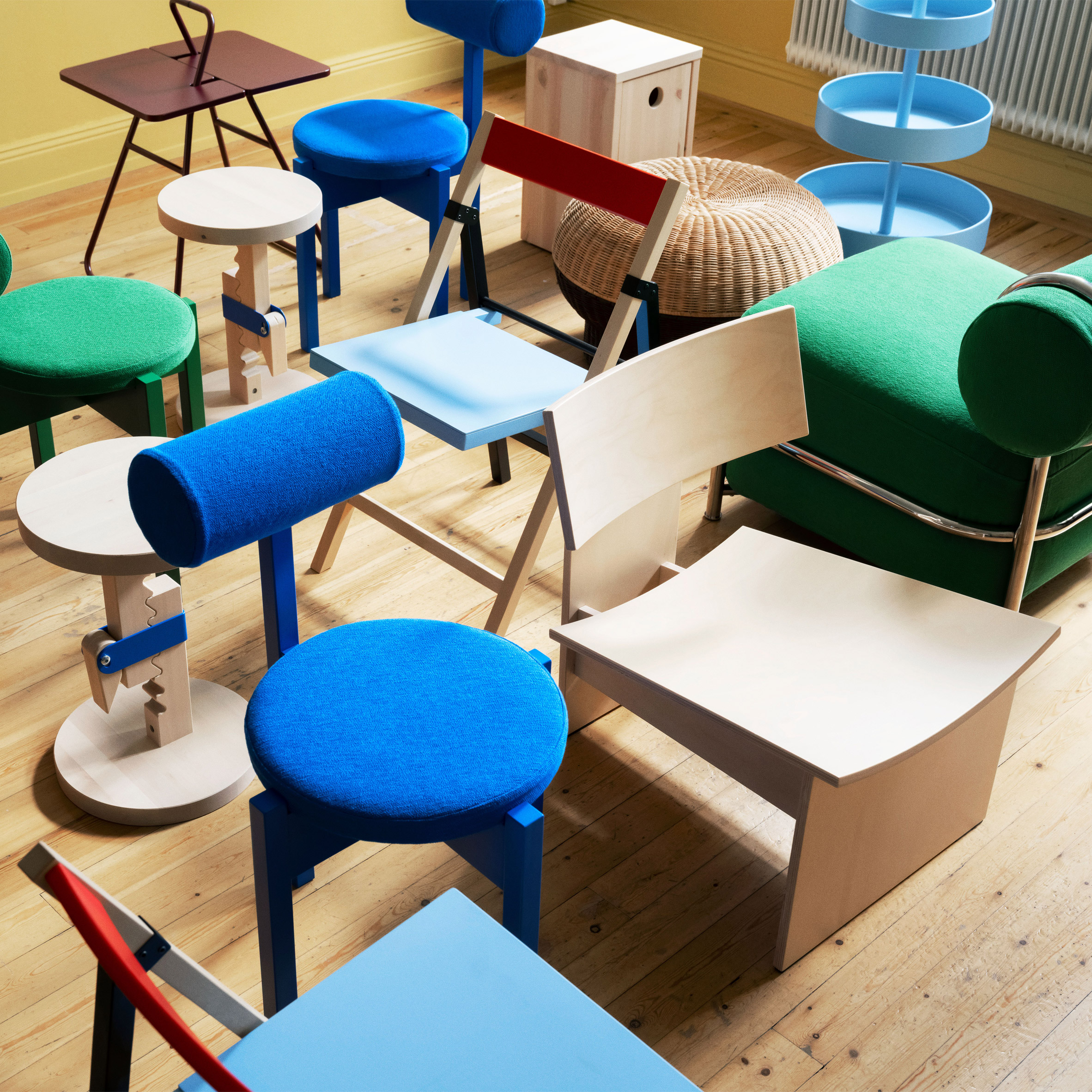
At World Archi Design, we've long observed that the most interesting design briefs are often self-imposed constraints. IKEA's PS collection—relaunched this month with pieces including a blow-up armchair, a wooden rocking bench, and a height-adjustable stool informed by woodworking clamps—presents a constraint that doubles as a manifesto: make cutting-edge Scandinavian design accessible to the general public at price points below £100. It's a noble thesis, and one the Swedish retailer has pursued episodically since the PS line's 1995 debut. But the constraint raises a perennial tension in contemporary practice: does democratization dilute the conceptual rigor that defines experimental work, or does it sharpen it by forcing designers to reconcile formal ambition with industrial reality?
The question is not merely rhetorical. Across the projects we've covered this year—from adaptive-reuse social housing in Rotterdam to modular CLT systems in rural Japan—we've seen how material economy and fabrication logic can become generative forces rather than post-rationalized compromises. The PS collection, in its latest iteration, offers a microcosm of that tension: a portable lamp described as "universal and unpretentious," a stool derived from the tectonic language of carpentry clamps, an inflatable chair that literalizes the modernist dream of dematerialization. Each piece is legible, affordable, and unapologetically functional. Whether they constitute experimental design—or simply competent product development wrapped in the rhetoric of experimentation—depends on how one defines the term.
Precedent and the Scandinavian Lineage
The PS collection's DNA traces back to a specific moment in postwar Scandinavian design: the 1950s and '60s, when figures like Bruno Mathsson, Arne Jacobsen, and Alvar Aalto sought to reconcile modernist abstraction with craft traditions and social equity. Mathsson's bentwood loungers, Jacobsen's molded plywood Series 7 chairs, Aalto's laminated birch furniture for Artek—all emerged from a milieu in which formal innovation was inseparable from material experimentation and democratic aspiration. The PS collection positions itself as heir to that lineage, but with a crucial difference: where midcentury Scandinavian modernism relied on skilled labor and relatively small production runs, IKEA's model is predicated on global supply chains, flat-pack logistics, and economies of scale that would have been unimaginable in Aalto's Finland.
This shift is neither inherently good nor bad—it simply reframes the design problem. The height-adjustable stool, for instance, borrows the visual and mechanical language of woodworking clamps: a threaded rod, a tightening mechanism, a vocabulary of compression and tension. It's a clever formal gesture, one that makes the object's function legible and imbues it with a sense of craft heritage. But unlike a traditional clamp—or a Mathsson chair, for that matter—the stool must be designed for disassembly, global shipping, and assembly by non-specialists. The constraint is not just affordability; it's the entire logistical apparatus of contemporary mass production. In that sense, the PS collection is less a revival of midcentury ideals than a renegotiation of them under radically different conditions.
Material Strategies and the Rhetoric of Playfulness
IKEA's framing of the PS line as "playful" is telling. Playfulness, in contemporary design discourse, often functions as a euphemism for formal freedom—a way of signaling that a given object is not bound by the austere minimalism that has dominated high-design interiors for the past two decades. The blow-up armchair is the most overt expression of this ethos: a pneumatic structure that collapses the boundary between furniture and toy, permanence and ephemerality. It recalls Verner Panton's inflatable furniture experiments of the late 1960s, as well as more recent work by studios like Soft Baroque and the early-2000s output of Marcel Wanders. But where Panton's inflatables were provocations—statements about the mutability of domestic space and the obsolescence of traditional typologies—the PS armchair feels more like a wink than a manifesto. It's approachable, yes, but also safe.
The wooden rocking bench, by contrast, gestures toward a more subdued vernacular. Rocking furniture has deep roots in Scandinavian and Shaker traditions, where repetitive motion and tactile engagement with materials were understood as forms of domestic ritual. A well-designed rocking chair—or bench—should have a specific center of gravity, a rhythm that feels neither sluggish nor frantic. Whether the PS bench achieves that balance is difficult to assess without direct experience, but the typology itself is significant: it's a piece that invites sustained use rather than novelty, durability rather than disposability. If the inflatable armchair represents the collection's speculative edge, the rocking bench represents its claim to longevity.
The Portable Lamp and the Question of Universality
The portable lamp—described as "universal and unpretentious"—is perhaps the most architecturally legible piece in the collection. Portable lighting has become a minor obsession in contemporary interior design, driven in part by advances in LED and battery technology but also by a broader cultural shift toward flexible, non-hierarchical domestic spaces. Studios like Flos, Marset, and Hay have all produced portable lamps in recent years, many of them priced at several hundred euros. The PS version, priced well below that threshold, raises an interesting question: what does universality mean in this context?
In architectural terms, universality often implies a kind of formal neutrality—a design that can adapt to multiple contexts without asserting a dominant aesthetic. But neutrality is never truly neutral; it's always a product of specific cultural and economic conditions. A "universal" lamp designed for IKEA's global market must accommodate a staggering range of interior styles, from minimalist Scandinavian apartments to maximalist eclecticism in São Paulo or Mumbai. The result is often a kind of studied blandness, a design that offends no one precisely because it says very little. Whether the PS lamp avoids that trap—or whether it even needs to—is a question of intent. If the goal is truly democratization, perhaps a certain degree of formal modesty is not a failure but a prerequisite.
Parametricism, Paris, and the Week's Wider Context
The PS collection's launch coincided with broader developments in architectural discourse this month, including the topping-out of Herzog & de Meuron's Tour Triangle in Paris—a 180-meter trapezoidal tower that has sparked considerable debate about high-rise development within the city's historic core—and the completion of MAD's spiraling Hainan Science Museum in China, wrapped in silver-toned polymer panels. Both projects operate at a vastly different scale and budget than the PS collection, yet they share a common preoccupation: how to reconcile formal experimentation with public legibility.
Herzog & de Meuron's tower, now the third-tallest structure within Paris city limits, has been criticized for its visual weight and its departure from the Haussmannian fabric that defines much of the city. MAD's museum, by contrast, embraces a kind of sculptural exuberance that has become the studio's signature—a flowing, parametrically derived form that suggests motion and transformation. In an interview this month, Turkish architect Melike Altınışık—whose Seoul Robot & AI Museum was also discussed as part of an ongoing parametricism series—argued that parametric design should not be adopted as a universal architectural style, but rather as a set of tools that can inform specific design problems. It's a measured position, and one that echoes the tension within the PS collection: the question is not whether experimentation is valuable, but whether it can remain conceptually rigorous when subjected to the constraints of mass production or, in architecture's case, site-specific context and regulatory frameworks.
Craft, Commerce, and the Designer's Dilemma
British industrial designer Jasper Morrison, in a recent interview, expressed "a lot of sympathy" for young designers navigating today's landscape, noting that the rising prominence of craft amid dwindling commercial opportunities recalls the design scene he experienced in 1980s London. Morrison's early career was characterized by what he called "micro-production"—assembling pieces from local shops, self-publishing catalogs, operating outside the established channels of industrial design. The PS collection, in some ways, represents the inverse of that model: it's design at the scale of global infrastructure, where the unit of production is not the individual object but the supply chain itself.
Yet Morrison's observation is relevant precisely because it highlights the bifurcation that has come to define contemporary design practice. On one end, there is the artisanal, small-batch work that commands high prices and cultural capital but reaches a limited audience. On the other, there is mass production, which offers broad reach but often at the cost of formal ambition. The PS collection attempts to occupy a middle ground: objects that are industrially produced but retain some trace of conceptual intent. Whether that middle ground is sustainable—or whether it will continue to erode under the pressures of global capitalism—is an open question.
The Limits of Accessibility as Critique
To close: the PS collection is not a failure, but neither is it a revolution. It is, instead, a reminder that democratization is a process, not a product—and that the work of making good design accessible is never finished. The inflatable armchair, the clamp-inspired stool, the portable lamp: each represents a specific negotiation between formal ambition and industrial constraint. Some of those negotiations are more successful than others. But the act of negotiation itself—the willingness to work within the messy realities of global production rather than retreating into boutique exclusivity—is worth acknowledging.
At World Archi Design, we remain skeptical of design rhetoric that conflates affordability with virtue, or accessibility with innovation. The PS collection is affordable, yes. It is accessible, certainly. Whether it is truly experimental—whether it pushes the boundaries of what mass-produced furniture can be—depends on how one defines those boundaries. For now, it stands as a testament to IKEA's enduring commitment to the democratization thesis, even as the conditions that made midcentury Scandinavian modernism possible have long since vanished. The question is whether that commitment is enough.
Save this story. A free account keeps your reading list and the 07:00 email in one place.
CREATE FREE ACCOUNT →SIGN IN